
Throw Away Instruments…Not Enough Clinical Evidence for Reverse Shoulder?…Gunnar Andersson Wins Alfred R. Shands Award…Doctor-Owned Hospitals Fighting for Place in the Sun…No Surgery on Obese Patients?…and more.
On (and Off) the Record
5 min read Premium comments
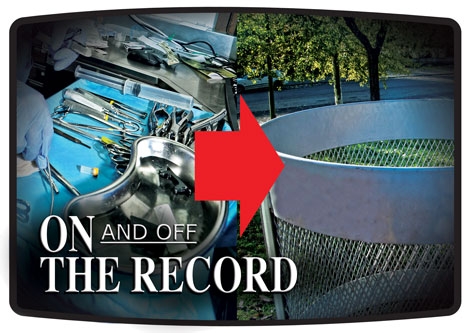
Throw Away Your Instruments
An in-the-know orthopedist tells OTW, “Companies have picked up on the issue of OR efficiency as it is well known that room turnover can take a long time—in part because the staff has to open five or six instrument trays for one surgery. Several companies have just begun creating disposable instruments and trial implants. For example, there might be a case specific cutting jig created such that you know before the surgery what size you need. Along with disposable instruments, it cuts down on inventory and reduces the number of trays you have to open. Not to mention that you don’t have to sterilize. Many surgeons are excited about the prospect of having completely disposable case trays. At some hospitals, it can take an hour to turn over an OR…with this it could be reduced to 15 minutes.”
Not Enough Clinical Evidence for Reverse Shoulder?
“More and more insurance companies are asking us to clearly define the benefits of what we do, ” says an orthopedic surgeon to OTW. “For example, a large East Coast insurance company has recently decided that there is not enough clinical evidence that reverse total shoulder arthroscopy is a valuable procedure…and that they are not going to reimburse for it because they thought it was at best investigational. The issue is that the data we have emanates from case series that do not use cost effectiveness or quality outcomes measures, and therefore do not allow us to determine the real cost/benefit of this procedure. Insurers have a point…these procedures are more expensive than a traditional shoulder replacement, and they are asking, ‘Are they that much better?’ and ‘These patients are usually sicker…are we improving their quality of life?’”
Gunnar Andersson Wins Alfred R. Shands Award
The ORS Board has spoken…Gunnar B. J. Andersson, M.D., Ph.D. is the 2012 recipient of the Alfred R. Shands, Jr., M.D. Award, an annual honor bestowed on a North American who has made significant contributions to orthopedics. Dr. Andersson, who is credited with designing the seat in Volvo automobiles, is Professor and Chair in Spinal Deformities at Rush University Medical Center. He is also a former president of the Orthopaedic Research Society. The Alfred R. Shands, Jr., M.D. Award is sponsored by the Orthopaedic Research Society (ORS).
Thomas Einhorn Wins Distinguished Investigator Award
Thomas Einhorn, M.D. has been named the 2012 recipient of the ORS/OREF Distinguished Investigator Award, an honor bestowed on those who have had a long-standing, productive career in orthopedic research, and who have demonstrated outstanding mentorship of research trainees, service to the professional community and exemplified academic collegiality. Dr. Einhorn, a former president of the Orthopaedic Research Society, has also been chair of the study section on orthopedic and musculoskeletal health at the NIH.
No Surgery on Obese Patients Coming?
A veteran orthopedic surgeon tells OTW, “I am seeing that doctors are becoming more supportive of price controls and more focused on evidence based medicine. Our hospital started an infection reduction program and reduced our rate nearly tenfold in two years. However, part of getting these rates down required limiting access to care. We won’t do an elective joint replacement on someone whose body mass index is over 40…or on someone with a HbA1c level over 7.2. With the anticipation of bundled episodes of care, the infection issue looms larger than ever.
“An infection costs anywhere from $50, 000 to $100, 000 to clean up. A typical hospital has a profit of around $2, 500 on a total joint operation. Let’s say the hospital does 50 total joints a month…then with only ONE infection, there goes the entire month’s profit. But we must do something to reduce the cost of healthcare; and, the transparency that’s more and more a part of our lives means that doctors are more motivated to reduce complications. I know of one situation where a doctor was spending more than three times as much to drape a patient than other doctors in his practice. Again, with the increasing transparency, this kind of thing will diminish greatly.”
Doctor-Owned Hospitals Are “No Brainer”
Brian Parsley, M.D. is a partner in a physician-owned specialty hospital. He tells OTW, “Many doctors have either cancelled or put their plans to pursue hospital ownership on hold as a result of President Obama’s healthcare initiative. The case to watch is now playing out in the federal courts in Houston where several doctor-owned hospitals are challenging the President’s law, saying that it is unconstitutional. Another debate involves if the Patient Protection and Affordable Care Act (PIPACA) is voted to be unconstitutional, whether they will throw out the whole law or just the segment on individual mandates. That would create an opportunity for doctor-owned hospitals. Doctor-owned hospitals are a no-brainer as far as quality care. Patients have a much better experience at the hospital, their satisfaction rates are incredibly high…there’s no reason they shouldn’t have the opportunity to have that level of care. The only reason these restrictions were placed in PIPACA was because the American Hospital Association has quite a strong lobby. It will be interesting…as we move toward Accountable Care Organizations and bundled payments, doctor-owned hospitals will be highly qualified to put together packages that are cost sensitive.”
Jon E. Block, Ph.D. Named Associate Editor at BMC Research Notes
The Jon Block Group has announced that Jon E. Block, Ph.D. has been appointed to Associate Editor at BMC Research. Dr. Block will be focused on musculoskeletal disorders, joining a renowned editorial team that reviews and adjudicates journal submissions across a broad spectrum of research areas. Dr. Block has served on the review boards of numerous publications, including the Journal of the American Medical Association, the Journal of Bone and Mineral Research, and SPINE.
Dr. Claus Christiansen M.D., MMSci Wins ESCEO-IOF Medal
Dr. Claus Christiansen M.D., MMSci, co-founder of the European Foundation of Osteoporosis—later to become the International Osteoporosis Foundation, is the winner of the 2nd Herbert A. Fleisch ESCEO-IOF Medal. The award is valued at 20, 000 EUR, and is named after the late Professor Herbert A. Fleisch, whose pioneering work contributed to the development of the field of scientific knowledge about metabolic bone diseases and their treatment. Dr. Christiansen has published extensively in the field of osteoporosis with over 900 articles and book chapters, particularly in the area of calcium metabolism in postmenopausal women. He was Head of the Department of Clinical Pathology and Clinical Chemistry, Glostrup Hospital, University of Copenhagen for 14 years, and was for several years the youngest department chairman in Denmark. He has been chairman of several international symposia on osteoporosis, and has been an invited speaker on calcium metabolism at almost all international meetings in the field. Dr. Christiansen is currently the Chairman and President of Nordic Bioscience and CCBR-Synarc.
React:
Discussion
This is a fascinating development. In my practice we've seen similar outcomes with the revised protocol. The key differentiator seems to be patient selection criteria. Has anyone else noticed the correlation with BMI thresholds?
Great point. I'd push back slightly on the conclusion, the sample size in the cited study is too small to draw population-level inferences. That said, the directional signal is compelling and worth a larger RCT.
We implemented a similar approach last year. Early results are promising but we're still gathering 12-month follow-up data. Happy to share our protocol if anyone is interested.
Join the conversation
Orthopedic professionals are discussing this. Sign in and upgrade to read every comment and add your voice.