
“Dead shoulders don’t tell us much, ” states Dr. Flatow. “My argument stands, ” says Dr. Sperling. “Tenotomy for repair of the subscapularis is simple, reproducible, and time efficient.”
Subscapularis Tenotomy: Right or Wrong? Flatow Versus Sperling
7 min read Premium comments
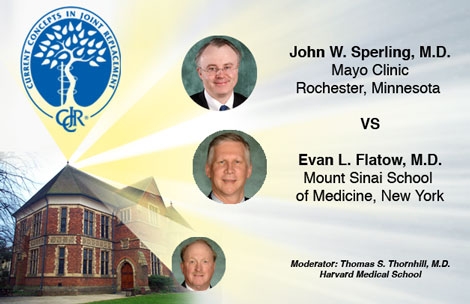
This week’s Orthopaedic Crossfire® debate is, “Subscapularis Tenotomy: Optimal Approach to Shoulder Replacement.” For the proposition was John W. Sperling, M.D. from Mayo Clinic in Rochester, Minnesota. Against the proposition was Evan L. Flatow, M.D. of The Mount Sinai School of Medicine in New York; moderating is Thomas S. Thornhill, M.D. of Harvard Medical School.
Dr. Sperling: “The benefits of tenotomy are that it is simple, reproducible, and a time efficient method to provide a secure repair of the subscapularis. As for the challenges of the lesser tuberosity osteotomy, it’s a complex procedure. It’s also possible to crush that metaphyseal bone during the procedure; fragmentation and a union of the lesser tuberosity are also possible.”
“The biomechanical literature comparing tenotomy and osteotomy shows one study of 24 cadaveric shoulders. The researchers found that there was no difference in maximum load to failure, stiffness, elongation amplitude, and cyclic elongation. Another study comparing the two involved nine paired cadaveric shoulders; they found that in the tenotomy group the cyclic displacement was 0.82mm; it was nearly double that (1.76mm) in the osteotomy group. The maximum load to failure was similar among the two groups. Another study on the clinical outcome of tenotomy—done by Dr. Nevaiser—looked at 45 patients who underwent a total shoulder arthroplasty, tenotomy and repair. The key for this was the protected postoperative motion. The results: 41 of 45 had a negative lift-off test; 45 of 45 had a negative belly-press test.”
“Another concern of osteotomy is fatty infiltration. In a study done by Gerber he looked at patients who underwent a shoulder arthroplasty with a lesser tuberosity osteotomy. He found a 44% rate of progressive fatty infiltration…without an identifiable cause.”
“The complexity of an osteotomy, together with the concerns of non-union, fragmentation, fatty infiltration, and lack of evidence of superiority does not warrant changing from the proven technique of tenotomy.”
Dr. Flatow: “I’m going to argue against doing a subscapularis tenotomy because the subscapularis is important and doesn’t like to be cut. Tendons don’t like to be cut and bone can take it! Subscapularis tenotomy, lengthening, and medialization are dangerous. Lesser tuberosity osteotomy allows solid fixation and reliable bone healing…and cadaver studies—dead shoulders—don’t tell you what happens with healing.”
“We’ve been careless with the subscapularis; we used to say, ‘Look at the great external rotation patients have!’ That’s because there was nothing holding them back, and they couldn’t tuck in their shirt and couldn’t reach behind them. Now that we can get MRIs on them with special sequences, subscap insufficiency is common. And while patients still do pretty well, if someone has two shoulders, one side where the subscap works and one side where it doesn’t, they notice the difference.”
“Subscapularis lengthening: we used to do it, but it shreds the subscapularis…it remains stuck to the rim, it over-lengthens the subscap because it isn’t a muscle problem, it’s a capsular problem. And when you medialize it—or take it off and move it medially—you lose the lever arm. So an anatomical repair is the goal.”
“In our study with 41 patients we found that a lot of them had poor subscap function; they had difficulty tucking in their shirt…they had a lot of things they didn’t like about their result if they had subscapularis problems. I had several cases of reoperating on a total shoulder at around two weeks: one person dislocated, another in whom we thought they may have had an infection and we put in a spacer and then came back when the cultures and path were negative. A good looking tendon at the time of surgery looks like jello. Hand surgeons know this…they don’t fix tendons two weeks after an injury, they wait until the right period. In old greater or lesser tuberosity fractures the tendons still look good when they had a piece of bone on them. And finally, bone healing may be better than tendon healing.”
“I do a flake of bone of the lesser tuberosity with the take down of the subscapularis. I now do it with a double Krackow suture through bone tunnels tied over an endobutton to have secure fixation so that I don’t have to restrict them.”
“Historically, as we’ve gotten better at lesser tuberosity fixation, you can see not only good motion, but good stomach press and active internal rotation. Rehab: we limit external rotation to 45 degrees in the first six weeks, and limit abduction/external rotation stretches until about the third month afterwards, and we try to get patients to avoid pushing up from a chair.”
“In a comparison that Joe Iannotti did looking at the ultrasonographic and radiographic evaluation, all the lesser tuberosity osteotomies healed and had higher Penn scores at one year versus tenotomy…and more abnormal subscaps in the tenotomy group…and this is in living patients, not cadavers. We have reduced this after changing this approach—this was before Krackow sutures—in terms of getting a negative belly press, and 83% had no difficulty tucking in a shirt. So for good subscapularis function, you must release the capsule; a lesser tuberosity osteotomy helps by giving you good bone healing; and you want to repair the subscapularis securely and anatomically, and protect it during early rehab…unless you’re a cadaver—then a tenotomy works well. Thank you.”
Moderator Thornill: “Fatty infiltration is generally in the muscular part not the tendonous part. Would that sway you if there was any from doing a tenotomy?
Dr. Sperling: “Not necessarily. The main thing that sways me about the lesser tuberosity osteotomy is the increased complexity without firm data to show that it’s better biomechanically or clinically.”
Moderator Thornhill: “Evan, in rheumatoids the proximal humerus is often bad. Do you do osteotomies in anyone—what if you had a really osteopenic rheumatoid?”
Dr. Flatow: “I don’t do them in rheumatoids, and I don’t typically do them in reverse shoulders because you’re making a more anteverted cut where you have a bigger risk that the cancellous surface of your cut is going to become confluent with the lesser tuberosity. The indication for me is a typical osteoarthritic shoulder where you’ll make an anatomic cut and you have reasonable bone.”
Moderator Thornhill: “What do you do in rheumatoids?”
Dr. Flatow: “Tenotomy.”
Moderator Thornhill: “Do you limit external rotation?”
Dr. Flatow: “Yes, because they usually get their motion more gradually and it’s not as big an issue. In such a case I limit them to about 20 degrees for the first six weeks.”
Moderator Thornhill: “Do you do a biceps tenodesis in all people with total shoulder?”
Dr. Flatow: “Yes.”
Moderator Thornhill: “If you’re doing a subscap osteotomy you pretty much need to take the biceps.”
Dr. Flatow: “Are you psychoanalyzing me, Tom?”
Moderator Thornhill: “I’ve tried and I’ve found nothing.”
Dr. Flatow: “I saved the biceps for 20 years doing total shoulders and never had problems. Then, so many people said it was a problem that I figured, ‘Well, if anyone gets pain they’re going to blame it on the biceps.’ So I started taking them and it does make it easier to do a lesser tuberosity osteotomy.”
Moderator Thornhill: “I pronounce you normal. Do you take the biceps?”
Dr. Sperling: “Yes. And I tenodese it high in the groove, and if the subscap is a little thin, if you make your cuff of tissue a little thin laterally you can reinforce that and grab the biceps tendon on the way out. So if the tissue, particularly a subscap, comes down lower it does peter out—the tendon—so you can grab a portion of that if necessary.”
Moderator Thornhill: “Evan, can you lengthen the subscap if you’re doing an osteotomy?”
Dr. Flatow: “Not really.”
Moderator Thornhill: “Can you move it proximally?”
Dr. Flatow: “If you take a flake of bone—we don’t take a huge piece—it will key in nicely if you put it back anatomically. So I’ve never tried to move it, I’ve always done an anatomic repair with this technique. The only time I would lengthen the subscap is if they had a previous shortening like an old Putti-Platt, but usually the contracture is all capsular, and I’d just do an anatomic repair.”
Moderator Thornhill: “Do you think one of the advantages of a tenotomy is that you can better manipulate it in moving it?”
Dr. Sperling: “Yes… I agree with Evan, if someone has a prior instability procedure I would take it down through tendon…and you can medialize it. That’s one of the benefits—you have more flexibility in where you’re able to put the tendon back. Also, most people who do shoulder arthroplasty do one or two a year, so I think you can make this operation as complex or simple as you like. I like to keep it simple, so for me, a tenotomy is a simple way to do the procedure. I think a lot of it is the postoperative rehabilitation, so that’s really an area of confusion. I have friends in the U.S.—postop day one—who allow full active motion. Other people keep patients in a sling for six weeks—with no motion. Evan, how has your rehab changed when you do a tenotomy versus a lesser tuberosity osteotomy?”
Dr. Flatow: “I’m interested in your comment on making it complex…is cutting a bone more complicated that cutting a tendon, John? No, my rehab is the same. I’m not sure that the Time 0 strength of the repair—what you would find in a cadaveric study—is all that different. If I do a tenotomy I tend to do some Krackow sutures also, then I tunnel them under and tie them the same way. I just have tendon to tendon biology instead of bone to bone biology. So I don’t think it makes a difference—if you avoid those very osteoporotic cases that Tom mentioned—I think it’s pretty much the same construct. And I limit all of them to about 40 degrees for the first six weeks.”
Moderator Thornhill: “Final statement, John?”
Dr. Sperling: “There’s no right or wrong answer in this regard. There are good arguments both ways.”
Dr. Flatow: “The right answer is my position.”
Moderator Thornhill: “Not always informed, but never in doubt, right? Thank you both for a balanced discussion.”
Please visit www.CCJR.com to register for the 2012 CCJR Spring Meeting, May 20-23 in Las Vegas, Nevada.
 “You may now view content from the CCJR Meetings on the CCJR Mobile™ App. Please scan the QR code to download the CCJR Mobile App to your Android or iOS mobile device, or visit www.ccjrmobile.com.”
React:
Discussion
This is a fascinating development. In my practice we've seen similar outcomes with the revised protocol. The key differentiator seems to be patient selection criteria. Has anyone else noticed the correlation with BMI thresholds?
Great point. I'd push back slightly on the conclusion, the sample size in the cited study is too small to draw population-level inferences. That said, the directional signal is compelling and worth a larger RCT.
We implemented a similar approach last year. Early results are promising but we're still gathering 12-month follow-up data. Happy to share our protocol if anyone is interested.
Join the conversation
Orthopedic professionals are discussing this. Sign in and upgrade to read every comment and add your voice.