
“There is a shit storm ahead of arthritis in young people, ” states Dr. Burkhead. “True, ” says Dr. Seitz, “And frankly, I’ve drunk your Kool-Aid.”
Burkhead vs. Seitz in Shoulder Reaming Debate
7 min read Premium comments
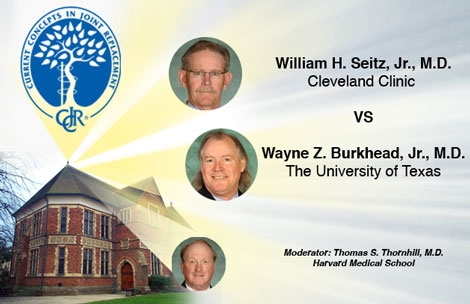
This week’s Orthopaedic Crossfire® debate is, “Ream and Run: Best Management Option for the Young Arthritic.” For the proposition was William H. Seitz, Jr., M.D. from Cleveland Clinic. Against the proposition was Wayne Z. Burkhead, Jr., M.D. of The University of Texas; moderating is Thomas S. Thornhill, M.D. of Harvard Medical School.
Dr. Seitz: “Dr. Matsen is responsible for the concept of ‘ream and run, ’ but that was reaming the glenoid to centralize the head. However, we want to do everything possible to save glenoid bone. So the issue is, ‘Should we do a hemi-arthroplasty in the face of various forms of arthritis in the young patient?’ There is a fair amount of agreement in the types of cases that we would do a hemi-arthroplasty. The bigger question is how we do it, and what we do to preserve the bone stock of the glenoid.”
“So what do we do with the glenoid? We can do some soft tissue coverage and preserve bone stock, as Dr. Burkhead will tell you. And I frankly have drunk his Kool-Aid. But we do need to correct the glenoid version if there’s significant wear…and center the head.”
“For example, after a capsulorraphy with posterior subluxation and erosion, we may need to do a bit of glenoid reaming, but in that situation I would do what Dr. Burkhead mentioned and put some soft tissue there. In many young patients this will give early good results, but the problem is that these patients are living longer.”
“The disadvantages: blood loss, longer operation, requires more dissection, and you must remove a significant amount of glenoid bone stock if you put a polyethylene glenoid in. And revising these is harder and it burns bridges.”
“The real problem is if you put a glenoid component in and the patient lives quite awhile, and you get loosening and poly particulate debris, what’s going to happen is that you have little glenoid bone stock left. So when there is posterior wear I remove a bit of the glenoid, but try to leave as much of the canal as possible, and do a resurfacing. What I really ream is the humeral side. I do a cup arthroplasty and try to preserve as much humeral bone stock as possible.”
“Young patients with cuff tear arthropathy (CTA)…if you put a reverse in, they’re not going to reduce their activities.”
“Avascular necrosis is a very good indication for doing ream and run. Contraindications for this technique include: poor bone stock, an unstable joint, and inadequate peripheral support such as in a fracture. I’ve learned from Dr. Burkhead that it’s good to use the patient’s own fasciae to resurface the glenoid if possible. If not, we can use other tissues such as an Achilles tendon allograft.”
“In cuff tear arthropathy, as long as the head is captured, and we have a patient who wants to return to being active, we can also resurface the coracoacromial arch. You surface ream, fit, and get your implant on, and then get it centered again. But you must have superior subluxation without escape…that way you’ll get good pain relief and good motion…but you need to be centered well below the coracoacromial arch.”
“This is a crossfire, so have at it, Buz.”
Dr. Burkhead: “I think Bill and I agree that there is a shit storm ahead of arthritis in young people. Our colleagues in the arthroscopic arena have created a new condition for us—chondrolysis—and we will be reaping their sad harvest for many years. If you haven’t stopped using polylactic acid anchors in the glenoid, please do so today.”
“We know that total shoulder arthroplasty in the first five years is superior in every parameter to hemi-arthroplasty. But in longer term follow-up this trend isn’t statistically significant. Total shoulders deteriorate with time, glenoids get loose, and cuffs tear…and many times the results equalize. The goal is to relieve pain and improve motion to the extent that total shoulder arthroplasty does. We want to create a durable surface on the glenoid side that is cartilage-like; a smooth, wettable surface with a low coefficient of friction…and you can do that better with an interposition than you can with a native glenoid.”
“The goal is to try to get to the mould arthroplasty by Smith Peterson…his goal of obtaining hyaline cartilage, and with some of the newer materials we are seeing chondroblasts and chondrocytes. You can’t leave a hemi-arthroplasty, or even a biologically resurfaced shoulder in the operating room stiff. You have to gain motion—even if you must go back to some of the old fashioned Z lengthenings.”
“You may have to correct version on the humeral side, and you may have to adjust that to what you have to work with on the glenoid side if you’re not going to bone graft. You’ve got to ream the glenoid, you’ve got to change the version, but we ream only to subchondral bone; we don’t ream into cancellous bone, which is the principle that Rick Matsen has postulated and really this microfracture over a broad area is trying to create fibril cartilage as part of the fracture healing. The key is to create drill holes…you must drill past the subchondral plate because pain doesn’t come from cartilage…pain doesn’t come from the surface of the bone.”
“Rick Matsen’s data had only 72% satisfactory rates. If you compare that to our article where we had up to 15 years’ follow-up, we had an 86% successful rate. So just in reviewing the historic literature it makes sense to put a biologic surface on the glenoid. There are several people who are now doing interposition grafting with osteochondral grafts…press fit into the glenoid. With newer materials like dermal matrix allograft we’re seeing some plump chondrocyte-looking material in that, and achieving Smith Peterson’s goal. Thank you.”
Moderator Thornhill: “Bill, where are you reaming?”
Dr. Seitz: “I have a hard time telling people to go in and ream beyond the subchondral bone in a glenoid. It’s dangerous and takes away much of the strength. The reality is that sometimes you do have significant posterior wear and you must ream down a bit of the front, but then I would do a fascial resurfacing. I ream the humeral head and I don’t put a stem in—a conservative procedure in young folks.”
Moderator Thornhill: “So you’re folding like a $3 suitcase?”
Dr. Seitz: “A few years ago Buz sent everybody in the Shoulder and Elbow Society his CD and when I played it in the OR the next thing I knew I was putting fascial arthroplasties in.”
Moderator Thornhill: “Bill, are you now over on his side…that interposition is better than just reaming?”
Dr. Seitz: “Yes.”
Moderator Thornhill: “Do you ever combine that with a bony block to restore glenoid height and put an interposition on top of that?”
Dr. Seitz: “Not to restore the height, but if I’m revising a shoulder with a failed glenoid component, and I have a big void, then I’ll do a graft into the void and then do a fascial resurfacing over that…with the anticipation that I could come back once that bone got incorporated and put a glenoid in.”
Moderator Thornhill: “So why would you even put a fascia on that? Why not just put the bone in if you’re going to come back?”
Dr. Seitz: “It holds it in better; it acts as a retaining wall.”
Moderator Thornhill: “Buz, let’s say there’s enough posterior glenoid wear that to get a good surface you would have to go through the subchondral bone anteriorly. What would you do?”
Dr. Burkhead: “I usually just burr down the ridge, do the drill holes, ream down the high side. When you ream the high side you end up with a central ridge…you have about 19 degrees of version that you can safely ream. And I burr down that central ridge. I alter the version on the humeral side, even though Christian Gerber showed that limits abduction and increases your force. I’ve always made my changes on the humeral side. I’ve not tried to graft these with bone and then put a surface over it.”
Moderator Thornhill: “My German knee colleagues don’t resurface the patella and they say that one of the ways they prevent postoperative pain is to use an electrocautery and to circumferentially go around the soft tissues of the patella. Have you done that?”
Dr. Burkhead: “We do it inadvertently because that’s how you release the labrum.”
Dr. Seitz: “I’ve never thought of it in terms of the plexus of nerve endings around there, but Buz is right. The other thing is that the glenoid isn’t a fixed structure. The scapula is a moving target.”
Dr. Burkhead: “Also, cysts in the glenoid are common, and in the equine literature they’ve measured substance P within the cyst. One of the things ream and run doesn’t always do is that if you ream down past those cysts you’re really getting into thin bone. If you see a cyst on the surface, make sure you curette it all out and drill a separate hole in the cyst.”
Moderator Thornhill: “Would you both agree that yes, we can make chondrocytes, Type II collagen, etc. but we’ve yet to take these structures and get the ultra structure of articular cartilage?”
Dr. Burkhead: “Yes.”
Dr. Seitz: “Yes.”
Moderator Thornhill: “Thank you both.”
Please visit www.CCJR.com to register for the 2012 CCJR Spring Meeting, May 20-23 in Las Vegas, Nevada.
 “You may now view content from the CCJR Meetings on the CCJR Mobile™ App. Please scan the QR code to download the CCJR Mobile App to your Android or iOS mobile device, or visit www.ccjrmobile.com.”
React:
Discussion
This is a fascinating development. In my practice we've seen similar outcomes with the revised protocol. The key differentiator seems to be patient selection criteria. Has anyone else noticed the correlation with BMI thresholds?
Great point. I'd push back slightly on the conclusion, the sample size in the cited study is too small to draw population-level inferences. That said, the directional signal is compelling and worth a larger RCT.
We implemented a similar approach last year. Early results are promising but we're still gathering 12-month follow-up data. Happy to share our protocol if anyone is interested.
Join the conversation
Orthopedic professionals are discussing this. Sign in and upgrade to read every comment and add your voice.