
“Dual mobility poly is more stable and has long-term data to back it up, ” argues Dr. David Stulberg. “This construct doesn’t make sense, ” counters Dr. Steve MacDonald. “I could find no published wear data in the literature.”
Three Rounds Over Dual Poly Liner: Stulberg vs. MacDonald
8 min read Premium comments
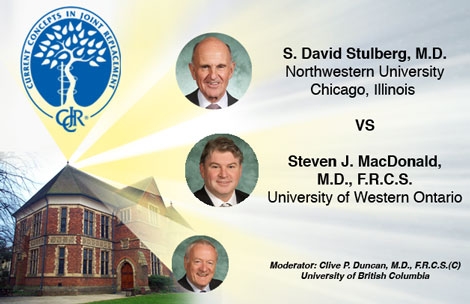
This week’s Orthopaedic Crossfire® debate on total hip arthroplasty (THA) is, “Dual Poly Liner Mobility Optimizes Wear and Stability in THA.” For the proposition was S. David Stulberg, M.D. from Northwestern University in Chicago. Against the proposition was Steven J. MacDonald, M.D., F.R.C.S. of the University of Western Ontario; moderating is Clive P. Duncan, M.D., F.R.C.S.(C) of the University of British Columbia.
Dr. Stulberg: “It’s a pleasure to celebrate with this audience and to remind Steve that the center of professional hockey now resides in Chicago, not Canada. Dual mobility is really a tripolar cup; it has a fixed, porous-coated metal device which articulates with a large polyethylene ball, into which is placed a bi-polar 22 or 28mm head, so that you have motion at the two surfaces—and two bearing surfaces.”
“The concept was introduced in France in the 1970s. As the cup initially moves the smaller femoral head impinges and then the large femoral head moves. The idea was that there were a number of issues that could predispose to instability, both in primary and revision situations. In England, dislocations account for 16% of revisions; in Australia it’s 15%. In Canada in 2006 they accounted for 16%; when I tried to get more recent data I got this error message that the site was blocked [image showing error message with Dr. MacDonald’s photo]. I’m not saying that Steve blocked it, but he knew the debate was coming.”
“When you look at the incidence of revision, and the incidence of instability following revision, this incidence increases because: the hip anatomy is distorted, deficient soft tissues, altered hip biomechanics. There may be a role for large femoral heads in fixed acetabular components. There are significant disadvantages to using large femoral heads with a fixed acetabulum. The size of the head is limited by the patient’s anatomy; and if you use a thin polyethylene you may end up with a device that is intolerant to cup malposition, and is associated with unknown wear.”
“Dual mobility is inherently more stable…there’s a bigger jump distance…and there’s a bigger theoretical range of motion when you use full mobility concepts. When you couple this with highly cross-linked polyethylene (HCLP), it’s being suggested that even if these cups are placed in abnormal positions, something that I think no one should try to do or tolerate. These will tolerate malpositions perhaps better than metal-metal. But the proof is in the results…the French results: in primaries their revision rate using conventional poly is extremely low (<0.4%). In revisions it’s also very low (2.1%); surprisingly their survival rates are very high using conventional poly.”
“The future? We could introduce HCLP…this seems to reduce wear. Another concern will be the impingement potential. Hemispherical cups may be adapted to the anatomy, and can be made anatomic so that you retain the hemispherical advantage while avoiding the potential for impingement. I think the dual mobility seems to offer a safe, effective solution to hip instability. The long-term durability may be increased, particularly with improvements in the polyethylene. The indications start with revision total hips that are being done for recurrent instability. It may be an attractive option for most revision total hips where instability is a problem…also for primary patients where you can identify the risk factors for instability. The unresolved question is, ‘Will it be a couple that lasts long enough that makes it interesting for primary hips in general?’ Also, ‘Will it perform when malpositioned?’ Thank you.”
Dr. MacDonald: “I’ve been charged with debating dual poly liner mobility…and thankfully I’m in strong opposition. For most of us in North America this is a new concept. It’s a monoblock shell with a large piece of poly that articulates against that shell…the ball fits in and that gives you your ultimate hip construct. The first question is, ‘Does it make inherent sense?’ If you look at a total hip model, it’s a differential hardness bearing…i.e., the harder surface (head) articulates against a softer surface. There are lots of examples of that: every hip we basically do globally is that construct, whether it’s metal-poly, ceramic-poly, so it’s hard on soft; metal-on-metal…there is some—globally and in North America—differential hardness. Always though, the head is harder, the liner is softer. I didn’t block the registry data…but I could have.”
“Why is it hard on soft? Because if you reverse the situation you get increased wear. So we have by design a construct with inherent increased wear. The published basic science on this construct: I could find no published wear data in the literature. What I did find were advertisements, saying there’s 94% reduction in wear compared to metal-metal if the metal-metal is at 65 degrees of cup inclination. But we’re not advocating that, so I challenge the thinking that we’re there with the basic science on this construct.”
“The poly is free to go into a more closed position…it looks good here [showing picture], but what if it’s more closed…the theoretical issue of edge loading and polyethylene failure. We have two articulating polyethylene surfaces…one with a huge surface area. What’s that going to do to wear and osteolysis? Not reduce it. The claim is for improved range of motion (ROM) and stability, but I challenge that because we know in lots of good basic science, and our own clinical acumen tells us that once we get to a 36, 38, or 40mm head, there really is no improvement in ROM beyond that.”
“There is no clinical evidence for the claim that because it’s anatomic that it may decrease psoas impingement. I think that left and right sockets increase the risk for improper implantation. Information from the Australian registry on monoblock shells shows a higher failure rate than modular shells—certainly in metal-metal.”
“Who is this recommended for? The techniques manual says: OA, RA, revisions, patients with a dislocation risk…that’s basically everyone. If we can assume that the goal of this construct is increased stability—and David did publish on this recently and showed a dislocation rate in this small series of less than 1%. But there are lots of publications with series less than 1% when you look at certain centers.”
“I would concede we know we have a risk of dislocation issues in revision arthroplasty. But an acetabular component with no screw fixation, that doesn’t help me in a revision. I’m not going to use a monoblock shell in a revision…I’m more worried about getting the cup to fix than I am with instability in this kind of construct and design.”
“So conceptually, there are challenges with this design. Since its introduction over 30 years ago we’ve had many advances in our thinking in terms of materials, designs, and techniques. And while it’s been used for 30 years we don’t have 20 year data…and I would say any new implant today must show equivalence in terms of wear, fixation, midterm results, complications, and cost…and we’re not there yet with this.”
Moderator Duncan: “David, do you want to answer any of those complaints?”
Dr. Stulberg: “We have been raised in North America on the idea that convex polyethylene is a bad idea. But if you actually do it and look at the results…this idea has been around a long time. If this were a bad idea then we would know it. We must expand our thinking with regard to this concept…and it’s a good time to do it when the alternative bearings are taking a beating.”
Moderator Duncan: “David, I think the criticism is valid that we have no data on the wear characteristics between the polyethylene and the outer monoblock cup. Are you aware of any that aren’t in-house?”
Dr. Stulberg: “The available testing data is limited and it’s by and large industrial. And I think we need more information, but it’s consistent at least with what seemed to be very good clinical long-term results. So I think it’s a start, but I think this concept—and the fact that it’s being clinically used—should now stimulate this kind of laboratory information.”
Moderator Duncan: “So it’s overdue. Steve, the jump out distance of 11mm is attractive. Are there any circumstances under which you might turn to this?”
Dr. MacDonald: “No.”
Moderator Duncan: “David, the fact that you can’t put any screws on this is alarming. Could we have a new design with a recessed screw head that might not increase the risk of poly wear?”
Dr. Stulberg: “Clive, are you asking if screws were introduced…”
Moderator Duncan: “In a revision setting. I think Steve made a good point that you have to depend on interference fit and friction surface fit to use this shell. There is no capacity to fix it with peripheral or polar screws.”
Dr. Stulberg: “I was trying to suggest that there were a number of ways this concept was going to go. I’d be willing to bet Steve a dinner at the next CCJR that we will see this combination with screws in the very near future.”
Moderator Duncan: “So that’s the improvement you’d see that would make it more attractive. David, what are the indications under which you would use it next Monday? In your clinical setting…circumstances under which you feel this would be a good socket.”
Dr. Stulberg: “It’s a good socket in patients who have bony anatomy that allows a cup without screws. So you need good coverage at the moment in which you can get good fit of the shell in a patient that has the potential for instability. So that might be a revision where you have good bone stock, and it certainly is a primary where the patient is at significant risk and you have enough bone stock to place this current concept.”
Moderator Duncan: “Because of the lack of data on wear, would you limit it to use in elderly patients?”
Dr. Stulberg: “I don’t think I would use it routinely in highly active people, but I’m not sure that age in and of itself would be a contraindication.”
Dr. MacDonald: “Moving forward we need good quality data…and that’s where registries help. A series of 100 or 200 is not going to give that same viable data that we look for in a registry. The question is, ‘Who gets that implant put in them? Is it that elderly patient?’ That’s a challenge because I don’t see a role for it to get big enough numbers to capture a good registry…and I don’t know if that’s going to be possible. I don’t think a case series from developers anymore is the way to go.”
Dr. Stulberg: “I agree, and I think that its use is increasing enough that we’re going to be able to see this information within the next two or three years.”
Moderator Duncan: “Please join me in thanking the speakers.”
Please visit www.CCJR.com to register for the 2012 CCJR Spring Meeting, May 20-23 in Las Vegas, Nevada.
 “You may now view content from the CCJR Meetings on the CCJR Mobile™ App. Please scan the QR code to download the CCJR Mobile App to your Android or iOS mobile device, or visit www.ccjrmobile.com.”
React:
Discussion
This is a fascinating development. In my practice we've seen similar outcomes with the revised protocol. The key differentiator seems to be patient selection criteria. Has anyone else noticed the correlation with BMI thresholds?
Great point. I'd push back slightly on the conclusion, the sample size in the cited study is too small to draw population-level inferences. That said, the directional signal is compelling and worth a larger RCT.
We implemented a similar approach last year. Early results are promising but we're still gathering 12-month follow-up data. Happy to share our protocol if anyone is interested.
Join the conversation
Orthopedic professionals are discussing this. Sign in and upgrade to read every comment and add your voice.