
“Reverse arthroplasty for a fracture avoids complications of both ORIF and hemi before they happen, ” argues Dr. Louis Bigliani. “Au contraire, ” says Dr. Leesa Galatz. “Reverse shoulder arthroplasty for a fracture has a high complication rate. You can get hematomas, dislocations, and scapular notching.”
Reverse Shoulder Arthroplasty or Not? Bigliani Debates Galatz
7 min read Premium comments
Great Debates
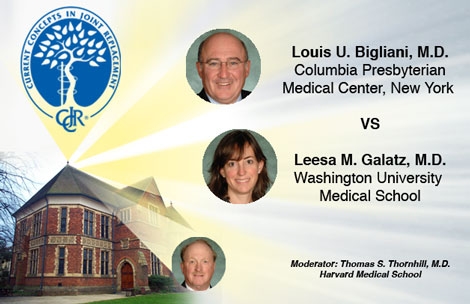
This week’s Orthopaedic Crossfire® debate is, “Reverse Arthroplasty: Best Option for 4-Part Fx’s in the Geriatric Patient.” For the proposition was Louis U. Bigliani, M.D. from Columbia Presbyterian Medical Center in New York. Against the proposition was Leesa M. Galatz, M.D. of Washington University Medical School; moderating is Thomas S. Thornhill, M.D. of Harvard Medical School.
Dr. Bigliani: “I am affirming that a reverse should be used in a displaced fracture of the proximal humerus. These fractures can be difficult to treat, and are controversial, especially in the elderly—mostly because the bone is osteoporotic and rehab might be difficult. What happens in the elderly with other forms of fixation is that you can get nonunions, loss of tuberosity, which is especially important in a hemiarthroplasty, not as much as in a reverse. Twenty years ago we had internal fixation with plates. Now we’re in another round with more screws, better plates…problem is there isn’t any bone for the screws to fit into.”
“In a 2008 series about internal fixation, 36% had radiological complications; 57% in people over 60 years old; 15% required revision…so I don’t think it’s a good indication for the elderly. When we look at hemiarthroplasty—in a meta-analysis of 808 patients—most reported no or mild pain. The constant score was fair at 56; functionally they got 105 degrees of forward elevation; the complication most often related to fixation and healing was loss of the greater tuberosity, which was 11.5%.”
“So reverse arthroplasty avoids complications of both ORIF [open reduction internal fixation] and hemi before they happen…at least that’s what we say…and I think there is some truth to that, especially in those over 75. The literature reports predictable results—and this is probably one of the most important factors…less demanding rehabilitation. There are some patients who are just not up to rehab; and I think that if you’re going to do a hemiarthroplasty they must do rehab.”
“There are complications. Secondary tuberosity displacement occurs in 53%, but that’s probably because they never intended to fix it in the first place. Older patients have lower constant scores, so there are drawbacks with a reverse too. Another series in 2009 showed that at mean follow-up unsatisfactory radiologic outcome for the glenoid was at 70%.”
“Then why do a reverse? Well, the reverse that I do has trabecular metal on the glenoid component, and the angle here is less than 65 degrees at 60, so you don’t get notching and you get good fixation on the glenoid side. Furthermore, there is trabecular metal on the humeral side so that a fracture which has a lot of bone loss and a lot of comminution is going to be difficult for a hemiarthroplasty in someone over 80 years old. And you must look at the glenoid because it could be arthritic, and if that is the case your hemi is probably going to fail. Thank you.”
Dr. Galatz: “So my job is to tell you why we shouldn’t do a reverse shoulder arthroplasty for a fracture. I do do some, but for the sake of argument I’m going to oppose this. So Louis, are you sure you want to do this? A reverse for fracture has a high complication rate. We’ve seen a very high rate—at least initially—in reverse shoulder arthroplasty… anywhere from minor complications such as hematoma, dislocations, and also scapular notching. There’s also a significant amount of technical skill required to do a reverse shoulder arthroplasty, and many people who do them don’t do very many.”
“Some external rotation is necessary for hand to mouth function; some external rotation is necessary to maintain the midline position, and so if you have no rotator cuff the arm falls into obligate internal rotation with elevation. Meticulous repair is also necessary in a reverse for reasonable function. So we need to still do a repair of the tuberosities.”
“A hemiarthroplasty isn’t always perfect either. Some complications are rare such as dislocation, hematomas, and scapular notching. But tuberosity healing in a hemiarthroplasty is extremely challenging, even after good fixation. We’ve seen migration and absorption of the tuberosities, and this leads to proximal migration; and failure of a hemiarthroplasty for a fracture is one of our most common indications for a reverse shoulder replacement.”
“In a 2007 study there were a tremendous amount of complications; follow up was short in some patients, but had a huge range. We have three patients with RSD [reflex sympathetic dystrophy], five nerve injuries, one dislocation, 53% tuberosity displacement, scapular notching, an acromial fracture; in one there was misplacement…the humeral component articulated with the coracoid; and deltoid dehiscence in a patient with an anterior/superior approach. The mean constant score was 44 and the modified was 66 and their elevation was 97 degrees. From a functional standpoint they didn’t do much better than a hemi.”
“We often use AVN [avascular necrosis] as an argument not to do an ORIF. We looked up our results with Evan Flatow and Gerry Williams, and we followed 36 patients treated with percutaneous pinning. In the long term we had a very high rate of avascular necrosis—26%—but keep in mind that a lot of the trauma literature does not follow patients as long as we did. If you look in the Journal of Orthopaedic Trauma they follow their patients for about six months. This is a longer term follow up, and we were actually surprised to see this AVN rate. One thing we noticed is that if a patient has rapid onset AVN, they’re often symptomatic and require revision. However, we had a number of patients with later AVN…and they were surprisingly relatively asymptomatic.”
“One thing that these studies didn’t evaluate is the cost of the implant compared to a hemiarthroplasty, which is significant. And thus far an improved outcome isn’t clearly established. Thank you.”
Moderator Thornhill: “Lisa, you feel that in these four parts you should do ORIF when you can, hemi in some, and a reverse in a few?
Dr. Galatz: “I feel that you should, in the geriatric patient, fix it if you can, and then often a reverse is my first arthroplasty choice, but I am a fixer of fractures and I fix a lot of fractures that other people wouldn’t. I think that it is possible now and we know that AVN to a certain extent is tolerable and it seems that people do better with their own bone. Tuberosity healing is challenging, but they will reliably heal to the native shaft and the native head if you can get it anatomically reduced.”
Moderator Thornhill: “So you don’t do hemis for this, you do reverses?”
Dr. Galatz: “Yes.”
Moderator Thornhill: “Louis, in the original Grammont one of the advantages was that it medialized the center of rotation. The first attempt to lateralize it was associated with a higher incidence of dislocation. Do you think that now with the trabecular metal that it’s going to improve that?”
Dr. Bigliani: “The trabecular metal version is not lateralized as much as the other versions and is a bit more than the original Grammont. But the proximal humerus is much smaller, and it is only 52 degrees…and the poly makes up to 60 degrees; and it has holes so you can attach the tuberosities and build the fracture around the prosthesis, so it will heal. And we’ve had relatively good results. I will not do another type of reverse because I think there’s too much metal and the bone’s not going to heal to it.”
Moderator Thornhill: “Lisa, for a skilled trauma surgeon does it take longer to do an ORIF than it does to do a reverse? And if so do you have to amortize the cost of the operating room?”
Dr. Galatz: “I have never looked at that, but when I take a patient to the operating room with this problem I consent them for everything. Assuming we’re talking about the geriatric patient, I still will spend time trying to fix this, but I can recognize when it’s not possible. So I try, but I won’t spend four hours trying to fix it and then do a reverse. I think that’s bad for the patient and surgeon, and obviously bad for the cost. There are some patients where you evaluate the fracture and you can recognize that it’s not fixable and proceed directly to arthroplasty.”
Moderator Thornhill: “Louis, there’s different levels of arthroplasty skills amongst trauma surgeons and trauma skills amongst arthroplasty surgeons. Who should be doing these reverses?”
Dr. Bigliani: “I don’t like to limit people, but we do have suggestions at our hospital. Upper extremity trauma goes to the shoulder team. If you’re going to do something specialized and you’ve had no experience with arthroplasty in the shoulder…it should be someone with experience because what you don’t want to do is throw away pieces of bone and increase your lever arm. You want to build the pieces of bone in the fracture around the prosthesis. If you can accomplish this with a reverse I think it can be done. Experience is key; when you look at a 70% failure rate for the glenoid it’s something where you need some expertise.”
Moderator Thornhill: “Louis, Charles Neer used to speak about limited goals in some patients. Do you think when we’re looking at reverses we should be lumping the people who have revisions, failed cuffs, and fractures into the same cohort of people?”
Dr. Bigliani: “No…it’s a different operation. One is a revision operation which is kind of a bailout…and if you get someone with cuff tear arthropathy and you look at that subset they’re probably going to have much better results than the revisions. Lisa is 100% right when she says these catastrophes that people try to revise with a reverse get worse.”
Moderator Thornhill: “Thank you both for a very nice discussion.”
Please visit www.CCJR.com to register for the 2012 CCJR Spring Meeting, May 20-23 in Las Vegas, Nevada.
 “You may now view content from the CCJR Meetings on the CCJR Mobile™ App. Please scan the QR code to download the CCJR Mobile App to your Android or iOS mobile device, or visit www.ccjrmobile.com.”
React:
Discussion
This is a fascinating development. In my practice we've seen similar outcomes with the revised protocol. The key differentiator seems to be patient selection criteria. Has anyone else noticed the correlation with BMI thresholds?
Great point. I'd push back slightly on the conclusion, the sample size in the cited study is too small to draw population-level inferences. That said, the directional signal is compelling and worth a larger RCT.
We implemented a similar approach last year. Early results are promising but we're still gathering 12-month follow-up data. Happy to share our protocol if anyone is interested.
Join the conversation
Orthopedic professionals are discussing this. Sign in and upgrade to read every comment and add your voice.