
“Lubricate the joint!” says Mark Pagnano, who says that the benefits of a superior wear couple as represented by ceramic-ceramic likely outweigh the potential risks. Jay Parvizi disagrees, pointing out that while we have a longer clinical experience with ceramic-ceramic components than we do with highly crosslinked polyethylene, at the midterm, they perform essentially equivalently.
Pagnano and Parvizi Debate Squeaking Hips
9 min read Premium comments
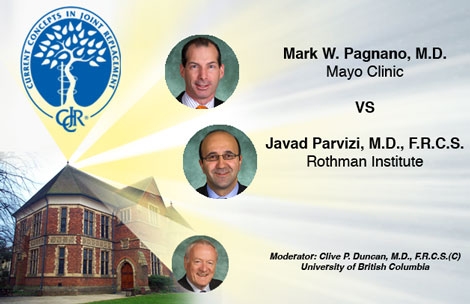
This week’s Orthopaedic Crossfire® debate is, “The Squeaking Hip: Much Ado About Nothing.” For the proposition was Mark W. Pagnano, M.D. from Mayo Clinic. Against the proposition was Javad Parvizi, M.D., F.R.C.S. with the Rothman Institute in Philadelphia; moderating is Clive P. Duncan, M.D., F.R.C.S.(C) of the University of British Columbia.
Dr. Pagnano: “I would like to take the position that squeaking hips after ceramic-ceramic are largely much ado about nothing. It’s my contention that ceramic-ceramic bearings in total hip arthroplasty are the best bearing selection for a selected subgroup of patients. If we review the volumetric wear rates with different total hip bearing combinations, they are cobalt chrome against traditional polyethylene (120-200um), cobalt chrome against crosslinked polyethylene (0-25um), and then ceramic-on-ceramic (less than 1um).”
“All bearing surface couples have risks. But at a certain young age the benefits of a superior wear couple of ceramic-ceramic likely outweigh the potential risks. In an extreme example, a 12-year-old patient with bilateral advanced hip problems…really nothing short of total hip arthroplasty is going to give this patient substantial pain relief. And a ceramic-ceramic hip is a reasonable treatment option for this person. Similarly, in an 18-year-old patient with bilateral avascular necrosis and disabling pain total hip arthroplasty is clearly the best option, and a ceramic-ceramic couple is probably the best bearing couple.”
“There are risks with ceramic-ceramic, but they can be minimized. The potential disadvantages: there is a small risk of fracture of the ceramic head or chipping of the liner, a risk of runaway wear—you heard that earlier about metal-metal—same things with malposition and edge loading with ceramic-ceramic, an impingement risk, and then the squeaking phenomenon which has really dominated this discussion over the last three to five years.”
“The fracture risk has decreased with modern technology. Improvements in the ceramic include smaller grain sizes, better burst strength, and with alumina ceramic the risk of fracture is now in the range of <1 in 2, 000-10, 000. Ceramic-ceramic is sensitive to cup position, however. If the cup is too vertical you can get edge loading and then runaway wear. If you have improper version you can have impingement of metal against ceramic or metal against metal in certain cup designs. The squeaking noise has received lots of attention. There is a spectrum of these squeaking noises, from intermittent nuisance type squeaks to more consistent reproducible squeaks in every step. But squeaking is typically not painful, and usually occurs with walking or changing position; prevalence is anywhere between 0 and about 6% in big series.”
“About a year ago we had one of our fellows pull all the English literature that discussed hip component squeaking and it turns out that most of those reported cases are with a single acetabular component design, one in which there’s a rim of titanium around a recessed ceramic bearing, leading to a potential for edge loading. We thought that there was potential to look at this on a basic science basis to try and figure out why squeaking occurs. We developed an in vitro study and looked at squeaking in the biomechanics lab at Mayo. Turns out that we could reproduce squeaking in dry conditions and so we had an effective model to look at this. In the dry condition, every potential pattern that we could think of will produce squeaking quickly and that squeaking will remain constant. If we add lubrication to the joint the squeaking goes away in almost every situation you can imagine. The only condition in which squeaking was reproducible in the lubricated condition was when there was titanium material transfer to the head.”
“So it’s our contention that squeaking occurs via a disruption of fluid lubrication in the joint. It will always occur in a dry joint, but in a lubricated joint it only occurs with metal transfer. Squeaking is commonly reported with certain designs.”
“So in conclusion, in my own practice, metal-polyethylene bearings are applicable to the majority of total hips. Ceramic-ceramic is the best for a subgroup of young, active patients. I think we will see a resurgence in interest in ceramics as we better understand the interrelated aspects of design and surgical technique to avoid impingement.”
Dr. Parvizi: “Like Dr. Pagnano, I use ceramic-ceramic in a select group of patients. Squeaking following ceramic-ceramic does happen, and the rate is between 0 and 29%. Part of the problem relates to what exactly we call squeaking. Our institution, as well as Dr. Ranawat, was the first to draw attention to the phenomenon of squeaking. We first noticed this in 2002, and the incidence of squeaking was around 3%. The incidence is affected by the definition and length of follow up. We did a study in which we looked at the natural history of squeaking and we found that some resolved, some were late starters (happening up to two years after surgery)…and it did go up when the patients became aware of this phenomenon, especially if they were stimulated by some lawyers.”
“The etiology of this remains unknown. Some of these have not been proven to be scientifically sound such as—cup thickness initially was thought to be a problem. Patient demographic does not seem to have an influence on squeaking. We performed a bilateral total hip arthroplasty study in which we did not see any demographic factor that could be a risk factor for squeaking. Also, people have talked about malseating such as trying to put a ceramic liner that is encased in a jacket into the hip. There is difficulty seating the cup, perhaps due to the fact that the socket has deformed due to the hard bone of the patient. After impaction one is fairly certain that the socket is seated, but when you test the socket unfortunately it’s not so. So this was thought to be one of the phenomenon related to squeaking, but that has not born out to be the case scientifically.”
“Other theories…We know for a fact that if you’ve got a mismatched couple that a ceramic liner is likely to squeak—that has been born out by multiple papers, including a very elegant scientific study done in Italy and presented at the AAOS [American Academy of Orthopaedic Surgeson] two years ago.”
“Dr. Walter drew our attention to possible malposition being a cause, and in his paper he found—in a small series—that component malpositioning was a risk factor for squeaking. We did a similar study in which we did a 2:1 match on all the patients, did a CT scan of the cup, looked at the version of the acetabular component. We didn’t see a difference in the cup position, but one of our problems was that we could not measure the femoral anteversion…and one could argue that perhaps the combined version does have a role in terms of causing ceramic-ceramic squeaking. But what we did see is that the anteversion in the majority of the squeaking cases was excessive.”
“Edge loading does lead to stripe wear and that has been implicated with squeaking, and I’m sure that is going to be proven even further. Dr. Capello and Dr. D’Antonio drew our attention to the importance of the femoral component, in particular the taper of the femoral stem. As they had not seen any squeaking with the C-taper design that they had used over a time period, whereas it happened that the TMZF, especially with the V-40 taper was a very significant risk factor. Dr. Walter also found that the most significant factor was the design of the femoral stem that they used in that study; now there have been multiple studies showing that the V-40 neck with the TMZF alloy is a risk factor for squeaking.”
“I agree with Mark completely that some designs are more likely to lead to more metal transfer. Our retrieval studies published with Steve Kurtz on about 18 cases so far have shown metal transfer and impingement to be very common with one specific design. We followed that study, we’ve used Trident cups and non-Trident cups at our institution and we’ve found that amongst a large number of patients squeaking was around 8% in the Trident design and 0% amongst other designs. The incidence of squeaking was 7x higher with the use of TMZF so I agree with Mark that it happens that squeaking may be related to one particular design.”
“So, you malposition the component, it leads to impingement. If you use a raised liner you might transfer more metal; perhaps the TMZF is more likely to transfer metal. It gets into the bearing surface; then, if you have a good resonance such as what you might see with a TMZF alloy that leaks or squeaks.”
Moderator Duncan: “Let’s turn to something which we were not dealing with and that is the fracture. Bring us through management of the broken ceramic head. Jay?”
Dr. Parvizi: “They are extremely tough. I’ve had the misfortune of revising two cases with fractures—not the modern generation, the old generation…very difficult. Chit Ranawat talks about doing an extensive synovectomy through the front and the back. We haven’t done that, but I can tell you that it’s one of those cases that takes a long time, and I do actually choose a hard-hard bearing surface in that sort of a circumstance because regardless of how meticulous you are in trying to get all those particles, I’m sure there are some that are left behind that could put that soft bearing surface at risk later.”
Moderator Duncan: “So what implant bearing surface did you put back into that patient?”
Dr. Parvizi: “I would use ceramic-ceramic.”
Moderator Duncan: “Mark, what was that incidence again?”
Dr. Pagnano: “Probably somewhere between 2 and 10, 000. Because the incidence is so low it’s hard to get hardcore data because you don’t know how many of these are reported back to central agencies that can accumulate the data.”
Moderator Duncan: “There have been a small number of reports of revision for squeaking itself. How should we manage that patient?”
Dr. Pagnano: “I think it’s an individualized decision and what we can say is that squeaking is a nuisance for a subset of patients, but it’s rarely painful…and at this point we don’t have data that squeaking leads to some catastrophic problem with the hip at a later date. That being said, if there’s something with the X-ray where there’s a major problem with cup position, it’s markedly abducted…you’re concerned about the potential for runaway wear, for instance, then that might be someone where you’d push them to surgery sooner rather than later. But for most patients the painless squeaking hip, it mainly comes down to whether it’s a big enough nuisance on a daily basis to make it worth going through another operation.”
Moderator Duncan: “Jay, if during the index arthroplasty you note during reduction, perhaps you’ve had to dislocate the hip again to ensure something, there is a stripe on the femoral head—will you throw that femoral head away?”
Dr. Parvizi: “That doesn’t worry me and that has been shown in multiple in vitro studies not to significantly affect wear characteristics.”
Moderator Duncan: “Mark, do you agree with that based on the Trousdale study? Do you keep that head or do you feel like it’s going to interfere with lubrication?”
Dr. Pagnano: “There is the potential that that could lead to squeaking because it’s some disruption of fluid film lubrication. But probably the negatives of changing that outweigh the positives.”
Dr. Parvizi: “Because of the taper issues. If you pull that ceramic head off you’ve got a taper issue.”
Moderator Duncan: “Thank you, gentlemen. It was excellent.”
Please visit www.CCJR.com to register for the 2012 CCJR Spring Meeting, May 20-23 in Las Vegas, Nevada.
 “You may now view content from the CCJR Meetings on the CCJR Mobile™ App. Please scan the QR code to download the CCJR Mobile App to your Android or iOS mobile device, or visit www.ccjrmobile.com.”
React:
Discussion
This is a fascinating development. In my practice we've seen similar outcomes with the revised protocol. The key differentiator seems to be patient selection criteria. Has anyone else noticed the correlation with BMI thresholds?
Great point. I'd push back slightly on the conclusion, the sample size in the cited study is too small to draw population-level inferences. That said, the directional signal is compelling and worth a larger RCT.
We implemented a similar approach last year. Early results are promising but we're still gathering 12-month follow-up data. Happy to share our protocol if anyone is interested.
Join the conversation
Orthopedic professionals are discussing this. Sign in and upgrade to read every comment and add your voice.