
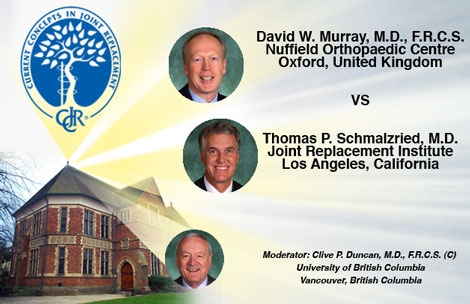
Mr. Murray: “We only have experience with hip resurfacing, so my remarks will focus on that. We have observed patients following hip resurfacing with a variety of symptoms; when we investigate we find a soft tissue mass—either solid or cystic. We call these inflammatory pseudotumors; this is controversial, but it is a catch phrase to describe all the lesions that have been described under different names.”
Houston Do we Have a Problem With Metal – Metal Pseudotumors? Murray
8 min read Premium comments
“We often see local destruction, with the lesion spreading through the tissue planes; by definition no organisms are seen or cultured. Histology usually shows metal wear debris, an inflammatory response, and extensive necrosis.”
“We have good results with revisions for fracture, infection, and loosening, but the results following pseudotumor are poor…in fact the scores are similar to those which patients have before primary hip replacement. In about 50% of cases following revisions for pseudotumors there are major complications, and a third have had re-revisions.”
“It was only when we’d been doing resurfacings for six years that we realized there was a problem…the problem has been increasing. We set out to determine the incidence of revision for pseudotumor. In Oxford our incidence is 1.8%; in other UK centers it is higher. Designer surgeons have a lower rate, but the main designer surgeons have now all reported appreciable numbers.”
“Survival analysis: end point is revision for a pseudotumor, at eight years we have a 4% revision rate…it is increasing. The cause is multifactorial: in our practice most are associated with high levels of wear caused by edge loading. We think the lesions are a manifestation of a local toxic effect caused by metal wear particles; a small proportion may be true hypersensitivity.”
“We must focus on indications, technique and design. The risk factors in our series are women, particularly those under 40, small size, and dysplasia. These risk factors are interrelated. A Cox regression suggests that gender is the most important risk factor, age is important, size is possibly important.”
“To avoid it, avoid impingement. Also, acetabular orientation is critical; an inclination of 40° and anteversion of 20° is optimal. If you take a zone of plus or minus 10° around this, if the surgeon hits this zone the rate of pseudotumors decreases significantly. Also, we need implants with optimal coverage, clearance…also, better metallurgy and machining, as well as alternate bearings.”
“We have little experience with metal on metal (MOM) pseudotumors after conventional hip replacement. There is little consensus; some series have low rates whereas a few have very high rates. We need longer follow-up. We have always been cautious about MOM in conventional hips because unlike hip resurfacing, you don’t have to use a MOM articulation.”
Dr. Schmalzried: “Houston, I understand the problem. This is not a boogeyman that jumps out and bites your patient for no reason. There are some similarities between the Oxford experience and my personal experience, but I’ve done an X-ray analysis and a retrieval analysis.”
“The Oxford Group is a multiple surgeon group; I’m going to present a single surgeon series. We both use the posterior approach, and that may be an important consideration for the occurrence of pseudotumor. Both groups have used multiple resurfacing implants. At Oxford the incidence is >1%; in my experience it’s 0.51%. The problems I’ve had have been in females. When David reports his results, I’ve seen frontal plane radiographs…I’ll discuss lateral plane radiographs.”
“Our histology is similar. We’ve done an extensive retrieval analysis; I haven’t seen that from Oxford. Regarding etiology, there have been rumblings from Oxford of a biologic basis; my conclusion is there’s a primary mechanical basis involving corrosion products.”
“A large mass can also present with a metal on polyethylene bearing—not MOM. The source of corrosion is a cobalt chrome to cobalt chrome taper. The histology is very similar to the histology that Willert subsequently coined as ‘ALVAL’ [Aseptic Lymphocytic Vasculitis Associated Lesions]. The original report from Oxford described 20 hips—MOM resurfacing—all women. Histology was consistent with ALVAL, but not much talk about the mechanics and pathophysiology.”
“I use the term, ‘Adverse Local Tissue Reactions (ALTR)’ because there is not one single reaction that occurs histologically…there are at least two and probably three. My experience includes 588 hips, all with greater than a 36mm MOM bearing; 77% are male and it’s predominantly a resurfacing experience through a posterior approach. I have one female with a surface replacement that has high wear and metal reactivity; one female surface replacement with a bilateral pseudotumor; another female total hip patient with a pseudotumor. If you look at the frontal plane X-ray you would say the lateral opening angle and the coverage of the hip looks good. But that’s not the important plane.”
“Metal reactivity—high wear—is a result of a relatively high amount of combined anteversion (on the acetabulum plus the anteversion on the femur) leading to edge wear and subluxation, high wear rate, with production of particles and the typical foreign body response leading to osteolysis.”
“My overall MOM outcomes have been excellent. I’ve had one revision for infection, one for loosening but none for instability or squeaking. But you get to the unique tissue reactions—one revised for reactivity, three for sensitivity…all females, none in modular total hips.”
“When looking at the lateral radiographs and the wear plots of the four hips in the three females that were revised, they were all small because the patients with high combined anteversion natively tend to be small females. There was no difference in their lateral opening angle compared to the other patients in the series. When you look at the retrievals the important finding is edge wear and corrosion.”
“In my experience it is a female issue. Component position influences wear and ion levels (from multiple reports). The primary role of mechanics in ALTR…it’s a gender association and a resurfacing association—not a causation. Why? Why do you do a resurfacing on a female in her 40s or 50s? Mostly because of dysplasia; they have small size, low offset, higher combined anteversion, and reduced head/neck ratio because of the resurfacing. Edge loading, subluxation, wear and corrosion are the pathomechanics. The most important factor is component position.”
Moderator Duncan: “It seems that in the UK they are not as much in denial about this issue as we are. It is being accepted widely, except perhaps at the centers where the innovators work, as being a looming problem in practice…at some centers surface replacement has stopped. In others it is being refused to female patients.”
Mr. Murray: “The reason it’s become a problem in the UK is that relatively large numbers have been done by many surgeons over ten years…and you don’t really appreciate the problem until you’ve been doing it awhile. It will become more of a problem here.”
Moderator Duncan: “Tom, it is critical to get the alignment correct and so important in the pathogenesis of this issue. Is it safe for the occasional surface replacing surgeon to do the operation without computer assistance…at least on the acetabular side vis a vis anteversion?”
Dr. Schmalzried: “Surgical technique…it’s difficult to give a categorical answer when you’re talking about thousands of surgeons, so the answer is that some guys are going to have problems and some won’t. There were seeds planted—meaning cases that were done—during a time when the mechanical orientation wasn’t as well understood, so it makes sense that over time you’ll have an increasing occurrence as those seeds mature and the problems related to that bearing come forward. I will distinguish between what was done when those seeds were planted and what I think is the important factor—understanding why it happens when it happens…there is a mechanical basis that we can understand and move forward. It doesn’t just have implications for MOM, but for hard-on-hard bearings categorically in order to get the desired wear mechanism.”
Moderator Duncan: “Over the next five years you think it’s going to be a diminishing problem, or the burden of this is going to be greater…in new cases?”
Dr. Schmalzried: “New cases will emerge because they are the product of surgeries that were done prior to the understanding of the mechanical orientation.”
Moderator Duncan: “David, in your opinion there have been many in which the alignment of the components was perfect. I’m paraphrasing what you said a few minutes ago…you couldn’t criticize the technique used by the surgeon, and yet this patient has returned with this pseudotumor. How can you explain that?”
Mr. Murray: “Despite perfect orientation we had pseudotumors. It decreases the risk, but they still happen. That example of the bilateral cystic pseudotumors…they were absolutely correct and they were done by the best resurfacer in the UK. One of our most interesting studies showed that, particularly in the flexible young women—with perfect positioning they can get edge loading. ”
Dr. Schmalzried: “We’re saying the same thing. You don’t have femoral anteversion measurements on any of your patients, right?”
Mr. Murray: “Tom, we have patients with pseudotumors with perfectly positioned components.”
Dr. Schmalzried: “Do you know what the femoral anteversion is? The reason is because the pathomechanics look like this—when they extend they have low offset and high anteversion, and they sublux on the edge and they go back in. That abrasive wear mechanism accelerates corrosion. I’m not saying that the component position in that patient is bad. It’s important to get past, ‘What is the pathomechanics?’ because understanding the pathomechanics defines the way forward. Do you disagree?”
Mr. Murray: “Absolutely. It matters, but that is why you can’t do it in flexible young women. In the stiff men you probably can…you’re not going to get a lot of edge loading. It’s indications, it’s patients, implant, and technique. You can decrease the incidence, but you’re not going to eliminate it completely.”
Moderator Duncan: “On patients who have already had surgery, should surgeons now alter their method of post-market, post-implantation surveillance?”
Dr. Schmalzried: “The value of metal ions in an asymptomatic patient is questionable. In a symptomatic patient if you have an elevated ion level you’ve got a combination that would push towards revision. If you have a positive ultrasound in an asymptomatic patient I wouldn’t know what to do with that…”
Moderator Duncan: “Tom, let me interrupt. Are you going to order those in your patients once a year or what?”
Dr. Schmalzried: “I don’t do either one routinely.”
Moderator Duncan: “David?”
Mr. Murray: “We don’t do either one routinely. Anyone with any symptoms we’d do an ultrasound. We’ve screened a large number of patients at five years with ultrasound and we found a significant proportion have lesions. When we speak to them they are mildly symptomatic. So probably patients with symptoms often have an underlying problem…and if they do have symptoms they should be investigated with some form of scanning.”
Moderator Duncan: “Excellent presentation. Thank you.”
Please visit www.CCJR.com to register for the 2012 CCJR Spring Meeting, May 20-23 in Las Vegas, Nevada.
React:
Discussion
This is a fascinating development. In my practice we've seen similar outcomes with the revised protocol. The key differentiator seems to be patient selection criteria. Has anyone else noticed the correlation with BMI thresholds?
Great point. I'd push back slightly on the conclusion, the sample size in the cited study is too small to draw population-level inferences. That said, the directional signal is compelling and worth a larger RCT.
We implemented a similar approach last year. Early results are promising but we're still gathering 12-month follow-up data. Happy to share our protocol if anyone is interested.
Join the conversation
Orthopedic professionals are discussing this. Sign in and upgrade to read every comment and add your voice.