
Getting assistance from an expert in computer-assisted surgery…ConforMIS has announced that Professor Mahmoud Hafez, Ph.D., a professor of orthopaedics and the head of the Orthopaedic Department at University in Cairo, Egypt, has joined the ConforMIS Scientific Advisory Board. He received his training in hip and knee arthroplasty via centers in the U.S., UK, Egypt, and Canada and was an early pioneer in patient-specific surgical instruments.
Mahmoud Hafez, Ph.D. Joins ConforMIS
1 min read Premium comments
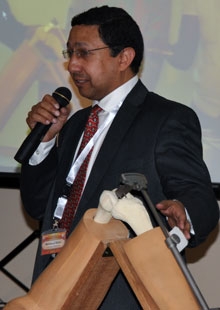
“It is exciting to see patient-specific orthopaedics gaining increased acceptance in the field, ” said Professor Hafez in the September 15, 2011 news release. “ConforMIS is the leader in patient-specific approaches to orthopaedics, not just in instruments but in the actual implant design. I am excited by the opportunity to work on new enhancements to their image-to-implant technology.”
Professor Hafez has been widely recognized for his expertise in the design and application of individual templates for orthopedics and in computer assisted orthopedic surgery. He has served as faculty at international orthopedic conferences including SICOT, ISTA, AAOS, and CAOS International. He is also the author of numerous articles and book chapters on computer-assisted surgery and patient-specific cutting guides for use in knee arthroplasty. In 2010, Professor Hafez won the HAP Paul Award from ISTA for his work on the laboratory validation and clinical application of patient specific instruments for total knee replacement.
“I am extremely pleased that Professor Hafez has joined our Scientific Advisory Board, ” added Philipp Lang, CEO of ConforMIS. “Professor Hafez has a rich base of knowledge and historical expertise in patient-specific systems and we are thrilled that he will be working with us on future applications for our patient-specific implant and instrument technology as well as clinical and scientific studies.”
Philipp Lang told OTW,
Professor Hafez will be reviewing our technology in detail and we will be engaging him in the design of iTotal clinical and scientific studies to help validate the technology.
React:
Discussion
This is a fascinating development. In my practice we've seen similar outcomes with the revised protocol. The key differentiator seems to be patient selection criteria. Has anyone else noticed the correlation with BMI thresholds?
Great point. I'd push back slightly on the conclusion, the sample size in the cited study is too small to draw population-level inferences. That said, the directional signal is compelling and worth a larger RCT.
We implemented a similar approach last year. Early results are promising but we're still gathering 12-month follow-up data. Happy to share our protocol if anyone is interested.
Join the conversation
Orthopedic professionals are discussing this. Sign in and upgrade to read every comment and add your voice.