
As a young Clarence Shields handed out soup at a homeless shelter, he was setting the stage for a lifetime of giving. Unbeknownst to Shields, later named president of the American Orthopaedic Society for Sports Medicine (AOSSM), he would at one point be in a position to do significant good for those around him—especially for children with no resources, but big dreams.
Dr. Clarence Shields
7 min read Premium comments
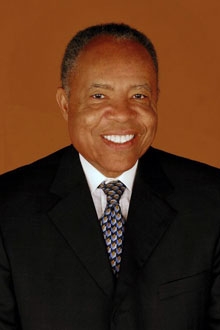
Picture Of Success
Once named “Mr. Sports Medicine” by the AOSSM, Dr. Clarence Shields gives substantial credit to his Jesuit education for putting and keeping him on the right path. “The Jesuits taught me that giving back is a vital part of a full life…and that when you do this good things happen.”
An orthopedic surgeon at the famed Kerlan-Jobe Orthopaedic Clinic in Los Angeles, Dr. Shields spent the first two years of his life in Arkansas, and then moved to Los Angeles with his carpenter father and restaurateur mother. “I did remodeling jobs with my dad and learned to use tools early on. Afterwards, there was always a hot meal waiting for us at my mom’s restaurant. This early exposure to drills, saws, etc. made a big difference in my career…I was even repairing tools and taking things apart by the age of ten. My father finally said, ‘Stop taking things apart, Clarence. They are not broken.’”
Perhaps frustrated then, the elder Shields would have been proud this summer when his manually gifted son was inducted into the Sports Medicine Hall of Fame. “This was an honor that was only enhanced by the fact that I had been the one to induct Drs. Kerlan and Jobe into the Hall of Fame.”
On his road to fame, Dr. Shields has met the mighty and the needy…and gave them all his pinpoint attention and compassion.
A former orthopedic consultant to the Los Angeles Rams, Dr. Shields says, “It’s very exciting to be a young doctor going to games and being exposed to these superbly talented athletes. It gets difficult when you have to leave your regular practice at 5pm, go to the training room for a while, and attend all of the practices and games. The upside is that is it really stimulating. You become closely aligned with the athletic trainers because they are with the athletes on a daily basis. They usually diagnose the problem and you close the loop with an MRI or an operation, etc. Then you ‘return them’ to the trainer. It was pretty different years ago when athletes were not paid very much and they did sports solely for the love of the game. Today, big money is involved, so it is easy to get the impression that some are in it just for that benefit.”

Dr. Shields and the Crenshaw High School Football TeamAs a neutral physician for the National Football League, Dr. Shields was essentially judge and jury when a player was injured. “There are times when the team doctor and manager decide that they don’t want a player to continue on their team. They would file a grievance saying that this person is not ready to play football, and as a neutral physician I would have to evaluate the situation and decide if the person had or had not recovered. As you can imagine, it’s not easy to tell a player that his time is up with a team.”
Years earlier, Dr. Shields’ talent was obvious to two doyens of the field—Drs. Kerlan and Jobe. “I was in my orthopedic residency at Los Angeles County/University of Southern California Medical Center, and in my third year I received the opportunity to do an elective that meant spending time in a physician’s office. Drs. Robert Kerlan and Frank Jobe opened their doors to me—something they had never done for a resident—and then two years later they asked me to join their practice. Their ‘experiment’ with me had gone so well that we put our heads together and started bringing other residents in to spend time with us.”
“It was 1973, the time when there was some inkling that sports medicine might become an official specialty. We were attempting to develop a training program, but there were no guidelines. The biggest challenge was to create a program with a balance of research and clinical experience; this was made more difficult by the fact that there wasn’t the official body of knowledge that we have now for sports medicine. We proceeded by jotting down what we thought made sports medicine different from general orthopedics. Our primary focus was protecting the athletes’ future.”
One of his most famous patients? Jack Youngblood of the Los Angeles Rams. “He broke his ankle during the playoffs, but was determined to play in the Superbowl. He and I sat down and came to the decision that he could play if he could function (he had to be able to push off and run). He played the entire game with a brace on…I was holding my breath!”
Opening a window into his daily practice, Dr. Shields says, “Aside from the many professional athletes I have treated, there are also people involved in some unusual sports…like motorcross. It’s a fast sport and the riders wear little protection. It’s amazing how much they can bounce back from some pretty serious injuries. What most people don’t take into consideration when thinking about professional athletes who get injured is that their bodies are at maximum performance level when they get hurt…that is why they recover so fast.”
Dr. Shields also treats another kind of patient…injured children with a potential for an athletic career. “If I am able to change their future by repairing an injury and keeping them on track for a college scholarship, then that is what it’s all about.”
Such wisdom and talent are what propelled Dr. Shields to the pulpit as head of the AOSSM in 2001. “I was elected to be president…then came 9-11. I did my best to make sure that our society could help in any way possible. I reached out to cities to see what they needed in the way of disaster preparedness; I also created a disaster preparedness taskforce. Many of our members helped out in the wake of 9-11, a role that was perfect for sports medicine specialists because we are accustomed to dealing with trauma in multiple systems.”
Other than his own children, perhaps nothing else makes Dr. Shields beam with pride more than the other “baby” he created…Team HEAL. “Because I grew up in L.A., I know many of the local high school coaches. Several coaches started bringing injured young athletes to see me—kids with no financial resources. I did that sporadically until the Rams left town—then I knew I would have the time to help on a broader scale.”
Dr. Shields used his good standing, and secured space at Rams Park to treat young athletes—along with a full time athletic trainer. “Several patients of mine in the entertainment industry stepped up and held a benefit concert, and we raised enough to develop a training room with rehab equipment at one high school. The next year we held a masquerade ball and as a result we added a second school. After being featured in the Los Angeles Times, a generous group called the Wasserman Foundation phoned and said, “Find a school and we’ll pay for it.”
Dr. Shield’s friends from other fields have gotten on board, and are helping to ensure that the kids have access to internal medicine care, cardiac care, as well as dental and eye care. “One of my most powerful memories is when a coach friend of mine brought a child to me and said, ‘Please fix him. He is in a foster home and has nothing…except a pretty good chance at a college scholarship.’ Years later I got a picture of this young man in his cap and gown.”
And then there is that long ago encounter at the Rams training facility. This, says Dr. Shields, left an indelible mark on his life. “I was doing clinic with the team and there was a young boy who waited until I was done and then approached me. I had treated him just prior to forming Team HEAL, and I knew that his family was having a tough time. He handed me a card that said, ‘One day I will make you proud.’ That is when it struck me that I absolutely had to move forward with creating Team HEAL. The young man did graduate…and made me proud.”
Dr. Shields knows he makes a difference, but he doesn’t let it go to his head. If there is ever any danger of that, he says, all he needs to do is go to the Grand Canyon. “There is no way that someone can sit and see that expansive beauty and think that they themselves are grand…we’re really pretty small.”
Dr. Shields doesn’t stare into the wilderness alone. “We are a camping family. While all of our kids are grown, my wife Barbara and I still get our three children and seven grandkids together at least once a year we just grab some food and pack it in one of our two coolers the yeti vs ozark and go camp. As for other hobbies, I just may go to cooking school when I retire. Right now I am experimenting with key lime pie; so far, my dessert reviews are going very well.”
Dr. Clarence Shields…a surgeon for all.
For more information on Dr. Shields’ foundation, please visit TeamHEAL.org
React:
Discussion
This is a fascinating development. In my practice we've seen similar outcomes with the revised protocol. The key differentiator seems to be patient selection criteria. Has anyone else noticed the correlation with BMI thresholds?
Great point. I'd push back slightly on the conclusion, the sample size in the cited study is too small to draw population-level inferences. That said, the directional signal is compelling and worth a larger RCT.
We implemented a similar approach last year. Early results are promising but we're still gathering 12-month follow-up data. Happy to share our protocol if anyone is interested.
Join the conversation
Orthopedic professionals are discussing this. Sign in and upgrade to read every comment and add your voice.