
Orthopedic surgeons are tough…but even they can get tired of hitting their heads against a brick wall.
Orthopedics in Medical School? ‘Bout Time
6 min read Premium comments
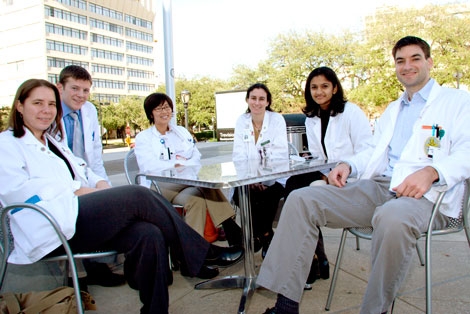
Alas, it’s an old tale of woe for the field…insufficient exposure to musculoskeletal issues in medical school. There have been numerous calls for action, as well as a 2004 National Ambulatory Medical Care Survey indicating that musculoskeletal conditions were the number one reason for visits to physicians’ offices.1 Why has this situation not been addressed? “Politics, ” says our expert, “…some physicians are playing politics with the medical school curriculum.” This orthopedist decided to do something about it.
Our expert is Dr. Charles Day, Associate Professor of Orthopedic Surgery at Harvard Medical School and Chief of Hand and Upper Extremity Surgery at Beth Israel Deaconess Medical Center. Alarmed by the fact that medical students were showing up at the Harvard clinic in their third year with little understanding of what actually causes orthopedic injuries, Dr. Day embarked on a study to examine whether medical students have sufficient skills to handle even routine orthopedic cases.
Dr. Day: “I saw that our medical students had no exposure to orthopedics until they chose it as an elective in their third year. This can be very dangerous for patients. These young doctors ‘hit the wards’ in their third year with no understanding of the pathophysiology of certain diagnoses. They are learning things by rote memory and don’t grasp the underlying mechanisms at play. Let’s say someone comes in with wrist pain and the student doctor orders a brace. What he or she doesn’t know is that there may be a scaphoid fracture, something that has a high rate of avascular necrosis. If the patient is young then all of a sudden this person is doomed to early arthritis in his early 30s because the medical student didn’t understand the pathology.”
Delving into the “back story, ” Dr. Day states, “Our medical school had a musculoskeletal block for 30 years but it was 95% rheumatology. The problem is that most of what doctors are seeing in clinic isn’t rheumatology…it’s run of the mill orthopedics (sprained ankles, carpal tunnel, etc.).”
When he brought his concerns to those in charge, Dr. Day says he received a response that is typical around the country: ‘Well, they do fine.’ Not so much, it turns out. Dr. Day: “We compared the students’ confidence in performing history and physical exams to their confidence in handling pulmonary problems—we found a statistically significant difference. Here is how this might play out clinically: a patient comes in with ‘hip pain, ’ which, many times can be solved with a round of physical therapy (PT) and anti-inflammatory medication. But if you do not know how to look for the underlying issues, you may miss, for example, that there are some lumbar radicular nerves being pinched.”
These young doctors often have a kneejerk reaction to send someone to PT for musculoskeletal pain…but they really don’t know what they are sending them for.
The good news? The student doctors think musculoskeletal medicine is important. Dr. Day says, “We asked 450 Harvard medical students how important musculoskeletal medicine was to their careers (regardless of what specialty they were going into). The majority indicated that on a scale from 1 to 5 with five being ‘most important, ’ musculoskeletal medicine was a ‘4.’ When we asked them to rank musculoskeletal medicine compared to seven other organ systems, it went as follows: number one was cardiology, followed by pulmonary medicine…musculoskeletal medicine was number three.”

When strategizing about how to use this data for change, the savvy Dr. Day knew enough not to sing to the choir. “Most studies demonstrating that there is insufficient attention to the musculoskeletal system in medical school are published in the orthopedic literature. Given that most of the senior leadership in medical schools are not orthopedists, I decided to publish my results in a journal read by most senior medical educators in the country—Academic Medicine.”
Stirring the pot, he was. “I wandered the halls and met with several Harvard Medical School course directors asking, ‘Could I administer this survey to your students?’ This created a buzz about the topic, several senior medical educators got involved, and that led to the creation of a task force that was appointed by the Harvard Medical School curriculum committee. In 2006, this group of orthopedists, rheumatologists, radiologists, anatomists, and primary care physicians all came to the conclusion that there was, in fact, a deficiency in musculoskeletal medicine at Harvard.”
Then, they gave him the keys to the kingdom.
“The task force selected me to be the one to create a four-year musculoskeletal curriculum. I began by focusing on the most common diagnoses that a primary care doctor would encounter…and then I worked backwards to include the pathophysiology and relevant anatomy of those diagnoses.”
“The curriculum includes carpal tunnel syndrome, rotator cuff impingement, among other common conditions. I also cover things that are uncommon but are so serious that you can’t afford to miss them (tumors, infections, compartment syndrome).”
“As part of this curriculum, firstyear medical students at Harvard are exposed to significantly more anatomy than in the past. It used to be that as part of an anatomy course, students dissected either an arm or a leg, but not both. Now, we have increased the orthopedic anatomy dissection time by 40%—and they dissect both an arm and a leg. Also, these students are now exposed to orthopedic surgeons in their lectures; before this program, there were no orthopedic surgeons engaging with them in year one.”
Year two is the heart of the matter, says Dr. Day. “Traditionally, it is year two when students are introduced to the pathophysiology of different organ systems, thus that is where the majority of our additions were. The ‘old’ musculoskeletal course was six days long and 95% rheumatology. Now, rheumatology has four days and orthopedics has four days.”
“There are 20 hours covering the pathophysiology of orthopedics, along with a physical exam course that includes two afternoons dedicated to orthopedic physicals. We spend eight hours on the knee, low back, hand, and shoulder exam; unfortunately, we don’t have time to cover the hip, elbow, ankle, or neck.”
This past January, Dr. Day “went to press” with an assessment of the results of this curriculum. The study, published in the American Journal of Orthopedics, found that medical students at Harvard did in fact report significantly higher levels of clinical confidence in performing orthopedic physical examinations.
If you’re wondering how to get your institution on board with such a program, says Dr. Day, you have to be comfortable with the role of persistent lobbyist.
Getting musculoskeletal medicine into years one and two has been such a big political battle that a lot of people have just given up. Take heart, though…it is possible if you approach things—and people—in the right way.
“First of all, in approaching the Dean you will likely encounter a response along the lines of, ‘Everyone else wants more time for their subspecialty so whose curriculum do you want me to cut?’”
But let’s assume that you’re guided by the principle that the curriculum should be dictated by patient needs. “You can point to the vast array of studies out there, including mine and some great work from Washington University in St. Louis or the University of Pennsylvania. You must first have a clear understanding of the current curriculum at your medical school…don’t be fooled by the name of the course. As we have seen, something called ‘musculoskeletal medicine’ may be nearly all rheumatology.”
“If you find a deficiency then you must prove to medical educators (most of whom are internal medicine doctors) that change is necessary. And, if you are going to go through the evaluation process then you may as well publish the results of your effort.”
Dr. Day continues to lead this charge, expanding his efforts to help other medical schools around the country. “Those at the leadership level of the American Orthopaedic Association are very invested in this movement, and in fact have recently hosted a symposium that was chaired by Dr. Martin Boyer of Washington University in St. Louis. On a Saturday morning at 7am we had over 50 faculty members show up to learn how to bring a musculoskeletal curriculum to their institution.”
“For years orthopedic surgeons have known that our specialty was being left out of medical schools. The overarching problem is that it is rare for orthopedic surgeons to be in senior leadership positions at medical school. I don’t know if that part is going to change any time soon, but in the meantime, we can’t let politics interfere with patient care. We have to lead this charge and get the medical students the education they need to help our patients.”
________________________
1Hing E, Cherry DK, Woodwell DA. National Ambulatory Medical Care Survey: 2004 summary. Adv Data. 2006;(374):1-33.
React:
Discussion
This is a fascinating development. In my practice we've seen similar outcomes with the revised protocol. The key differentiator seems to be patient selection criteria. Has anyone else noticed the correlation with BMI thresholds?
Great point. I'd push back slightly on the conclusion, the sample size in the cited study is too small to draw population-level inferences. That said, the directional signal is compelling and worth a larger RCT.
We implemented a similar approach last year. Early results are promising but we're still gathering 12-month follow-up data. Happy to share our protocol if anyone is interested.
Join the conversation
Orthopedic professionals are discussing this. Sign in and upgrade to read every comment and add your voice.