
Six primary care physicians from Augusta, Georgia, (The Georgia Six) have had enough and aren’t going to take it anymore.
Docs Sue Medicare: Physician Fee Schedule Unconstitutional?
8 min read Premium comments
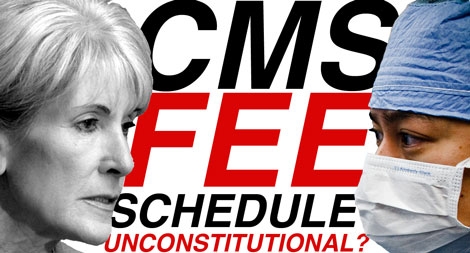
The “it” is the stranglehold the American Medical Association (AMA) has had on determining what the government pays physicians through the Physician Fee Schedule (PFS).
 On August 5, Paul Fischer, M.D. and five colleagues at the Center for Primary Care (CPC) filed a lawsuit against Kathleen Sebelius, the Secretary of the Department of Health and Human Services, for violating a number of federal laws and the U.S. Constitution by relying on the AMA’s Relative Value Scale Update Committee (RUC) in setting physician payments.
His co-plaintiffs include: Robert Clark, D.O. and M.D.s, Leslie Pollard, Edwin Scott, Robert Suykerbuyk and Rebecca Talley.
AMA Escaping Accountability
Their primary complaint is that the AMA’s RUC is serving as a de facto Federal Advisory Committee (FAC) without having to follow federal rules governing such committees. As a result, the AMA’s recommendations to CMS (Centers for Medicare and Medicaid Services) that result in the fee schedule are, among other things, arbitrary, capricious and deny the physicians their Fifth Amendment right to due process.
They are not asking for higher payments, but rather are asking a federal judge to stop CMS from using RUC recommendations until the government complies with the appropriate federals laws and the Constitution.
By not challenging the fees and addressing constitutional and federal statute requirements, the physicians hope to overcome the government’s immunity claim and get to a favorable ruling.
This article is part one of a two-part feature that looks at The Georgia Six’s lawsuit and their allegations. Part two will look at the policy implications of the lawsuit and the fierce political smackdown that has been going on between the AMA and primary physicians.
Allegations
Specifically, the physicians claim that the government is violating the following laws and constitutional clauses:
The Federal Advisory Committee Act (FACA)
The Administrative Procedure Act (APA)
The Patient Protection and Affordable Care Act (ACA)
The Mandamus Act
The Delegation Clause of the Constitution
The Due Process Clause of the Fifth Amendment
The physicians are seeking a declaratory judgment that CMS is violating these statutory and constitutional requirements by utilizing the AMA’s Specialty Society Relative Value Scale Update Committee “as an unchartered and unofficial Federal Advisory Committee that forms the basis of the Physician Fee Schedule (PFS)”
By allowing AMA to serve as a de facto advisory committee, the RUC must, according to the suit, ensure that meetings are open to the public, allow public petitioning, provide public access to the records of the meeting and ensure that the RUC is constituted of members that have a balanced representation of views.
If the RUC was chartered as a Federal Advisory Committee, members would also be required to disclose financial relationships with industry.
The physicians argue that CMS is also failing to ensure that agency’s actions are not arbitrary, capricious, or an abuse of discretion in violation of the physician’s Fifth Amendment’s right of due process.

Paul Fischer, M.D./Courtesy of Dr. FischerIn addition, they say CMS is unconstitutionally sub-delegating duties to the AMA that were delegated to CMS and violating the new health care law (ACA) by failing to ensure the accuracy of the fee schedule.
Dr. Fischer is no lightweight. Beginning his career in Weeping Water, Nebraska, he moved to the Medical College of Georgia where he led the research team that studied the influence of tobacco advertising. That work led to a pivotal study that showed children as young as age five recognized the “Old Joe” Camel cartoon character as well as they did Mickey Mouse. He founded the Center for Primary Care in Augusta in 1993.
Fischer alleges that, due to the government’s alleged violation of federal law, he and his fellow petitioners have been directly harmed in their ability to carry out their professional duties to provide primary care to his patients.
The RUC Story
This story begins 20 years ago when a Harvard professor named Dr. William Hsiao developed a valuation system called the Resource-Based Relative Value Scale (RBRVS). The system was adopted by Congress in 1991.
The suit contends that the AMA’s determination of the value scale is a “regulatory capture” system, where independent regulators side with the interests of the industry they are supposed to regulate rather than with the interests of the general public. CMS, then known as HCFA (Health Care Finance Administration), at the urging of the AMA, utilized the RUC to adopt the value scale.
But the government did not charter the RUC as a Federal Advisory Committee. The AMA, states the suit, provided technical assistance to Dr. Hsiao to draft the first relative value units and then convinced the government to accept the AMA’s recommendations.
The complaint, written by constitutional attorney Kathleen Behan, notes that one of the purposes of FACA was to address the concern that “some interests had come to enjoy unchecked and perhaps illicit access to federal executive decision-making.” FACA imposes requirements on committees that provide advice or recommendations to government agencies.
The law says membership of a FAC must be fairly balanced in terms of the points of view represented and the recommendations cannot be inappropriately influenced by any special interest. The meeting must also be open to the public, allow attendance and input from interested persons and all records must be available for public inspection.
RUC doesn’t do any of those things.
The Committee
The RUC consists of 26 voting members and a chairperson. The AMA only offers voting seats to specialty societies that are associated with the AMA. CMS appoints advisors to the RUC. The AMA has refused to release the names of committee members in the past, but recently made the list public.
Here are the current committee members:
RVS Update Committee (RUC) Members
|
Panelist |
Role/Representing |
From |
On Panel Since | ||
|
Barbara Levy, MD |
Chair, RVS Update Committee |
Federal Way, WA |
2000 | ||
|
Bibb Allen, Jr., MD |
American College of Radiology (ACR) |
Birmingham, AL |
2006 | ||
|
Michael D. Bishop, MD |
American College of Emergency Physicians (ACEP) |
Bloomington, IN |
2003 | ||
|
James Blankenship, MD |
American College of Cardiology (ACC) |
Danville, PA |
2000 | ||
|
Robert Dale Blasier, MD |
American Academy of Orthopaedic Surgeons (AAOS) |
Little Rock, AK |
2008 | ||
|
Joel Bradley, MD |
American Academy of Pediatrics (AAP) |
Brentwood, TN |
2008 | ||
|
Ronald Burd, MD |
American Psychiatric Association (APA) |
Fargo, ND |
2006 | ||
|
William F. Gee, MD |
American Urological Association (AUA) |
Lexington, KY |
2010 | ||
|
John O. Gage, MD |
American College of Surgeons (ACS) |
Pensacola, FL |
1991 | ||
|
David F. Hitzeman, DO |
American Osteopathic Association (AOA) |
Tulsa, OK |
1996 | ||
|
Peter A. Hollmann, MD |
CPT Editorial Panel (AMA/CPT) |
Providence, RI |
2003 | ||
|
Charles F. Koopmann, Jr., MD |
American Academy of Otolaryngology‑Head and Neck Surgery (AAO-HNS) |
Ann Arbor, MI |
1996 | ||
|
Robert Kossmann, MD |
Renal Physicians Association (RPA) |
Santa Fe, NM |
2009 | ||
|
Walter Larimore, MD |
American Academy of Family Physicians (AAFP) |
Colorado Springs, CO |
2009 | ||
|
Brenda Lewis, DO |
American Society of Anesthesiologists (ASA) |
Cleveland, OH |
2009 | ||
|
J. Leonard Lichtenfeld, MD |
American College of Physicians (ACP) |
Atlanta, GA |
1994 | ||
|
Scott Manaker, MD, PhD |
American College of Chest Physicians (ACCP) |
Philadelphia, PA |
2010 | ||
|
Bill Moran, MD |
Practice Expense Review Committee |
Oklahoma City, OK |
2000 | ||
|
Guy Orangio, MD |
American Society of Colon & Rectal Surgeons (ASCRS) |
Atlanta, GA |
2009 | ||
|
* Gregory Przybylski, MD |
American Association of Neurological Surgeons (AANS) |
Edison, NJ |
2001 | ||
|
Marc Raphaelson, MD |
American Academy of Neurology (AAN) |
Leesburg, VA |
2009 | ||
|
Sandra Reed, MD |
American College of Obstetricians and Gynecologists (ACOG) |
Thomasville, GA |
2009 | ||
|
Daniel Mark Siegel, MD |
American Academy of Dermatology (AAD) |
Brooklyn, NY |
2003 | ||
|
Lloyd S. Smith, DPM |
Health Care Professionals Advisory Committee |
Bethesda, MD |
2007 | ||
|
Peter Smith, MD |
Society of Thoracic Surgeons (STS) |
Durham, NC |
2006 | ||
|
Susan Spires, MD |
College of American Pathologists (CAP) |
Lexington, KY |
2007 | ||
|
Arthur Traugott, MD |
American Medical Association (AMA) |
Champaign, IL |
2006 | ||
|
James Waldorf, MD |
American Society of Plastic Surgeons (ASPS) |
Jacksonville, FL |
2008 | ||
|
George Williams, MD |
American Academy of Ophthalmology (AAO) |
Royal Oak, MI |
2009 | ||
*Editor’s Note: Greg Przybylski, M.D., is also president of the North American Spine Society
Source: http://replacetheruc.org/
Secret Voting
What happens during a RUC proceeding is secret. Votes are typically taken by electronic ballot, and members are not informed of how other members voted. Meeting minutes are not released to the public. And all RUC members and observers agree to a confidentiality pledge that they will not disseminate documents or discussions from the meetings.
AMA: Public Service and Profits
The AMA says it is doing the government a service and spends up to $6 million a year for the proceedings. However, the suit says, AMA benefits from the RUC since CMS has given the AMA the right to publish the code sets that result from the valuation by the RUC and the AMA CPT Editorial Panel. The AMA obtains profits of approximately $56 million in copyright royalties each year.
AMA’s website lists 116 national medical specialty societies that have representation in the AMA’s House of Delegates, but only 23 have a voting membership on the RUC. Three members hold “rotating seats.” The rotating seats have been held by 11 different specialty societies since 1991.
Industry Ties
The suit says there are significant financial ties between industry and RUC members as companies have compensated RUC members for consulting and other services. This creates potential financial conflicts because companies have direct interests in the outcomes of the RUC decisions. The AMA claims to have no responsibility to disclose conflicts, as would members of an official federal advisory board.
The lawsuit lists a number of “criminal matters” and settlements involving companies with ties to physicians on RUC.
Former CMS Administrator Thomas Scully has publicly stated that the RUC system is “indefensible” and that “it’s not healthy to have the interested party essentially driving the decision-making process.”
Specialty Bias
The composition of the RUC is highly biased towards procedural specialties and particularly surgical specialties, say the physicians. Only two seats actually represent primary care. The cognitive medical disciplines, those involving complex tasks of evaluation, discernment, medical management, and comprehensive patient care, are drastically underrepresented on the RUC, and this process results in direct harm to their ability to obtain the valuations to which their services are entitled.
The process is perversely incentivizing physicians to enter higher paying procedural specialties.
Dr. Hsiao has publicly distanced himself from the process, noting that the RUC’s use of specialty survey data was “almost guaranteed to inflate values.”
Primary Care and Specialist Disparity
The physicians contend that CMS has relied on the RUC to set physician payments for primary care, “despite 20 years of the RUC’s failures to adequately address the disparity between payments and reimbursement to primary care physicians as opposed to specialists. They say CMS has virtually uniformly adopted RUC recommendations.
Since 1991, the RUC has submitted more than 7, 000 recommendations to CMS. The agency has overwhelmingly “rubber-stamped” RUC recommendations, accepting more than 94%, according to AMA numbers cited in the suit.
Validating Values
The new health care law requires the government to establish a process to “validate relative value units under the fee schedule, ” and identify misvalued codes in the fee schedule. The new law also requires an increase of Medicaid payments to primary care physician payments to the “same level as current Medicare primary care physician payments.”
Without complying with the new law, the physicians say millions of new Medicaid patients will be left without primary care physicians and will be forced to seek the subpar and overly expensive care available to them in emergency departments.
The government has not responded to the lawsuit. In part two of this series we’ll look at the straw that broke the camel’s back and brought this issue to the courts.
Author
React:
Discussion
This is a fascinating development. In my practice we've seen similar outcomes with the revised protocol. The key differentiator seems to be patient selection criteria. Has anyone else noticed the correlation with BMI thresholds?
Great point. I'd push back slightly on the conclusion, the sample size in the cited study is too small to draw population-level inferences. That said, the directional signal is compelling and worth a larger RCT.
We implemented a similar approach last year. Early results are promising but we're still gathering 12-month follow-up data. Happy to share our protocol if anyone is interested.
Join the conversation
Orthopedic professionals are discussing this. Sign in and upgrade to read every comment and add your voice.