
“You can’t imagine what you don’t see, ” says Dr. Claudia Thomas, the first Black female orthopedic surgeon in the United States. Think about that. If in your youth you saw no one in your immediate environment who had achieved some measure of success, how would you even begin to think that there were options open to you? Combine that with the pressures of “the street” and it’s clear that many of today’s young people have little hope of exploring their full potential.
The Carver Boys: Going Somewhere
7 min read Premium comments
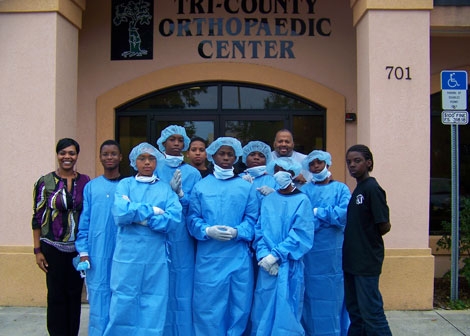
I have had the pleasure of interviewing roughly 400 orthopedic surgeons in the past six years. There is not one who achieved success without having had someone who believed in them and stuck with them. Perhaps it was a physician—someone in the family or someone who fixed your leg—but more often it was another type of respected individual who coached you to focus on your studies, grab hold of a goal, and not let go.
Dr. Thomas, winner of the 2008 Diversity Award from the American Academy of Orthopaedic Surgeons (AAOS), grabbed hold of a challenge several years ago and isn’t letting go anytime soon. Dr. Thomas sits on the board of the J. Robert Gladden Orthopaedic Society (JRGOS), a group whose mission is to increase diversity in the field. She states, “In 2007 my colleagues and I on the JRGOS Board were discussing the educational pipeline for African Americans, and came to the conclusion that it was especially difficult for males. We saw that the number of African American males in medical school had decreased. But especially alarming was that they weren’t just dropping out of school, they seemed to be dropping out of life.”
As she reflected on this, Dr. Thomas knew that each day when she opened her private practice and looked forward to rewarding experiences, not far off there were young children who started their days with a slim chance of having their days—or their lives—turn out well. “We saw that it was at the middle school level that we were losing African American males to the streets and to the penal system. When the Gladden Society suggested that its members mentor a group of middle schoolers I couldn’t not get involved.”
Dr. Thomas took this message back to her partners, who were equally enthused about the chance to alter the trajectory of young lives. “My four partners are all African American males. One of them, Dr. Isaac Mitchell, is originally from Compton, California—gangland—and was particularly taken with the idea of helping young boys create a path that leads away from ‘the streets.’ He identified the school, Carver Middle School in Leesburg, Florida, and set things in motion.”
“Talented, but at risk.” That was the specific type of child with whom they thought they could succeed. Dr. Thomas says, “The principal of Carver identified 30 African American boys in grades 6-9 who had potential but were not of such excellence that it was a given that they would go on to greatness. In the fall of 2007 my four partners and I had our first meeting with the students and delivered a strong message that we were successful and that they had a better chance of being like us than being like ‘Mike.’”

Students on the Zimmer bus.With the “know your audience” rule in mind, the organized Dr. Mitchell had already learned a bit about the boys before that first meeting. Dr. Thomas says,
Dr. Mitchell had sent the students a questionnaire asking things such as, ‘What do you think you will be when you grow up?’ (most said ‘rap star’ or ‘professional athlete’). We could see that our job was to give them some perspective and be very frank that, ‘Hey, that is not going to happen.’
Knowing that they needed concrete, live examples of what happens in the real world, Dr. Thomas and her colleagues pulled in others who have ‘walked the walk.’ “It’s difficult to tell a 12 year old that he should banish his dreams of becoming a football star. So one of my partners, Dr. Kerina came in and told them, ‘My son made it all the way to the draft pick and then was cut for no apparent reason. This kind of thing happens all of the time. It is better to set your sights on being a different kind of professional.’
“Last year I brought in my neighbor, an African American gentleman who had played with the New York Giants and the New England Patriots. The children were surprised to hear that he was now head of the FBI for Central Florida. As he passed around his badge he continued with the message of, ‘Sports is not a given for anyone, and it’s not forever.’ The boys were in awe of him.”

Dr. Thomas with a student on the Zimmer bus.Then it was time for the students to get a hands-on sense of how Dr. Thomas and her colleagues spend their days…and how they might follow in their footsteps. “Zimmer brought its mobile OR to the school, and the kids had a chance to use saws and perform mock surgery. Their expressions as they sawed through the artificial bones were amazing, as in, ‘Hey, look what I did!’ Their little faces just lit up.”
A local hospital also opened its doors to the curious youngsters. Dr. Thomas notes, “That day, the students got to do mock arthroscopy where they used the arthroscope inside of an artificial knee. They looked at the monitor and saw how their hands were directing the arthroscope and the cutting instrument. I told them, ‘This is better than any video game you’ve ever played.’”
Then these successful professionals took the students somewhere in the hopes that they would never return. “My partners took the boys to a local prison. These kids often romanticize prison, and many of them walked in with a street swagger. But after witnessing the ugly reality, and having horrible comments directed at them, they were looking over their shoulders as they hurried out of the prison later on.”
Let’s bring in the perspective of Dr. Isaac Mitchell. “I always knew that this program would be important, but at first I thought that it would be very painful to see children who were growing up much like I did—limited financial resources, tough neighborhood, etc. Now I am thrilled and gratified to see that they are so proud when they do something well. And it is truly heartening to see their faces light up when they are exposed to things that many of us with money take for granted. This may be going to a pro sports game with great seats, or going to a restaurant and ordering whatever you want without studying the prices at length.
“Probably the best single experience to date was taking these boys to a Magic/Lakers game. We went to dinner, then headed to the arena, where we had incredible seats. At the game they were screaming so much and in such high pitches…the principal said that they were bragging about it for weeks.”
So is it working? Are these tireless mentors “getting through” to the Carver boys? Dr. Mitchell: “Some of them really seem to ‘get it, ’ i.e., no grades=no opportunities. We attempt to instill a sense of pride in them, in part by ensuring that the rewards they receive are publicly presented. That way, they get to show everyone how ‘cool’ it is to be smart.”
Dr. Thomas, known for her loving toughness, adds, “The boys’ grade point average has gone from 2.2 to 2.9 over the last four years. We have established a message that Cs are unacceptable and Bs mean that you didn’t try. When the boys get As they are rewarded with tickets to professional basketball or baseball games, as well as gift certificates.”
And those who get a D grade? “We call their parents and try to impress upon them the importance of taking this opportunity for us to all be on the same page for their child. We even offer to buy the child’s video games so that they won’t have that as a distraction.”
Someone else who is working to open windows in the children’s minds—and keep them open—is A. Denise Kinsey, the Achievement Liaison at Carver Middle School. Commenting on the value of this program, Kinsey states, “The majority of the participants did not know or had never met a Black doctor. With this program, the children interact personally with the doctors, and have even visited the physicians’ homes. The majority of the participants are from single family households headed by women. Aside from introducing the boys to the outstanding Dr. Thomas, this program has given the students several positive Black male role models.”
Kinsey has seen a number of concrete and promising changes in the boys during this program.
Not only did the students’ grades improve, but so did their behavior and attendance. By being challenged and monitored by these doctors, the students have become more goal oriented and aware of what they need to do in order to excel. We now have students who are aspiring to be doctors, and seem to truly understand that this can be a reality for them.
The lessons are vast and timeless. Helping others makes for a better society overall. Kinsey says, “The students have learned the real meaning of the saying, ‘I am my brother’s keeper.’ They have bonded and realize that they too must give back. Several are now Peer Tutors, and volunteer their time to tutor students who need additional extra help.”
Dr. Thomas challenges her orthopedic peers, saying, “This is our responsibility…this is your responsibility. We cannot abandon these children who are left without fathers, without role models, and without hope.”
Dr. Mitchell:
This program is low cost/high reward. We must all remember how we got where we are now…someone somewhere helped us. Now we must carry the torch.
Note: The Carver Middle School students will be touring a Zimmer plant in August 2011. Stay tuned to learn how their trip turns out!
React:
Discussion
This is a fascinating development. In my practice we've seen similar outcomes with the revised protocol. The key differentiator seems to be patient selection criteria. Has anyone else noticed the correlation with BMI thresholds?
Great point. I'd push back slightly on the conclusion, the sample size in the cited study is too small to draw population-level inferences. That said, the directional signal is compelling and worth a larger RCT.
We implemented a similar approach last year. Early results are promising but we're still gathering 12-month follow-up data. Happy to share our protocol if anyone is interested.
Join the conversation
Orthopedic professionals are discussing this. Sign in and upgrade to read every comment and add your voice.