
Ask most spine surgeons how their profession will advance, and they will talk about the commitment to gathering the best available evidence, to using the scientific method and then applying a double-blind, randomized controlled trial to the problem. But then there are those cases where you don’t need to do a study…you just know.
Dr. Dennis Devito
7 min read Premium comments
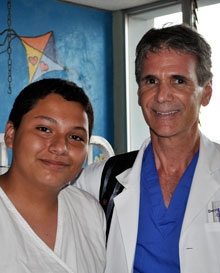
Picture Of Success
For Dr. Dennis Devito that moment came in the form of an 11-year-old girl from El Salvador in the summer of 1996. Unfortunately, there was no gray area, no uncertainty and as the young girl with her twisted spine looked into the eyes of Dr. Dennis Devito she did not find hope. Dr. Devito, a pediatric orthopedic surgeon at Children’s Healthcare of Atlanta at Scottish Rite, is a recognized expert on scoliosis…but despite his capabilities there was nothing he could do. “I was incredibly frustrated and saddened, ” says Dr. Devito.
Modern spine surgery can trace its roots to a similar moment for Dr. Paul Harrington in the 1950s, a frustration which was the impetus behind the Harrington rod for treating spinal deformities. Despite 50 years of dazzling progress, the room for error in complex spine scoliosis surgery—as in the case of Dr. Devito’s 11-year-old patient, remains infinitesimally low.
Scoliosis surgery is difficult to teach. Getting the angles right is tricky. Surgeons have to master both the axial and compressive forces and anticipate where instrumentation may ultimately deliver symmetry as the child grows.
The question facing every scoliosis surgeon is: can I see all the dimensions of this case now and for the next decade? We’re talking 4D vision.
Looking at problems multi-dimensionally is something Dr. Devito started developing even before medical school. “My mother was a Renaissance woman…an artist, a writer, and a teacher. One summer in middle school I took an art class and decided that I would try working in stone. My mom took me to a local quarry and I became fixated on a certain stone. I began to envision it as a woman’s head, and developed ideas about how to ‘bring it to life.’”
It was his early days of creating, and following the flow of stone that laid the foundations for Dr. Devito’s understanding of art, symmetry, and balance. “Doing scoliosis surgery on children means that I am taking something deformed and envisioning how to change it, i.e., using a sense of artistry to help decide how to make the patient’s spine look a certain way.”
My background in art helps me line things up; you are looking at a uni-dimensional image but you must understand it as 3D object. This is normal for me now, and I don’t get upset if I go into a case where things are unclear and you have to go with flow. I actually thrive on that because I know that it means that my mind is free to be creative.
That is, if the window for treatment is open far enough. In the case of the 11-year-old girl from El Salvador, the window for surgery had shut. What was needed was a new kind of tool—something to make near perfection almost routine. Something that could, in other words, open up surgery for the more afflicted patients. “Four years ago I was approached by a robotics company that wanted me to help them develop or apply their system for scoliosis surgery to children. My challenge to them was, ‘Let’s make something that provides better outcomes than I can get without such a program.’ I worked with their engineers and software people over many sessions until we made it happen.”
And make it happen he did. In a study that included 120 scoliosis patients and 2, 000 pedicle screw placements, Dr. Devito demonstrated that with robotic assistance, a scoliosis surgeon could get results that are an order of magnitude better.
Dr. Devito:
The existing literature showed that even the best studies were saddled with a 10% misplaced screw rate. I am extremely proud to say that ours was a mere 0.3% (but even those did not involve complications).
“When I recently presented these results at a national meeting there were hardly any comments. People just said, ‘Well, you can’t argue with 99.7% accuracy.’”

Dr. Devito in examining young patientWhile this precision is not at the expense of OR time, it is—in a budgetary sense—costly. First, the good news: “Robotic assisted surgery is a reliable, safe, and accurate procedure that can produce better outcomes and make an institution more attractive to patients. And it saves time as well. Pedicle screw placement is the most difficult part of scoliosis surgery, and you really have an unknown element when there is a small deformed pedicle involved. And, because of the challenging anatomy, it can sometimes take over 20 minutes to get this right. With robotics it is more routine and can be done in less than three minutes.”
The price of precision can be high. Dr. Devito says, “The technology can run an institution between $500, 000 and one million dollars. Can a facility survive without it? Yes. But I go back to the old saying that it only takes one poorly placed screw to make you wish that you had had something to prevent that. I don’t know how you put a price on that.”
Indeed, the price is too high for many of Dr. Devito’s patients. But they do have the benefit of his unusual spatial abilities. “One day, after that experience of not being able to help that little girl, the mission team coordinator showed up at my door and said, ‘Everyone has backed out of the next trip to El Salvador. Will you please come?’ I said ‘yes’ immediately. What I saw there was more severe pathology than I had ever encountered, coupled with a paucity of resources. They do not have a lot of the special equipment necessary to perform these surgeries, so I bring everything…including my 3D instinct.”
Also accompanying Dr. Devito on his now regular trips to El Salvador are some residents and fellows who have to set aside what they are accustomed to and learn something else…they must learn to trust their own hands and eyes. “The younger surgeons often ‘squawk’ because we don’t have the equipment that we are used to. They have not learned about—and are not comfortable with—using their innate abilities to assess 3D and spatial issues. They are not comfortable when there is no set plan, and sometimes they get upset—never a good thing in the OR. I tell them, ‘This is what real surgery is like and you get to learn it here.’”
“For example, say we have to realign a hip and must cut the bone, turn it, and point it toward the hip socket. In the U.S. we would bring in the fluoroscope, make the adjustments, realign things, put in the plates and screws, and take another image. That is not readily available in El Salvador. The trainees must learn to stick their finger in there, conceptualize the angle they just made, and implant the plates and screws by tapping and feeling the depth.”
Dr. Devito is also ensuring that his orthopedic colleagues in El Salvador have the capacity to help their own people. “My initial mission was that within five years I would have taught the surgeons there how to do spine surgery. This was partially successful but the instrument and implant technology is just too expensive for their medical system. This is especially true because while they are capable surgeons who learn fast, the cases they are doing are not routine…they are ‘off the wall’ difficult. So I altered my mission, and began focusing on teaching the orthopedists there to recognize scoliosis early on, i.e., before it gets severe.”
Citing his attention to detail as a reason for his success, Dr. Devito states, “Take patient contact as an example—literally, contact. Physicians don’t seem to touch patients as much anymore, and instead are often tempted to derive their answers from various tests. I’m not just bemoaning the loss of patient/doctor connection…there is a practical, clinical side to this as well. For example, the beauty of treating children is that while they can’t always tell you what is happening with them, if you rely on your hands and others senses you can feel any stiffness, and/or tightness or resistance to movement that might indicate a painful area. Whether working in the U.S. or El Salvador, that diligence and attention to detail has given me an edge and makes me a much better physician.”
And then sometimes, doctors have other reasons not to touch patients. “When I first went to El Salvador someone said, ‘Just so you know, these kids don’t live in the most sanitary conditions.’ The first thing I did when I arrived at the clinic was give each child a big hug. They were thrilled…they could feel that I’m gentle and was going to do my best to help them.”
Patient care is unquestionably the center of Dr. Devito’s career life. “I began in academic medicine at Vanderbilt, but was dismayed to find that the academic life wasn’t what I was looking for. I altered course, and dedicated myself to being the best practitioner I could be. My biggest legacy is having trained a number of talented surgeons, and I’m glad to say that I still get calls from former fellows who have questions about tough cases.”
This legacy is based on not being a “one man show.” Dr. Devito states, “Years ago I realized that the fact that I had skills meant that I was here for a purpose. As a surgeon you do the pedigree thing, building your career and focusing on yourself. I came to see that it’s not about me…I have to use my energy to give what I have. I can do nothing better than to pass on my knowledge to future generations.”
His next generation involves four children and two grandchildren. “And there’s my wife, ” says Dr. Devito, “who is my biggest supporter, and says I have ‘too much energy.’ This is likely because I did Ironman competitions for 18 years. I enjoy pushing myself to the limit; I mainly do a lot of bike riding now, something that makes it easier to stand in the OR all day.”
Dr. Dennis Devito…multi-dimensional innovator, teacher and humanitarian.
React:
Discussion
This is a fascinating development. In my practice we've seen similar outcomes with the revised protocol. The key differentiator seems to be patient selection criteria. Has anyone else noticed the correlation with BMI thresholds?
Great point. I'd push back slightly on the conclusion, the sample size in the cited study is too small to draw population-level inferences. That said, the directional signal is compelling and worth a larger RCT.
We implemented a similar approach last year. Early results are promising but we're still gathering 12-month follow-up data. Happy to share our protocol if anyone is interested.
Join the conversation
Orthopedic professionals are discussing this. Sign in and upgrade to read every comment and add your voice.