
There are many opportunities to do business abroad. There are even more opportunities to get it wrong. Bonovo Orthopedics, Inc., is taking the time to discover the secrets of getting it right.
One Ortho Entrepreneur’s China Venture – Part II
6 min read Premium comments
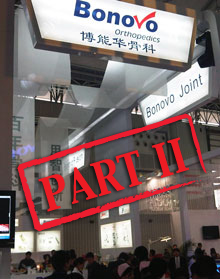
Picture Of Success
What is the secret? According to Peter Slate, CEO of this burgeoning company, “There are no quick fixes. Making a business successful in China requires a strong local Chinese team that buys into a company’s goals, and intimately understands the unique aspects of the Chinese business environment. It must be built over time.”
Is it worth the effort? According to Slate,
China will be the fastest growing economy over the next 50 years. Companies that wish to be global leaders and fail to implement a strong China strategy run a great risk of losing their competitiveness.
You’ve probably never heard of the Louisiana cookbook named, “Who’s Your Momma, Are You Catholic, and Can You Make a Roux?” The sentiment behind the title applies equally as well to China, namely, “Why should I trust you?” and “Is there a connection here?” Peter Slate knows that to go beyond the stereotypical way of doing business abroad—flying in for a few days, having an “appetizer” with the Chinese orthopedic world, and leaving—is a recipe for failure. Slate says, “China seems like a large country with a strong central government that efficiently dictates national policy. But more accurate is that China is a group of provinces with differing competitive needs. The economy is decentralized, and business relationships in one province don’t necessarily help you in another. As a result, to do business throughout the country you must have relationships throughout the country.”

Hall of Prayer for Good Harvest – China. Source: Charlie fong/Wikimedia Commons
With oceans of potential misunderstandings between East and West, says Slate, it is vital to understand Chinese culture. “In the East, business relationships take longer to build than in the West, where the code of conduct is more along the lines of, ‘Let’s get down to business.’ Chinese companies place more of a premium on getting to know a partner before the discussion of pricing or products takes place. This can be frustrating for many Western partners. It can be wrongfully viewed as a lack of willingness to do business.”
Communication is hard enough between native English speakers that share the same culture. When it’s a different country with a very different language, things can get interesting. “It is important to realize that communication is not only complicated by the obvious differences between English and Chinese, it is compounded by the multiple dialects and phrasing in China. It is safe to say that your American football metaphors will not be as effective in China as they are in the U.S.”
And to be effective, you have to know what works and what doesn’t. When asked to provide some basic tips for a Westerner attending a business dinner in China, Slate advises, “While in the U.S. it may be fair game for a guest to make a first toast, in China, that honor is strictly reserved for the host. That said, if the guest doesn’t make a personal toast to the host during the meal it may be perceived as disrespectful. When toasting someone to whom you are showing great reverence, you should hold the lip of your glass just below theirs. Also, if someone begins to eat before the host it can be considered bad form. Time and again I have seen that Westerners who take the time to learn these things are viewed very positively.”
Slate notes that there are many aspects of the Chinese business opportunity that are hard to see from the outside looking in. “The buying power in China can be disproportionate to the level of spending. While the high savings rate in China is well documented, the high number of cars on the road as compared to the low average income in China illustrates how powerful this buying power can be when it is unlocked. While China’s emerging middle class is small as compared to its overall population, it is larger than many countries and will soon surpass the total population of the United States.”
Where is Slate betting that the Chinese population will spend their money? “Despite cultural differences between the East and the West, everyone wants what is best for their families…this includes quality healthcare.”
Bonovo places a premium on cultural expertise within its corporate framework. Slate notes, “Chip Bao, Ph.D., is the head of Bonovo Asia, and is the former Chief Technology Officer for Pioneer Surgical Technology. He has risen to the highest levels within Western organizations and understands Chinese business culture. Based in Beijing, Dr. Bao is able to overcome business and cultural hurdles ‘on the ground.’ He has truly brought an eye toward branding to Bonovo’s Chinese business that is driving sales growth.”
Cultural difference also come into play when setting employee expectations. “In Western culture, consensus building within an organization is a priority. Chinese companies are more often led from the top down, and the desire to build consensus can sometimes be seen as weakness. It may trigger responses like, ‘Why is he asking me?…Doesn’t he know what we should do?’ As a result, to be successful in building a team, your management style may need to be modified a bit.”
So what has Slate found to be the inner workings of the Chinese orthopedic world…and where can Westerners effect change? “In the U.S. we have addressed many of the challenges that China is facing today, meaning that ideally we can be of some help regarding certain pitfalls. In the U.S., privatization and managed care have forced a level of expertise in hospital management that is very different from other parts of the world. Even our public hospitals must be run with a clear view toward ‘profitability.’ This kind of hospital management expertise in the U.S. has taken years to build and can bring a lot to the Chinese healthcare market. ”
Using his laser focus, Slate has homed in on a certain type of hospital in China—those with the highest prospects for growth. “We focus on top provincial hospitals that set the standard of care for the region and where we see strong positive trends in procedures volume. As the healthcare system grows, this is where the lion’s share of the procedure volume will be. There is a bidding process in China that requires Bonovo to have strong regional relationships through multiple distributors. This bidding process occurs every 12 to 24 months across China; if we miss a bid then we are not selling in that region until the next bid. The bids set the maximum price and then we negotiate the final price with the individual hospital. This all means that you must be as effective at bidding as you are at developing great products. We spend significant resources on bidding…and it’s always a mad rush of activity to prepare for the bids.”
Macro-level changes now in play mean that the Chinese orthopedic market will only continue to mature. “We are seeing changes in clinical requirements and government reimbursement. Also, the market dynamics are changing such that there are more domestic products of good quality and more investment by large multinational players. The phrase, ‘A rising tide raises all boats’ comes to mind. Large companies investing in the market and working with the government to change materials and product approval standards improve the market for all players. The Bonovo team works closely with our U.S. distribution partners, Pioneer Surgical, NuVasive and Elliquence, to push the regulatory agenda forward.”
When asked to reflect on some things that may get in the way of progress, Slate notes, “The payer system is critical. Despite the growing middle class in China, growth of government reimbursement and private insurance to pay for products is critical. Something else that we keep our eyes on is the privatization of hospitals in China. Private hospitals can make purchases faster, and are beginning to push new and innovative products into the marketplace.”
And five years from now? “I want Bonovo to be a globally competitive healthcare company that is based in China. We have tried to create a seaworthy vessel on which we can put different types of cargo. The infrastructure is scalable such that in five years everything will have grown.”
Peter Slate and Bonovo…altering the landscape of a nation’s healthcare.
React:
Discussion
This is a fascinating development. In my practice we've seen similar outcomes with the revised protocol. The key differentiator seems to be patient selection criteria. Has anyone else noticed the correlation with BMI thresholds?
Great point. I'd push back slightly on the conclusion, the sample size in the cited study is too small to draw population-level inferences. That said, the directional signal is compelling and worth a larger RCT.
We implemented a similar approach last year. Early results are promising but we're still gathering 12-month follow-up data. Happy to share our protocol if anyone is interested.
Join the conversation
Orthopedic professionals are discussing this. Sign in and upgrade to read every comment and add your voice.