
Today, learn about Dr. George Bagby’s contributions to veterinary science, his work with the Prosthetics Outreach Foundation, and his work abroad.
Dr. George Bagby – Part II
5 min read Premium comments
Picture Of Success
In 1930s Minnesota a young boy named George Bagby accompanied his stepfather on house—actually—stable—calls. George’s stepfather, a veterinarian, laid the groundwork for George’s interest in caring for animals. But then Germany invaded Poland. Dr. George Bagby, who went on to become a notable orthopedist, recalls, “Although I was interested in the veterinary field, thoughts of World War II changed me to thinking that caring for humans would be of greater use to the world.”
From the time he cropped a dog’s tail at the age of 16, George Bagby has been eager to learn about the science and the art of medicine. Years into his career as an orthopedist—and not forgetting his equine roots—Dr. Bagby heard of a serious condition in horses that he thought he could solve. “In speaking to veterinary friends at Washington State University (WSU) I heard about wobbler’s syndrome, a condition where the cervical spine encroaches on the spinal cord. I was disturbed to learn that horses afflicted with this problem were most often euthanized.”
Working with the WSU team, Dr. Bagby performed an experimental surgery on a number of hooved patients. “Basically, I was taking a surgery done in humans—the Cloward procedure for fusions (arthrodesis) and adapting it for horses. Using instrumentation that I had utilized on my patients, I drilled a hole between two vertebrae and then filled it with the bone dowel. We had some great initial success and the WSU veterinary staff has gone on to perfect my techniques. A number of the horses that would have otherwise been killed have gone on to great success in the racing arena.”

And what of Seattle Slew? In 2000 the much-loved Triple Crown Winner was grazing in Kentucky pastures, but was struggling to walk. Enter Dr. Barrie Grant of WSU and his talented sidekick, Dr. Bagby. “Seattle Slew was nearly walking sideways and we could see that his vertebrae were putting pressure on his spinal cord. We implanted a variation of the Bagby Bone Basket (BBB), which is a hollow cylinder meant to fuse the cervical interbody spaces of horses like Slew. This implant cylinder goes into place with the disc in the center and peninsulas of living bone in the edge of the vertebrae.”
“The peninsulas of bone act like living bone grafts in contrast to the BBB which has a non living bone graft. This is now referred to in the veterinary field as the Seattle Slew Implant. It was a success and he went on to sire many colts following surgery.”
Indeed, it was Dr. Bagby who pioneered the modern stainless steel cage.
In 1984 I presented my equine work to the North American Spine Society (NASS), and from that I began a working relationship with Dr. Stephen Kuslich, a spine surgeon from Minneapolis. He and I developed what came to be known as the BAK Cage, a threaded, hollow, titanium cylinder that was meant for use in human patients.
In 1987 Drs. Bagby and Kuslich presented their data at the NASS meeting in Banff, Alberta, British Columbia. Dr. Bagy: “We received strong acceptance and because of Dr. Kuslich’s leadership we were able to form a new company, Spine-Tech.”
Dr. Bagby is proud of his work on the Seattle Slew Implant. “A cut is made that maintains the living bone as peninsulas that act as living bone grafts inside the cylinder. This is basically an advancement of my original bone basket; instead of being like a basket with caps closures up front and on the other end, it is a totally open, smooth cylinder. To be clear, I have retained the rights for the veterinary, not the human, application. I originally patented the U.S. rights for both humans and animals; only the rights for human application were sold to a spine company.”
Sometimes Dr. Bagby is a world away from patents and paperwork. Having worked in lesser developed countries for a number of years, he is deeply concerned about the prohibitive costs of musculoskeletal care for those who have so little. “Working with a spine surgeon, Dr. Ted Wagner, as well as a biomechanical engineer, Dan Baker, Ph.D., I have developed an inexpensive implant for fracture fixation called Wire Rod Triangulation (WRT), and have recently introduced it in Bangladesh. The surgeon uses the wire and rod material to cut and thereby have the implant take the place of a plate and six or more screws. And it is significantly less expensive: $270 for a six hole plate and screws as opposed to $2 for the wire and rod material. This has huge implications for helping so many more people than we previously could. The results from the surgeries to date have been encouraging and we will continue to monitor how well the patients are healing.”
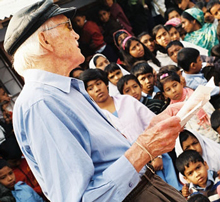
Dedicated to helping the patients of Bangladesh long term, Dr. Bagby provided the initial funds to create the building for a rural hospital. “Dr. Ruhal Haque, now the Minister of Health, provided the land for the Nalta Hospital, and I had the honor of placing the cornerstone for the building in 1999.”

And the building and the good works that go on inside it will continue, thanks in part to the Bagby Family Endowment Fund…and a donation by Dr. Bagby of $250, 000. “These monies seeded our endowment fund, which is meant to help provide medical services to impoverished children and adults through the Nalta Hospital. The hospital partners with the Prosthetics Outreach Foundation (POF), a Seattle-based entity that has several programs around the world to help those with limb loss or limb deformities. Since 2000, working together we have provided prosthetic and orthotic care to approximately 15 million people in Bangladesh. And unlike many under-resourced places around the globe, we actually have a Physical Rehabilitation Center at the Nalta Hospital, which offers many different types of assistance. One thing they do is assist patients with lower extremity prostheses; they also assist patients postoperatively with the Ponseti technique, a conservative treatment for children born with clubfeet.”
Dr. Bagby, a former POF Board member, states, “People in Bangladesh are at risk for musculoskeletal injuries to a large extent because of roads that are extremely crowded with trucks, buses, and cars that compete for space with ox-drawn wagons, rickshaws, and pedestrians. Traffic accidents are very common, resulting in numerous deaths and amputations. Infections are a routine issue…and with antibiotics being hard to get, amputations are often the only option. One of the most common causes of paralysis is workers who repeatedly carry heavy loads—sometimes around 100 pounds—on their heads. How much they carry is often determined by a supervisor, and there are no legal restrictions of the weight that they can carry.”
Someone involved in such serious work might be rather somber. Not the lively Dr. Bagby. A past skier who now enjoys his evenings with a banjo, Dr. Bagby is anything but dry. “I also love to sing to myself in the car—often silly ditties. I also take great pleasure in sharing my work with my four granddaughters. And I’m extremely proud of my granddaughter, Cali Bagby, who has been an embedded journalist in both Iraq and Afghanistan.”
Dr. George Bagby…seeing what is, and what could be…and growing strong patients worldwide.
React:
Discussion
This is a fascinating development. In my practice we've seen similar outcomes with the revised protocol. The key differentiator seems to be patient selection criteria. Has anyone else noticed the correlation with BMI thresholds?
Great point. I'd push back slightly on the conclusion, the sample size in the cited study is too small to draw population-level inferences. That said, the directional signal is compelling and worth a larger RCT.
We implemented a similar approach last year. Early results are promising but we're still gathering 12-month follow-up data. Happy to share our protocol if anyone is interested.
Join the conversation
Orthopedic professionals are discussing this. Sign in and upgrade to read every comment and add your voice.