
A man hails a taxi in Washington, D.C. in 1951. Once inside, he learns that the driver is a magna cum laude medical student named Charles Epps, who—once he hits a red light—studies his biochemistry notes via penlight. The taxi driver would evolve into Dr. Charles Epps, Professor of Orthopaedic Surgery at Howard University, Washington, D.C., a standout surgeon who has trained more than 4, 000 African American and minority medical students and 70 orthopedic residents during his career.
Dr. Charles Epps, Part I
5 min read Premium comments
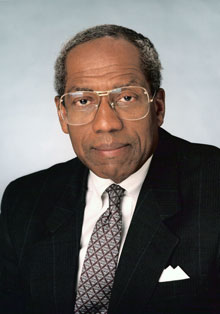
Picture Of Success
The winner of the 2000 Humanitarian Award from the American Academy of Orthopaedic Surgeons (AAOS), Dr. Epps was the Dean of Howard University’s College of Medicine for six years and program director of the minority residency program for 24 years. The first African-American president of the American Orthopaedic Association, Dr. Epps did his training during a time when not everyone was glad to see someone of his race walk through the door. But there would be no stopping the determined Dr. Epps.
“Growing up in Baltimore, my father—an elementary schoolteacher—raised my siblings and me with the philosophy of, ‘You do not need to be number one, but you must do your best in all things at all times.’ I graduated as the valedictorian of my high school class.”
But his father would not be there to see this momentous occasion. “My dad died due to a heart attack when I was 15 years old. Aside from the huge emotional cost, losing my father meant that my dream—our dream—of my attending college—was in jeopardy. I just didn’t know how I would afford it.”
At Howard University there is now an endowed chair named for Dr. Epps…he found a way to pay for college—and medical school. Along the way he thought of the compassionate physicians who tended to the physical needs of his dying father, and the emotional needs of the entire family. “These doctors were kind to our whole family and I couldn’t help notice that the calm, patient way they interacted with us seemed to help our situation; they were the type of person I wanted to be. My dad was only 41 when he passed away…losing him made me determined to succeed in spite of this tragedy.”
“I decided to pursue pharmacy studies at Howard University because it would be less of a financial burden and would require only four years. The class was filled, however, so I enrolled as a pre-med chemistry major, worked in the summers and saved my money. I then entered Howard’s medical school, despite being concerned about leaving my wonderful mother and my younger siblings. Mom was encouraging, saying, ‘Go ahead…be a good boy and write to me.’ After achieving good grades in my first year I said, ‘Well, if I can do one year of working and studying then I can probably do seven more years. In medical school, after driving the taxi for 18 months, I owned it…and this made my financial situation more secure.”
Stepping out into the wider world in 1955, the newly minted doctor would find that not all arms were open wide. “Things were very segregated then…all my life I had encountered discrimination and usually just bit my lower lip and moved on. As I moved into residency at D.C. General Hospital, some people (black and white) were outgoing and helpful, while others let me know that the color of my skin was an issue. For example, a Christmas party was held at a staff doctor’s home where residents and their wives were invited to attend—all except me and my wife. I felt that slight keenly. That, in addition to the fact that local restaurants wouldn’t accept us, made things difficult. At work, however, things were different. African American trainees in all specialties insisted on—and got—equal treatment with regard to rotations, promotions, etc. Yet even some of the patients contributed to the overall problem as they didn’t want to be cared for by African American residents. Fortunately, in almost every instance white staff members stepped forward and insisted that we be treated like everyone else.”
Dr. Epps, whose resounding message to young minority orthopedists is, ‘You can succeed in spite of obstacles, ’ reflects on a specific instance when his services were not wanted due to the color of his skin. “There was a situation in which I had completed my training and was called to the ER to see a patient.”
The woman looked at me and as I went about working she began whispering and I was informed that she didn’t want me to treat her. Another physician called the medical director, who knew me well. He came to the ER and told the patient, ‘Dr. Epps is the orthopedic surgeon on duty and if you’re going to get any orthopedic treatment tonight he is the one who is going to do it.’ She agreed reluctantly, I proceeded, and the treatment was successful. During this uncomfortable situation I remained confident that my training and abilities would see me through.
Dr. Epps completed his residency program on a Friday…Monday morning he was on staff at Howard University. One of his proudest moments during this time? “I was only the fifth African American orthopedist in history to be certified, something that gave me an extraordinary sense of accomplishment. And I always felt a special responsibility toward Howard as it was the premier institution for black people. I am proud to say that we admitted some of the first females into our medical school and residency programs.”
In addition to his surgical talents and wisdom, Dr. Epps says that something else has been with him—and many African Americans—for years. “There was always an acute consciousness of being excluded…of having to stand on the outside. As I grew in my career I strove to make things easier for those individuals who were coming up through the ranks. The AAOS Humanitarian Award was in fact recognition of the mentoring I have done to help young minority orthopedic surgeons. Today, the questions I most frequently get from these young doctors is, ‘Should I subspecialize?’ and ‘Where should I go for training?’ I advise them that if possible, they should do their residency and subspecialty training in the area where they are ultimately going to practice so that they can put down professional roots.”
And what of that segregated Christmas party years ago? Dr. Epps, who now has an annual golf classic in his name, states, “I never made a fuss about it…I just kept working. Years later, however, I encountered the host of that party at an orthopedic meeting. He stopped to talk, shook my hand, and said, ‘By the way, when you were a resident I held a Christmas party at my home. It was in southern Maryland and I knew my neighbors would object to my inviting you and your wife.’ He was flushed, made a few niceties, then turned and rushed away; I realized that he still had some discomfort about the way he had treated me. I was nice to him, as my parents had taught me to be a gentleman and to treat people fairly—even when they didn’t accord me the same courtesy. I never felt that it enhanced my position to lash out at people; I tell young orthopedists that being courteous and fair will always stand them in good stead.”
Next week hear about Dr. Epps’ time as chief of the region’s only free, multidisciplinary program for limb-deficient children, as well as his role as an examiner for the American Board of Orthopaedic Surgery.
React:
Discussion
This is a fascinating development. In my practice we've seen similar outcomes with the revised protocol. The key differentiator seems to be patient selection criteria. Has anyone else noticed the correlation with BMI thresholds?
Great point. I'd push back slightly on the conclusion, the sample size in the cited study is too small to draw population-level inferences. That said, the directional signal is compelling and worth a larger RCT.
We implemented a similar approach last year. Early results are promising but we're still gathering 12-month follow-up data. Happy to share our protocol if anyone is interested.
Join the conversation
Orthopedic professionals are discussing this. Sign in and upgrade to read every comment and add your voice.