
If you ever need proof that a good idea won’t die, just look at the Orthopaedics Overseas* program in Ghana, West Africa. Born of extensive coordination among a number of organizations, including the American Academy of Orthopaedic Surgeons (AAOS), the Orthopaedic Trauma Association (OTA), and Health Volunteers Overseas (HVO), the program was crafted during the recent economic downturn and is beginning to find its wings.
Bringing Advanced Orthopedics to Africa
7 min read Premium comments
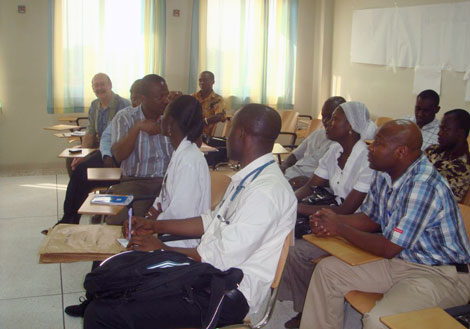
Dr. Peter Trafton, a semi-retired traumatologist from Brown University, is the program director of HVO’s Orthopaedics site in Ghana. He states, “The new residency program at the Komfo Anokye Teaching Hospital (KATH), in Kumasi, Ghana, is an outgrowth of efforts by AAOS, OTA, and the Pediatric Orthopaedic Society of North America and others—efforts that extend back to the year 2000. Known as the African Cooperative Education Program, it was a highly developed project with detailed curricula for orthopedic education that would eventually be available in numerous African countries. As the financial crisis hit in 2007, however, it was clear that the program was not going to be fundable to the level of excellence that was desired.”
Every initiative needs stewards…people who can see a way through the problems and feel a connection to the project. Paying homage to his colleagues, Dr. Trafton says, “Lynne Dowling, director of the international department at AAOS, along with Dr. Oheneba Boachie-Adjei, the esteemed chief of the Scoliosis Service at Hospital for Special Surgery—and a Ghanaian—wouldn’t let go of the possibility of developing a program for Africa. He and Lynne are the godparents of this program.”
An English-speaking country, politically stable with a better-than-average African economy, Ghana was an obvious choice for those moving this program forward. “The other thing that made it interesting, ” says Dr. Trafton, “was the new national trauma center next door to the teaching hospital. Dick Fisher, the president of HVO’s Orthopaedics Overseas, and Dr. Boachie worked to obtain approval from the national authorities to establish the residency. The hospital had already hired three German-trained Ghanaian orthopedic trauma surgeons. After the program officially began in fall 2010, I was honored with being the first volunteer.”

Ward Rounds/Dr. Peter TraftonEven with volunteers, says Dr. Trafton, this skeleton crew has its hands overflowing. They are juggling an inordinate—by Western standards—number of severe injuries on a daily basis. Dr. Trafton: “Traffic accidents are a major epidemic in this part of the world, with the volume increasing rapidly.”
They see between 15 and 20 significant injuries per day (but only have 100 beds). The reality is that people sometimes must be turned away. It is not unusual to have to canvas the wards to see who can be sent home so that someone else can take their place.
With the constant flow of desperately injured patients coming in from two and four wheeled accidents, there is no coffee break for the weary. “The Ghanaian staff surgeons feel overwhelmed, but are now fortunate to have three orthopedic residents, as well as several general surgery residents who rotate through the orthopedic service. The good news is that the hospital is solidly behind the program, which will hopefully mean an increasing number of residents and resources being directed to orthopedics.”
And the details of the training program? “The curriculum, full of hands-on training and in-depth lectures, was established by the Ghanaian College of Physicians and Surgeons, and is fairly equal to what one would expect in an American orthopedic residency. The differences emerge ‘on the ground’ because the volume of trauma patients is so heavy that the balanced curriculum that the Residency Review Committee in the U.S. would want to see is hard to reproduce. Essentially, it is difficult to ensure that trainees receive the full complement of surgical experiences. For example, the residents are not usually exposed to the spectrum of treatment for developmental hip dysplasia; also, they must leave scoliosis care to the visiting surgeons because they are not prepared to deal with spinal deformity.”
Breaking down the three types of orthopedic trauma and how they are managed at Komfo Anokye Teaching Hospital, Dr. Trafton notes, “First, there are the lifesaving situations. The Ghanaian orthopedists are routinely encountering patients with multiple severe fractures and/or an unstable bleeding pelvis, cases that are made even more difficult because of a shortage of blood. In the U.S., one might go through 40 units of blood with a bad pelvic fracture; at KATH they have to send out a call for donors. On another note, they can handle multiple long bone fractures pretty well at the same time they are resuscitating patients…I have seen some wonderful ‘saves’ there.”
As for limb salvage, not only are the Ghanaian surgeons accustomed to these procedures, they are adept at using things that aren’t meant for surgery…for surgery. “Limb threatening open fractures are something that these orthopedists handle all the time; the challenge is how to cover the wound so that it won’t get infected. The staff surgeons are quite comfortable with external fixation, however they must often rely on the more junior doctors to handle the debridement.”
The goal is to develop skills within the group; to this end we are recruiting plastic surgeon volunteers to come over and teach. In the meantime, the surgeons are making do without things such as negative pressure wound dressings. They are working on ways to improvise this expensive technology, such as use of reversed aquarium pumps and locally available foam, as described on the website, An Orthopod’s Workbench.
“The third approach, the restoration of function, typically involves trying to achieve better results from articular fractures. This is harder in Ghana, however, because it requires long, technically challenging procedures done with wounds that may be at risk of getting infected, and without some of the more modern implants and instruments”
Dr. Trafton traveled to Ghana three months ago to volunteer his time and get the lay of the land. “I wanted to try and duplicate what a typical HVO volunteer is going to be doing so that I would understand what was working and what wasn’t. The reality of limited imaging is something that volunteers have to be ready to deal with. The hospital has a CT scanner, but because of the expense it is rarely used for anything other than head injuries. Most X-rays are usually done in miniature so as to reduce the amount of films used; also, it is unusual to see a comparison view of the other side of the body part being imaged. If you have a bad articular fracture and would like to have a CT scan then you must proceed without this modern convenience. So what do you do? You may need to work through a larger open wound. This lack of imaging also precludes the ability to plan out the procedure beforehand, something that is an essential part of complex fracture surgery. For those of us who trained many years ago, it may be a bit easier…we can think back to a time before CT scans were available.”

Komfo Anokye Teaching HospitalA day in the life of a trauma surgeon at Komfo Anokye Teaching Hospital begins at the 8am morning report. Describing his experience, Dr. Trafton states, “During what is essentially a teaching conference, cases are reviewed and plans are made for the day. Then we would split off and go to the clinic/OR/or ward; I went to the OR most days and rotated amongst the two surgery rooms with a Ghanaian attending orthopedist (we worked with trainees throughout this time). We did this until the late afternoon; nighttime emergencies were handled by the trainees. I was really struck by how hard everyone works to take care of these significantly injured patients—and they do a really good job.”
Dr. Trafton has such resounding enthusiasm for the program in Ghana that while lecturing on-site he actually lost his voice. His message to his colleagues in Topeka and Boston? “This program is an outstanding opportunity for North American orthopedic surgeons, particularly those with trauma experience, to contribute to the efforts being made by Ghanaian surgeons to develop their skills. These individuals are becoming not only the caregivers for future generations, but the teachers for the many surgeons they will need. We can help the short-handed Ghanaian team with teaching and patient care; we can help them develop skills and techniques that will be safe and self-sustaining in their environment. This may mean avoiding some of our more challenging techniques until all local resources are ready.”
To those who might join the volunteer effort in Ghana, Dr. Trafton says, “I would urge the volunteer to leave his or her high-tech toys and home, and bring basic principles and skills, flexibility, and common sense. While it is always tempting to bring the latest orthopedic gizmos, if what we leave the people with is not something that is self sustaining then we are not being of assistance. It is only by helping to develop the technology locally, and by training future orthopedists that our efforts will mean something.
We have to ensure that what we deliver doesn’t depend on our ability to provide the answers.
So come to Ghana, where you will leverage your knowledge, improve your skills, and leave a big, important footprint.
For additional information about this and other programs, please visit www.hvousa.org. For more information on volunteering, contact Andrea Moody a.moody@hvousa.org.
*a division of Health Volunteers Overseas (HVO)
Komfo Anokye Teaching Hospital (KATH)/Dr. Peter Trafton
React:
Discussion
This is a fascinating development. In my practice we've seen similar outcomes with the revised protocol. The key differentiator seems to be patient selection criteria. Has anyone else noticed the correlation with BMI thresholds?
Great point. I'd push back slightly on the conclusion, the sample size in the cited study is too small to draw population-level inferences. That said, the directional signal is compelling and worth a larger RCT.
We implemented a similar approach last year. Early results are promising but we're still gathering 12-month follow-up data. Happy to share our protocol if anyone is interested.
Join the conversation
Orthopedic professionals are discussing this. Sign in and upgrade to read every comment and add your voice.