
Super Bowl rings are not just for the guys. Dr. Robin West, Associate Professor of Orthopedic Surgery at the University of Pittsburgh Medical Center, has one. Hers may be smaller than the men’s but the design is the same and the ring has the requisite number of diamonds. West is the Assistant Orthopedic Surgeon for the Pittsburgh Steelers—one of two female NFL team orthopedists, according to Stephania Bell of ESPN W. The other woman is Dr. Leigh Ann Curl, head orthopedic surgeon for the Baltimore Ravens.
Woman Orthopedist Keys Steelers’ Super Bowl Run
1 min read Premium comments
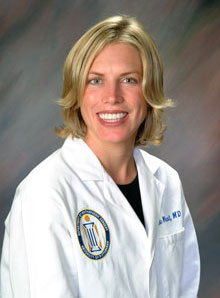
West who has been with the Steelers since 2003, assists injured players on the sidelines, in the operating room, and is considered not only a regular member of the team but the essential piece that kept players on the field and now in the Super Bowl.
When West, while a student at Johns Hopkins, was sidelined with mononucleosis her sophomore year, she began working as a student athletic trainer, an activity that ultimately led to medical school. Upon completion of a sports medicine fellowship at the University of Pittsburgh, Dr. Jim Bradley, the Steeler’s chief orthopedic surgeon, offered West a position. Bradley says simply,
She was the best candidate for the job.
In addition to her work with the Steelers, West serves as the head team physician for Carnegie Mellon University as well as the University of Pittsburgh’s men’s basketball team.
West believes that a factor in her acceptance by members of the Steelers football team may be because many of the athletes identify a woman, such as a mother or grandmother, as the strongest force in their personal lives. West applauds the Rooney family and the Steelers organization for being open-minded in its hiring processes. She also credits Ariko Iso, the only female athletic trainer in the NFL who has been with the Steelers since 2002, with establishing respect for women professionals among the medical staff prior to her arrival.
Author
React:
Discussion
This is a fascinating development. In my practice we've seen similar outcomes with the revised protocol. The key differentiator seems to be patient selection criteria. Has anyone else noticed the correlation with BMI thresholds?
Great point. I'd push back slightly on the conclusion, the sample size in the cited study is too small to draw population-level inferences. That said, the directional signal is compelling and worth a larger RCT.
We implemented a similar approach last year. Early results are promising but we're still gathering 12-month follow-up data. Happy to share our protocol if anyone is interested.
Join the conversation
Orthopedic professionals are discussing this. Sign in and upgrade to read every comment and add your voice.