
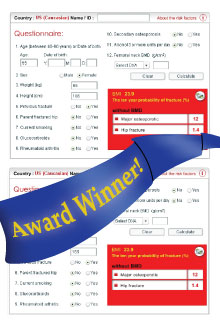
He wasn’t counting on an award…Professor John Kanis’ calculations were focused on developing a state-of-the-art fracture risk assessment tool. It is for his outstanding contribution to the development and validation of the WHO Fracture Risk Assessment Tool—FRAX—that he has been honored with the 2010 Hamdan Award for Medical Research Excellence in the field of osteoporosis.
John Kanis Wins Hamdan Award
1 min read Premium comments
Professor Kanis, President of the International Osteoporosis Foundation, is the Emeritus Professor in Human Metabolism and Clinical Biochemistry and the Director of the WHO Collaborating Centre for Metabolic Bone Diseases, University in Sheffield, UK. His research interests are largely related to disorders of skeletal metabolism including osteoporosis, Paget’s disease of bone, hyperparathyroidism, renal osteodystrophy and neoplasia affecting the skeleton.
He has also made a number of national and international contributions to guideline development, health technology assessment, epidemiology and health economics. Professor Kanis is a WHO Advisor on Osteoporosis, is Co Editor-in-Chief of Osteoporosis International, serves on the editorial board of several journals and is the author of more than 800 papers, chapters and books on bone disease and metabolism.
His current major interest is in the development of risk assessment algorithms and the formulation of practice guidelines in many regions of the world.
The Hamdan Awards for Medical Research Excellence were presented in Dubai on December 13, 2010, by His Highness Sheikh Hamdan Bin Rashid Al Maktoum, Deputy Ruler of Dubai, Minister of Finance and Industry, U.A.E., President of the Dubai Department of Health and Medical Services and Patron of the Award for Medical Sciences. The annual Awards pay tribute to three distinguished researchers who have made an enormous global impact through innovative research and novel advances in their respective fields.
React:
Discussion
This is a fascinating development. In my practice we've seen similar outcomes with the revised protocol. The key differentiator seems to be patient selection criteria. Has anyone else noticed the correlation with BMI thresholds?
Great point. I'd push back slightly on the conclusion, the sample size in the cited study is too small to draw population-level inferences. That said, the directional signal is compelling and worth a larger RCT.
We implemented a similar approach last year. Early results are promising but we're still gathering 12-month follow-up data. Happy to share our protocol if anyone is interested.
Join the conversation
Orthopedic professionals are discussing this. Sign in and upgrade to read every comment and add your voice.