
As he stood at the lectern for his first speech as president of the North American Spine Society (NASS), Dr. Joel Press, Founder and Director of the Sports Rehabilitation Program at the Rehabilitation Institute of Chicago, thought he might be “booed” offstage. His words that day had little to do with reimbursement or the latest, greatest spine surgery…they had more to do with the sociology of treating patients. But the audience welcomed his message, because, as Dr. Press has discovered over the years, simplicity often strikes a strong chord.
Dr. Joel Press
6 min read Premium comments
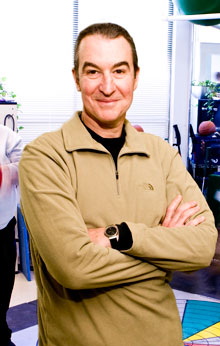
Picture Of Success
Dr. Press, a physical medicine specialist, widened the eyes of NASS members to the importance of nonoperative spine care. And he is known for always finding a way to encourage patients—even if he cannot help them. Years ago Dr. Press developed an appreciation for working with severely disabled people, looking at the positive, and working with what they have. But he doesn’t leave it at that. Dr. Press has been involved in the development of an innovative elliptical trainer that could revolutionize how those with many disabling conditions, from knee pain and arthritis to cerebral palsy live their lives.
Blessed to have an infectious passion for patient care, Dr. Press could have instead spent his days on an assembly line. “I was raised in a blue collar town in Illinois where my dad was an executive at a meat packing plant. There was a substantial amount of discussion about how I would not go into the meatpacking business. I was sold on that idea…from the age of 12 until I was 21 I spent most of my summers there, making boxes and grinding hamburgers. I didn’t know what I was going to do, but I studied extra hard to ensure that meatpacking was not in my future.”
Accused by his family of being “too optimistic, ” Dr. Press admits that sometimes he “sells a little hope.” “There is no point in saying to someone, ‘Your back is in terrible shape.’ Why not say, ‘There are some things that might be able to improve your back’ and, ‘I will help you learn how to deal with this problem.’ This is one of the lessons I learned in childhood when I came into contact with several physician role models. There was a physician in our neighborhood who was especially calm and encouraging. I was moved by his compassionate manner and therein began to develop an interest in medicine.”
And while he gave the surgical disciplines a chance, Dr. Press found that his calm in the center of the storm of options was nonoperative. “I spent a lot of time working with orthopedists and neurosurgeons, but came to feel that becoming a surgeon would move me away from interacting with patients. I followed my strengths and decided to learn what awaited me in the nonoperative realm.”
To those who doubt the role of nonoperative care, Dr. Press says, “A full 90% of patients with back pain do not need surgery. My NASS presidential speech discussed the fact that it’s not about the spine—it’s about the patient with the spine problem. I had numerous positive comments along the lines of, ‘Thanks for reminding us what is important.’ It is really telling that when you ask patients what is important (the doctor listens to me) and then ask the surgeon what is important (surgical techniques), that you get two different answers. In fact, the best surgical outcomes occur in patients who have had the best nonsurgical care. The key to patient care—and to doctors ‘playing nice in the sandbox’—is to be knowledgeable about, and respect, one another’s talents.”
But this can’t happen, says Dr. Press, if one medical hand doesn’t know what the other is doing.
Physical medicine is often a mystery to those in other specialties. But surgeons have a responsibility to understand the different aspects of nonoperative care; and physical medicine specialists must educate themselves as to what exactly surgery can offer patients. The bottom line is to know what you know and what you don’t.
Dr. Press had ample time to consider this and other medical issues—his own pain as well—while pedaling nearly 4, 000 miles across the U.S. “In 2007 I undertook a ‘Ride for Rehab’ to raise awareness and funds for the Rehabilitation Institute of Chicago. Funding of nonoperative care is truly lacking. It certainly doesn’t come from industry…who is going to pay you to develop a better exercise?”
While funding is an uphill battle, truth in treatment should not be. “We physicians need to be willing to look at our failures. There are certainly times when I ‘miss’ something that is going on with a patient. In both the surgical and nonsurgical worlds we treat patients and then when we don’t hear from them, assume that they improved. In fact, many times, they just went elsewhere for more treatment. The true test of treatment is how people do down the road. Following up with patients cuts down on the BS…as I like to say, ‘Nothing ruins a good outcome like follow-up.’”
So when patients climb off Dr. Press’ new elliptical trainer for the last time, he will be checking in with them months and years later. “We have done research on the role of the muscles around the hip and pelvis as they relate to the knee. We have traditionally done strength training for the lower extremities on Nordic Tracks, which operate front to back in the sagittal plane.”
Because it is also important to train side to side and rotationally, I have been part of a team that has developed an off axis elliptical trainer with inversion/eversion motion at the hip. This will help train different muscles to develop more functionality. We are doing the prototype now and are applying for funding to work with kids who have cerebral palsy.
Dr. Press, who has obtained several R01 grants from NIH (National Institutes of Health), states, “The key to research is to have strong collaborations between those with clinical backgrounds and those whose talents lie in the basic sciences. Scientists think they can prove everything, but don’t always know what is important to prove. In contrast, clinicians think that they know what is clinically important and what is the best way to prove it, when actually their research methods are not as good as they think. In the end, the great science is being done on that which is clinically relevant.”
When asked about his secrets of success, Dr. Press’ answer is simple. “I love what I do; my goal is to work until I’m old…until one day I walk out of my office and drop dead. Feeling such a connection to my work means that I am more engaged with and available to patients. Not only that, but if you are not passionate about your work, you will take short cuts (such as not staying up on the literature) and the quality of your work will suffer. If you regard every patient as a learning experience then you will be willing to do your best work. I tell young doctors coming up that they should remember that it is a privilege to do what we are doing.”
“My other ‘secret’ to success comes from the service industry. I once went on a backlot tour of Disney with a group of executives, many of them from hospitals. The thing that impressed me most was the Disney drive to consistently exceed their customers’ expectations. Since that time I have used the same model, doing simple things that can help patients have a better than expected treatment experience. For example, every patient that calls me during the day gets a return call that night. I usually say, ‘Sorry that it took me so long to get back to you.’ I think patients are expecting more than ever. We physicians as a whole are not very good at meeting, let alone exceeding those expectations.”
While Dr. Press does his utmost to exceed patient expectations, he himself doesn’t have outrageous expectations of life. “I am tremendously pleased with my life. I married the person I wanted to, I have a roof over my head, and I live in a terrific country. While it is easy to get wrapped up in complaining about things such as Medicare reimbursement, etc., I really think this is akin to background noise. We have to keep our perspective. In this country we still have opportunities to do what we think is best for patients. Yes, things are more restricted than they used to be, but we still have the best thing going. If you look around the world you will find that medicine is still like the ‘Wild Wild West’ in a lot of places. My advice to young doctors is to refrain from complaining and to be part of the solution.”
Alas, there are some things that while he might not like it, just evolve. “My wife and I are empty nesters and I just hate it. Fortunately, we still talk to our daughter and son every day. I’m left with more time to do my bike riding, however, and to explore the country.”
Dr. Joel Press…a quiet hero who cares deeply, has elevated non-operative care, and gives 110% to his patients.
React:
Discussion
This is a fascinating development. In my practice we've seen similar outcomes with the revised protocol. The key differentiator seems to be patient selection criteria. Has anyone else noticed the correlation with BMI thresholds?
Great point. I'd push back slightly on the conclusion, the sample size in the cited study is too small to draw population-level inferences. That said, the directional signal is compelling and worth a larger RCT.
We implemented a similar approach last year. Early results are promising but we're still gathering 12-month follow-up data. Happy to share our protocol if anyone is interested.
Join the conversation
Orthopedic professionals are discussing this. Sign in and upgrade to read every comment and add your voice.