
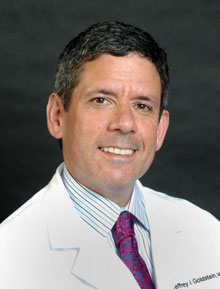
Dr. Jeffrey Goldstein, Director of the Spine Service at New York University Hospital for Joint Diseases, is renowned for his work on the groundbreaking multicenter study on cervical and lumbar disc replacement—AKA, ProDisc. In fact, his work has resulted in some of the first level one data concerning patients with low back pain and degenerative disc disease. And although it is Dr. Goldstein who has the limelight when consulting for entities such as ABC, CBS, and FOX, in a heartbeat he credits his success to the talented individuals who surround him.
Dr. Jeffrey A. Goldstein
7 min read Premium comments
Picture Of Success
Born on Long Island, Jeffrey Goldstein had no way of getting around the rigors of academia…his father was a high school principal and his mother was a high school teacher. “There were pressures, but as long as I achieved the most I could, then my parents were satisfied. Medicine was routinely discussed as being an honorable field, which dovetailed nicely with my natural bent for science. I was also inspired and intrigued by the opportunity to change people’s lives.”
As Jeffrey Goldstein made his way through Colgate University and SUNY Downstate Medical School, he came to see that the most concrete way to effect such change was—in the literal sense of the word—to manipulate people. “I was drawn to surgery because of the chance to change someone with my own hands. It is difficult to conceptualize what medications do, but when you use your own body as a tool, that is much more tangible.”
Not yet aware of the multiple opportunities available in orthopedics, Dr. Goldstein headed for an internship at Case Western in general and reconstructive surgery. He eventually took a different path, however, after deciding that if he was going to be called a “maniac, ” it would not be for his ego, but for his passion. “The first time I even considered orthopedics was when the Chair, Dr. Victor Goldberg, said, ‘I’ve heard about you. I have an open position in my residency if you’d like it.’ My initial plan involved general surgery because that’s where the big names in reconstructive surgery were. I came to see that my attitude was egotistical, however, and that this was taking me far afield from what I really wanted to do. I had to learn how to follow my passion…helping people by using the full capabilities of my hands and head.”
Dr. Goldstein then had the good fortune to work with the legendary Dr. Henry Bohlman at Case Western, who inspired Dr. Goldstein to pursue spine. This was followed by a fellowship with Dr. Paul McAfee in Baltimore. “From Henry I learned why to do spine surgery…from Paul I learned how. I was also interested in research, and learned during fellowship how to get the work out of the lab and to the patients.”
Some open their mouths…Dr. Goldstein opens his ears. Named the Director of the NYU Hospital for Joint Diseases Spine Service in 2007 by Dr. Joe Zuckerman and Dr. Tom Errico, Dr. Goldstein has made listening to his colleagues and trainees a top priority. Why? Because not only does being a leader who listens result in personal and institutional success, but it means top notch care for patients. “Years ago I chose to be open minded when receiving criticism, and to listen thoroughly to the ideas of those around me. I have been fortunate to have walked into situations where I am surrounded by smart innovators. And when I have to pull together a team, I ask myself, ‘Who can I get who knows more than I do?’”
The Associate Director of the Spine Fellowship, Dr. Goldstein extends his open-mindedness to those who are only beginning to learn the rigors of spine. “We treat fellows like junior associates, which is part of our effort to create a strong sense of community. I’m also proud of the fact that we are one of the few accredited spine programs in the country. In working with the fellows and residents, I am constantly aware of my role as a mentor. If I hurry a patient then they will think that this type of behavior is acceptable; if I take a shortcut on setting up a research project, then they get a negative message there as well.”
The diligent Dr. Goldstein has participated in some of the most important research being done for those with back and leg pain, namely the NIH-funded Spine Patient Outcomes Research Trial. “This was one of the first level one studies funded by the NIH. It was pretty challenging to enroll the right patients, and even more difficult to understand the data. The end result, however, is that for those with no other options, spinal fusion trumps nonsurgical treatment in symptom and pain relief.”
But Dr. Goldstein’s magnum opus may be his work in the cervical arena. “I was one of the lead investigators on the cervical and lumbar disc replacement trial (ProDisc), which resulted in some of the first level one data available for operating on patients with cervical radiculopathy and low back pain and degenerative disc disease (DDD). It was an enormous amount of work, but gave us the evidence that fusion is indeed a viable option for the right patients.”
During this time I often thought of a former professor who always asked, ‘Is this what you know or what you believe?’ With the ProDisc study, it was evident that the results were a matter of what we knew and not what we believed.
And while spine surgeons practice their craft with nerve root retractors as opposed to pastel paints, spine surgery is an art, says this veteran thought leader. But it is one that must evolve, says Dr. Goldstein. “Spine is an art that is by necessity growing up—and into—a science. As the onus is increasingly on surgeons to develop level one studies, it follows that we will have to be more rigorous in our approach. Something indicative of our current situation is the fact that when I do weekly case presentations we get eight different opinions from six spine surgeons. Additionally, I am concerned that unless we develop more level one evidence we will be told by people with other agendas what we can do for patients.”
So where does Dr. Goldstein have the most level of control over levels of evidence? In his own lab. “I am currently working on a unique surface structure for implants. If you look at the surface of a total joint you find a random microstructure, i.e., an amalgamation of pits and pillars that the bone can grow into. When we use a plasma spray process it is rather random. I have created a non-random process where we can anticipate bony integration of the implant to increase the success of fusion. We are able to dial in the appropriate height and depth, the space in between the pillars, and the size and shape of the pillars…this is controlled integration and is the next level of care for patients.”
In creating the next generation of those who will care for patients, Dr. Goldstein is as methodical as he is in the lab. “Because the immediate effects of a mistake in spine surgery can be disabling, you must approach fellowship training with an extraordinary attention to each person’s skill level. There’s only so much they learned as residents and in fact they may be temporarily relegated to sucking blood in the OR. It is important to bring trainees along at the residency level, however, because you don’t want the first time they’re seeing XYZ surgery to be in their fourth or fifth year. It is a matter of understanding what exactly they can do well with the appropriate guidance.”
“Many residents shy away from spine because they don’t understand it. It is easier to understand a fracture and more difficult to comprehend the rationale for performing a cervical disc operation. But, if in their first year of residency they can understand the anatomy and pathology, then they can understand why you need to put in a lumbar pedicle screw in a particular way. Then in the second year you can teach them how to put the screw in.”
Scientific equations are a routine part of Dr. Goldstein’s days. But perhaps his favorite equation is: orthopedics–passion=a job. “If you do not have passion as the train that drives you then orthopedics is just a job. When guiding trainees I always encourage them to look past what is alluring on the surface and dig deep to learn what really ‘turns them on.’ Everything gets back to patient care…if you choose spine, but are genuinely intrigued by shoulder, then you can’t be your best for the person in the exam room. You won’t know as much and you won’t care as much.”
The “Buddha” in Dr. Goldstein also knows that when it comes to one’s success, others play an important role. “Not only have I surrounded myself with smart, accomplished people, but they are also even handed and lack gargantuan egos.”
I tell young surgeons to look around and notice that there are not a lot of ‘jerks’ who are leaders in the specialty societies. People who are successful are those who are willing to learn from those around them.
And these days, he wants to learn more about the habits and loves of those at home. “My wife and I have an inquisitive three-year-old daughter and a son who will soon be two. I try to exercise when I can, but hobbies are generally on the back burner because I really want to be with my children as they discover the world around them. At this age my daughter thinks I make donuts…when I have to leave early for the hospital I tell her, ‘It’s time for daddy to go make the donuts.’”
Dr. Jeffrey Goldstein…using his passion for research and better spine care to inspire those around him and lay the foundation for more and better research studies.
React:
Discussion
This is a fascinating development. In my practice we've seen similar outcomes with the revised protocol. The key differentiator seems to be patient selection criteria. Has anyone else noticed the correlation with BMI thresholds?
Great point. I'd push back slightly on the conclusion, the sample size in the cited study is too small to draw population-level inferences. That said, the directional signal is compelling and worth a larger RCT.
We implemented a similar approach last year. Early results are promising but we're still gathering 12-month follow-up data. Happy to share our protocol if anyone is interested.
Join the conversation
Orthopedic professionals are discussing this. Sign in and upgrade to read every comment and add your voice.