
Look, listen and touch. Upgrade those listening skills, stay on top of anatomy and physiology and use observational skills which would make a hawk jealous.
Three Steps to Better Outcomes: Look, Listen, Touch
7 min read Premium comments
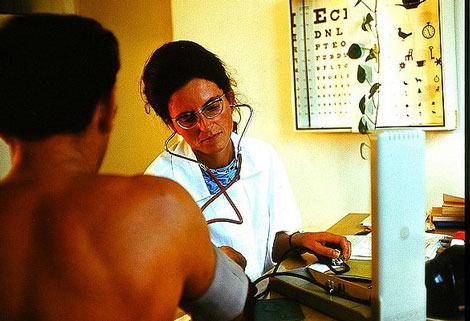
Result: Better patient outcomes. Guaranteed.
Commentary from American Academy of Orthopaedic Surgeons’ AAOS Communication Task Force and a study published in the Journal of the American Medical Association reiterated these elemental truths. Getting back to basics is even more important in these times of changing healthcare economics.
Dr. Ben Kibler, an orthopedist with Lexington Clinic Orthopedics-Sports Medicine Center in Kentucky, is famous for his comprehensive history and physical exams. He notes, “The first thing I ask myself when encountering a patient is, ‘Why is this person in my office?’ There is always some function that they can no longer do, with the accompanying pain. Inevitably, when you ask, ‘What are you here for?’ they reply along the lines of, ‘I can’t walk upstairs, I have swelling in my knee, etc.’ They don’t say, ‘I have a meniscal tear.’ So our job as orthopedists is to do a complete workup, including a history and physical that allows us to determine which components of the anatomy, physiology, and biomechanics are contributing to this dysfunction.”
Elaborating, Dr. Kibler states, “Proper functioning is when the anatomy is acted on by physiology to produce certain mechanical motions such as throwing. Thus, dysfunction involves pathoanatomy as well as pathophysiology and pathomechanics; an MRI can provide information on the pathoanatomy, but not the pathophysiology or the pathomechanics. This means that relying on technology can limit your ability to perform effectively as a physician.”
Doctors may be tempted to rush through the process of taking the patient’s history. Dr. Kibler: “You must devote the time necessary to understanding the full picture of the patient’s problem. As time goes on, you will be more seasoned, and things will move a bit faster. As for the content of the history, you begin by discussing what the person can no longer do (sleep, walk more than a block, etc.). You should then ask, ‘What makes it feel better?’ because then you know how they have tried to work around the problem. This gives you information on what positions they can achieve that don’t hurt or what substitute patterns they have used, which sometimes points you in the direction of muscular issues.”
“Then, ” says Dr. Kibler, “ask where it hurts and see if they can tell you if it’s, say, in one spot on the lateral elbow. If the pain is in a more generalized area that really doesn’t help you. Find out if they have already had treatment for the problem, whether it involved physical therapy, and how comprehensive the rehabilitation was. By the end of the history you should have a good idea about what structure is involved in the injury…then you can learn more by performing a complete physical exam.”
If you’re in too much of a hurry, says Dr. Kibler, you may miss the important signals that the body is sending.
Two-thirds of patients with shoulder problems have back or leg problems. Many patients with elbow problems have weak hips. So as not to miss such issues, examine the person’s posture when standing and walking, and assess all aspects of their flexibility.
“Also critical is the patient’s core stability (hips, legs, trunk). Have the person stand on one leg and see if that causes pain in the back, knee, or shoulder. When they lean over to touch their toes you should look at the posture of the spine. If the pain is localized to one area then you look at range of motion of the affected joint and do simple strength testing. You should also do provocative maneuvers, i.e., ‘Does it hurt when you do this?’”
He continues, “This is followed by corrective maneuvers. For example, if you want to stabilize the hip have the person lean over to that side so as to shorten the muscles. If afterwards they are pain free then whatever you did made them better. The beauty of the physical exam is that it is largely dynamic, as opposed to an X-ray, which is static. And, once you get some experience, a thorough physical should take no more than 10 or 15 minutes.”
Then, says Dr. Kibler, bring on the technology. “Now we turn to the anatomy piece, which leads you to the X-ray and MRI.”
Interestingly, despite the location of the injury, an MRI picture will show more injury than the patient will complain of. When all of the members of the Miami Heat basketball team had MRIs, 80% showed meniscal injuries…but not one of those players had mentioned pain in this area. Technology is critical, but it must be used with discretion.
Dr. Gary Friedlaender, Wayne O. Southwick Professor of Orthopaedics at Yale School of Medicine, is also a proponent of the seemingly simpler side of medicine. Dr. Friedlaender, who was on the Communication Task Force for the American Academy of Orthopaedic Surgeons states, “We often forget how important communication skills are; they are the vehicle by which we apply the principles of the history and physical. The bottom line is that when you communicate well with patients then you increase the yield of information—and critically—you increase patient compliance.”
According to Dr. Friedlaender, robotics belongs in the OR—not in the exam room. “In asking what is bothering the patient, we should aim to give the impression that we want to hear what they have to say. Don’t be robotic; sit down, act naturally, ask open-ended questions, and whatever you do, don’t interrupt.”
And, says Dr. Friedlaender, the paperwork is only the beginning. “Increasingly, we are relying on review of systems and medical history questionnaires that patients complete in the waiting room. While those can be comprehensive, they are not going to fulfill their purpose if no one follows up on the positive answers and flushes out the details.”
“Let’s say that a patient comes in with knee pain and has indicated on her questionnaire that there is a significant amount of cancer in her family. You search diligently for an answer, but somehow miss the cancer information on the questionnaire…and you miss the opportunity to reassure her that it is not, in fact, cancer.”
There is enough detective work in medicine such that you want to minimize confusion when at all possible.
Dr. Friedlaender tells his residents, ‘Don’t trust anyone, including yourself.’ People acquire information about themselves that may not be truthful; they may forget or misinterpret things. Go back to the primary sources to obtain a full picture. Someone may say, ‘I had something removed two years ago and they told me it was OK, ’ or, ‘I had a lab test done and didn’t hear back so assumed it was OK.’”
“Medicine is an art” goes the old saying. A program at Yale, led by Linda Friedlaender, the wife of the aforementioned Dr. Friedlaender, is breathing new life into this piece of wisdom. Friedlaender, the Curator of Education at the Yale Center for British Art, runs an unusual program that helps medical students heading into all specialties become more perceptive diagnosticians. She notes, “Along with Dr. Irvin Braverman, I bring groups of 20 medical students to the museum where we use paintings to help hone the students’ observational skills.”

Yale Center for British ArtThe program, which was published in the Journal of the American Medical Association, did just that. Friedlaender explains, “The students are told very little except that this is a visual exercise. They are given a pen and paper and are told to study the canvas for 15 minutes. Then, in groups of four students, each person goes around and tells the others what they saw. Interpretations are not allowed; instead we focus on the descriptive because they need to understand that looking at something carefully is a process and that you should not rush it.”
“We don’t want someone to say, ‘I see an angry man’ because ‘angry’ is an opinion. We want, ‘I see a man and his eyes are focused on XYZ object, the corners of his mouth are downturned, etc.’ All of those things form a composite view which the budding physician can use to more accurately say, ‘Because of these things the man looks upset.’ Or, take the portrait of a woman in front of two vases holding a flower. It’s unclear whether she is removing the flower or putting it back into one of the vases. This leads to a discussion about how she is holding the flower, the length of the flower, etc. We end up saying that there isn’t anything definitive, but that we can develop many hypotheses. In a clinical setting, patients can have multiple things going on simultaneously; clinicians usually need to get more information.”
This program, now used in 17 medical schools around the country, is building better doctors. “In one test of the program, we gave enlarged photographs of a skin condition to medical students and allotted them one minute per image to write down as much information about it as they could. Those students who had been through our program were significantly more fluid in terms of their writing; their vocabulary was also much more enriched in terms of how they described the rash (the outline, texture, color, distribution on the body, etc.). If notes such as these are in patient charts, then whatever staff is using the notes will be more thoroughly prepared to treat the person…and to get it right.”
Better observational, listening and anatomical skills equals better patient outcomes. And that, you can take to the bank. Guaranteed.
React:
Discussion
This is a fascinating development. In my practice we've seen similar outcomes with the revised protocol. The key differentiator seems to be patient selection criteria. Has anyone else noticed the correlation with BMI thresholds?
Great point. I'd push back slightly on the conclusion, the sample size in the cited study is too small to draw population-level inferences. That said, the directional signal is compelling and worth a larger RCT.
We implemented a similar approach last year. Early results are promising but we're still gathering 12-month follow-up data. Happy to share our protocol if anyone is interested.
Join the conversation
Orthopedic professionals are discussing this. Sign in and upgrade to read every comment and add your voice.