
The shortest distance between two points? In Dr. William Martin’s case it was not a straight line—it was actually one of life’s curve balls. “After college, both of my parents became ill, so I took two years off to care for them. Along the way I did research at Loyola University in Chicago and maintained a course for medical school.” That side trip laid the principled foundation that once informed his duties as Chair of the Arizona Medical Board and in his current position as Medical Director of the American Academy of Orthopaedic Surgeons (AAOS). His decision to delay his medical education in order to care for his parents is emblematic of Dr. Martin’s strong character and ethical compass.
Dr. William Martin, III
6 min read Premium comments
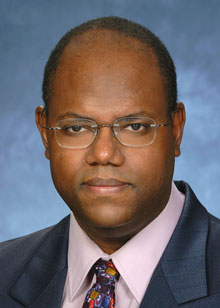
Picture Of Success
Opportunities are wonderful. But doing the right thing is everything.
Dr. Martin spent his youth in the suburbs of Chicago, where his mother owned a chain of dry cleaners and his father worked as a podiatrist. “My uncle was the first black orthopedic surgeon in the Chicago suburbs and was so very influential to me in my early life. Although he died when I was seven, the early impressions of his work have remained with me.”
Bill Martin’s attraction to orthopedics started early and found concrete expression while he was still in high school.
I spent my high school summers working at the University of Chicago doing research in orthopedics with the Chair, who was a family friend.
“This, combined with working as a cast technician, resulted in an early ‘love affair’ with orthopedics; I reveled in the fact that you could get tangible results. I recall the case of an elderly woman who came into the ER with a broken hip. It was quite something to be with her as she was treated there, underwent surgery, and then did rehabilitation. There are not many professions in or out of medicine that give you such an experience.”
Bill Martin started his post high school educational career at Harvard but finished his undergraduate degree at Tufts University. “I had an opportunity to enroll in an accelerated program at Tufts, so I took my scholarship and transferred there. While I spent most of my time in the microbiology lab so as to boost my medical school application, I did make time for my minor, religion.”
Despite their illness, Dr. Martin’s parents continued to support, even drive Dr. Martin to complete his post-graduate education. “My parents pushed me to continue with my plans, and thus I entered medical school at Loyola and began doing research with Dr. Terry Light. Terry knew that I had a lot of things going on in my home life, and he had empathy for me; one day I told him that I couldn’t get an assignment done. In his straightforward manner, he turned to me and said, ‘Bill, if this is important to you, you will get it done.’ That one line was incredibly helpful to me.”
Armed with a renewed focus, now-Dr. Martin entered the Phoenix Orthopedic Residency Program.
I wanted a program that was associated with a county hospital because I believe in the mission of helping the underserved.
“We saw a broad spectrum of pathology and because the patients were poor and tended to neglect problems, when they had something—arthritis, for example—it was particularly bad. The greatest thing about this period in my life was that I met my future wife and got married.”
He then got wedded to a subspecialty. “With my dad having been a podiatrist and my uncle an orthopedic surgeon, I felt a certain affinity for foot and ankle. While in California I met the famed Dr. Roger Mann, who invited me to become his apprentice. Over the years I have found that some people are the best technical orthopedists in the world, but are not Mr. or Mrs. Personality. Others are the opposite. When I think of Roger, however, it is always as a scholar and a gentleman.”
“I spent my fellowship with Dr. Mann, during which time I treated a lady who hadn’t walked in several years…and whose favorite thing was to amble through gardens. After a successful surgery her son was able to take her to a local botanical garden for a stroll…she said it was the best day of her life.”
But there would be no strolling for Dr. Martin…it was more like a sprint. “I completed my fellowship on the last day of 1998 and began my first day in practice on January 2, 1999. I joined a practice comprised of folks from my residency, meaning that it was a supportive environment. After five years I launched a solo practice, in part because I wanted to have more time to devote to entrepreneurship, as well as to AAOS activities.”
For the next several years it was as if he was earning an on-the-job MBA.
“I thought I knew the business of medicine but it wasn’t until I started having to do it on my own that I was forced to learn it. One thing I was concerned about was that my employees didn’t have enough to do if I was away from the office. My solution was to purchase a medical building and establish an urgent care center and a data management/document scanning company.”
“As for the latter business, it emerged after a new Arizona law was implemented mandating that documents had to be kept for seven years. Storing paper charts is expensive, however; there were even some doctors who, when closing their practices, were leaving their patient charts in alleys. Having multiple businesses enabled me to put employees on different projects depending on the needs of businesses. These were creative things I could do to help the businesses survive and continue to employ people.”
And what of the roundabout trip to becoming Chair of the Arizona Medical Board? “I was concerned about the state of high school education in our district, and approached the superintendant and said, ‘Help me do something to get grades 9-12 up to par by the time my children are ready for high school.’ His response: ‘Nine years is not enough time. The only way to effect change is to get on the state board of education.’ I completed the online application, but was actually selected for the medical board instead. I eventually became chair, and learned how important the role of regulators is, i.e., weeding out the bad apples so as not to let them take away from the profession. Fortunately, I can say that orthopedics was not one of the professions where there were egregious abuses.”
As the new Medical Director for AAOS, Dr. Martin hopes to help keep it that way. “I have three primary roles, the first of which is medical affairs, an area that largely involves issues such as coding and reimbursement. I am also in charge of supervising research and scientific affairs efforts.”
At present we are conducting member surveys on topics such as whether we will have enough orthopedists as the population ages, where the shortages will be, and what solutions there might be.
“We are also establishing orthopedic treatment guidelines; in the future, it is likely that we’ll move into other areas of the ‘quality arena’ like appropriate use criteria. Another substantial portion of my time is devoted to government relations. The issue of doctors’ decreasing Medicare reimbursement is not going away. The AAOS position is that we should have a permanent fix to the Sustainable Growth Rate formula so that we don’t have to go through the, ‘Are we going to have it or not?’ every couple of months.”
Ethics and equality are two major points on Dr. Martin’s moral compass. “I am drawn to the issue of diversity, and am pleased that the AAOS presidential line has elevated its importance within the organization.”
“It seems that diversity is a bit of a hard sell to some of our members because their time is so taken up by multiple competing interests. We hope that changes, though, as more women and minorities enter the profession.”
“At present, the trends are flat for minorities going into orthopedics, but AAOS is taking active steps to help to change that. It has been suggested that medical schools sometimes steer minorities into primary care as opposed to the surgical subspecialties. It may also be that minorities look around and say, ‘There are not many people like me in this field so why should I go into it?’”
Dr. Martin wants these—and any avenues—to be open for what he calls “God’s greatest gifts.” “My wife and I have four little ones…there is not a day that goes by that I don’t thank God for all I have. We participate in the children’s sports activities, and also volunteer as a family to help those who are less fortunate than we are. I think that you can’t just say that you are concerned about people—you must act on it.”
Dr. William Martin, III…a good apple who found his way to the top.
React:
Discussion
This is a fascinating development. In my practice we've seen similar outcomes with the revised protocol. The key differentiator seems to be patient selection criteria. Has anyone else noticed the correlation with BMI thresholds?
Great point. I'd push back slightly on the conclusion, the sample size in the cited study is too small to draw population-level inferences. That said, the directional signal is compelling and worth a larger RCT.
We implemented a similar approach last year. Early results are promising but we're still gathering 12-month follow-up data. Happy to share our protocol if anyone is interested.
Join the conversation
Orthopedic professionals are discussing this. Sign in and upgrade to read every comment and add your voice.