
Dr. Alpha: I’m thinking about hiring a PA…you know, a physician’s assistant, a physician extender, an orthopedic physician’s assistant.
The Role of Physician Assistants in Orthopedics
7 min read Premium comments
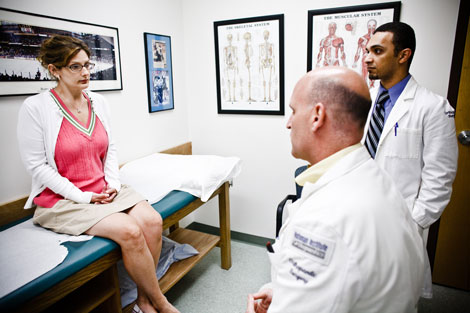
Dr. Beta: We have several PAs in our practice. You should know about the terminology though…“physician extender” is not the term used these days…and do you know what they do?
Dr. Alpha probably does not know what physician assistants (PAs) do. If Dr. Beta does in fact know, then he or she is ahead of the game. Orthopedists and others in the field are usually unfamiliar with the role of PAs in orthopedic practices, says Roderick Hooker, Ph.D., PA, who works with the Department of Veterans Affairs in Dallas, Texas.
Dr. Hooker explains, “A major part of the confusion about PAs working in orthopedics surrounds the terminology used by physicians to describe them.
There are technicians who call themselves orthopedic PAs (OPAs), and then there are the formally trained PAs who work in an orthopedic setting. While both groups have ‘orthopedic’ in the title, and each may refer to themselves as ‘OPAs, ’ their training and skill sets are quite different.
Individuals trained in orthopedic assistant programs learn technical orthopedic tasks, but are not taught the basic medical sciences that are emphasized by the certified primary care PA programs.”
“Furthermore, ” says Hooker, “OPAs are not eligible to sit for the Physician Assistant National Certification Examination, which is administered by the National Commission on Certification of Physician Assistants. The National Board for Certification of Orthopedic Physician Assistants manages the examination for certifying OPAs. This latter test is not equivalent to the NCCPA’s examination, and the organizations are not affiliated.”
The fully trained and formally certified PAs, however, can be like gold in an orthopedic practice. Rod Hooker: “NCCPA Certified PAs are involved in patient care at every level, including writing orders and progress notes, writing prescriptions, performing history and physical exams, ordering laboratory and radiographic tests, assisting in surgery, and participating in postoperative care. To a large extent, PAs make it possible for orthopedists to transfer much of their non surgical work, thus giving the surgeon more time for the operating room (OR). But along with cardiovascular surgery and neurosurgery, orthopedic surgery has the lowest ratio (largest number of PAs relative to physicians) amongst the surgical subspecialties, with approximately one PA for every three surgeons.”
Those practices that are PA savvy, though, benefit mightily. “In vertically integrated systems such as the VA or Kaiser Permanente, PAs might be managing 90% of closed fracture cases, managing preoperative care, and coordinating discharge planning. Once a patient is stabilized they need periodic evaluation, which is also something PAs can do.”
Caution is warranted, however, says Hooker. “An orthopedist excited by the prospects of bringing on a PA may overestimate the training of the individual and think that he or she is able to do everything. More often, however, the surgeon just doesn’t know what PAs do, or doesn’t know their range of skills because so little has been published about their role. PAs are also at fault because they have largely not taken the initiative to document their range of skills and roles as they apply to orthopedics.”
What we need, states Dr. Hooker, is hard data on what exactly PAs contribute to orthopedic practices. “In my ‘funding dreams’ I have ample grant money to identify as many practices as possible for conclusive findings (solo with a PA, solo without a PA, large practices with one PA versus those with more PAs than surgeons, etc.). Given the resources, I would look at one year’s worth of cases by ICD and CPT codes and identify how productive PAs were in terms of patients seen, cases administered, surgical versus non surgical time, to try to get a sense of the efficiencies of the organization and how the labor is divided. Orthopedic surgeons have ‘hit on’ a very good thing when it comes to PAs, but it would helpful to be able to reflect that with data.”
Hooker notes, “A 2010 paper on orthopedics in Winnipeg documented that with the incorporation of PAs to the orthopedic service surgical cases increased, wait times decreased and annual productivity was substantially enhanced.”
“As people are living longer and we are adding more people to the insurance rolls, it becomes imperative that we have trained care providers to help them. Heading into the future we will need more certified physician assistants in orthopedic surgery. The inclusions of teams in any type of care will improve the overall benefit and outcome to the patient.”
Dr. Charles Cornell, an orthopedic surgeon at Hospital for Special Surgery (HSS) in New York, knows that if the future is anything like the past, then Dr. Hooker is right on target.
Fifteen years ago there were 15 physician assistants at HSS…now there are 70. PAs are now on the front lines in orthopedics and they can be tremendously helpful in providing services that free up the surgeon.

For his colleagues unfamiliar with the role and skills of a PA, Dr. Cornell states, “PAs complement an orthopedic practice and are highly skilled professionals who, with proper training and experience, can become extremely competent in orthopedic care. I worked with one PA in Queens who was incredibly sophisticated. He had been in the field for 12 years and was superb at doing history and physicals and was an excellent diagnostician. This gentleman was very helpful in the OR, and would prep patients and assist with surgery, including opening and closing wounds. He was my alter ego.”
The model of the PA in an orthopedic practice is shifting toward one of independence, says Dr. Cornell. “It is increasingly common to see practices where the PA has their own practice within the group. They do the initial screening and workup on new patients and then refer the person to the appropriate orthopedic surgeon within the practice. This is useful because PAs can independently generate business for the practice and bill independently for their services (although what is permissible likely varies from state to state).”
And the more time a PA has spent in the classroom and in a clinical setting, the more independent he or she will be. “Many PAs are involved in administrative work such as quality assessment projects and personnel management. They can also take call and perform the initial examinations in the ER, order X-rays, make a diagnosis, and then consult with the supervising doctor. On the research front, as long as you provide opportunities for training, then a PA can easily participate in this realm. The star PA at Queen’s Hospital helped me establish a database of hip fracture patients, collected the data, and supervised several research students. In essence, PAs have a Masters degree, a year of basic science research, and a clinical year (similar to someone with two years of medical school). This is only a starting point for them, however, as PAs can pursue public health training, attend AAOS courses, participate in journal clubs, etc. As long as someone is trained and motivated to further their knowledge and skills the surgeon should give them as much responsibility as they can handle.”
But in doing so, advises Dr. Cornell, try not to step on any toes.
There is a natural conflict between PAs and residents, and in many situations they have not yet worked out how to share responsibility. There are often chain of command issues where the senior residents and experienced PAs must ‘feel out’ their relationship in order to work well together.
“I have seen some PAs who don’t want to work with residents at all because they don’t want to ‘answer to’ residents. These issues also occur in the operating room, where PAs use their skills to close wounds and assist with surgery. However, because my primary responsibility is to train residents, if a resident enters the OR I must allow the resident to do those tasks instead of the PA. To avoid these conflicts, when we have residents scrubbed in on a case we don’t have PAs present.”
Whether in the OR or in the office, egos and poor communication can be detrimental to patient welfare, warns Dr. Cornell. “One of the biggest things that results in medical errors is poor communication and ‘handing off’ patients between staff. All members of the team need to establish who is in charge at any given time; residents and PAs must have clearly delineated responsibilities and communicate regularly about what is happening. You never want to get into a situation where people are saying, ‘That wasn’t my patient that was your patient.’”
Much of a doctor’s ability to work with PAs depends on their mindset. Dr. Cornell: “Some surgeons are not comfortable delegating to non-physicians, something that I think is going to have to change.”
The resident workforce is limited—at HSS, for example, we have eight residents a year, meaning that there are only 16 fourth and fifth year residents—and that is to help cover 60 cases a day.
“So at a number of institutions you have PAs doing more work in the OR; traditionalists, however, are uneasy with these lines being crossed.”
We should remember that as compared with the profession of medical doctor, the physician assistant profession is a young one…and that means patients as well need time to get comfortable with the role of a PA. Dr. Cornell: “If patients see that a PA works closely with the physician then they feel more comfortable. You should be careful, however, if the patient is not doing well and they are unhappy. In that case, you need to ensure that they see the attending surgeon. A patient with complications who calls to speak to his or her doctor and is put through to the PA each time is not going to be satisfied…and may pursue litigation.”
But as they always do, things change. The future is here…and it is physician assistants.
React:
Discussion
This is a fascinating development. In my practice we've seen similar outcomes with the revised protocol. The key differentiator seems to be patient selection criteria. Has anyone else noticed the correlation with BMI thresholds?
Great point. I'd push back slightly on the conclusion, the sample size in the cited study is too small to draw population-level inferences. That said, the directional signal is compelling and worth a larger RCT.
We implemented a similar approach last year. Early results are promising but we're still gathering 12-month follow-up data. Happy to share our protocol if anyone is interested.
Join the conversation
Orthopedic professionals are discussing this. Sign in and upgrade to read every comment and add your voice.