
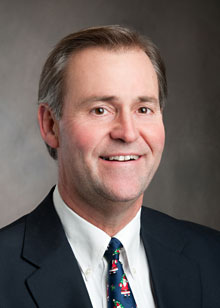
Dr. Robert Anderson, an orthopedic foot and ankle specialist at OrthoCarolina in Charlotte, North Carolina, and the head of the National Football League’s Foot and Ankle Subcommittee within the Injury and Safety Panel, loves nothing more than unraveling the complexities of “turf toe” or ankle reconstruction and getting athletes back to the joy of playing or, on a “regular” day, helping the average citizen walk without pain for the first time in years.
Dr. Robert B. Anderson
6 min read Premium comments
Picture Of Success
Born in Milwaukee, Wisconsin, Robert Anderson grew up under the tutelage of parents who knew the value of a textbook. “I am from a conservative, middle-class family; my parents were enormous supporters of public education, and made significant sacrifices to ensure that my three sisters and I got through school. When it came time for college, I wanted nothing more than warmer climes. As my parents and I drove south for campus visits at Tulane and Louisiana State University, I saw a sign that read, ‘University of Mississippi turn left.’ On a whim we took that exit and once I saw the beautiful campus and, frankly, the attractive women, I had made up my mind.”
While Robert Anderson had the usual spate of sports injuries that so often come with being an orthopedist, he also had an early experience that solidified his determination to pursue a career in this field. “On several occasions in high school I was treated by an orthopedist; over time I grew fond of the role of doctor, and began to see how great it would be to be able to make someone feel better. In a stroke of luck, during my junior year of college I was asked to work with an orthopedist who was the doctor for the University of Mississippi athletic teams. Putting on casts, removing stitches, etc.…all of that gave me a window into the world of orthopedic surgery. It was a window I was certain that I wanted to go through.”
In 1979 Robert Anderson dusted off his winter coat and headed home. “I matriculated at the Medical College of Wisconsin in Milwaukee and lived at home for two years to save money. I knew that being admitted to an orthopedic residency was going to be competitive, so I put my nose to the grindstone. When I came up for air, however, I played a bit. I helped start an annual party called the ‘Cadaver Ball’ which involved staging an anatomy suite at a local barroom. It was extremely popular and continued for several years.”
But it was not for his party planning skills that he was admitted to residency. “During medical school I did an orthopedic rotation in Columbia, South Carolina. There was a significant buzz about Carolinas Medical Center (formerly Charlotte Memorial Hospital) in Charlotte, North Carolina, being a well-kept secret, and many people encouraged me to take a look at their program. I did an early interview there, was accepted, and began my residency in 1983.”
The Peyton Manning’s of today can thank Dr. Anderson’s father figure for steering him in the direction of the metatarsals. “The person who gets the most credit for guiding my career is Dr. Basil Boyd, who was a charter member of the American Orthopaedic Foot and Ankle Society and a gifted sports and spine surgeon. He ‘looked around the curve’ and encouraged me to consider foot and ankle because he could see that it was an area ripe for growth. Indeed, in the mid ’80s there were only three foot and ankle fellowships in the entire country…now there are 45. He convinced me that there were a lot of people who had complicated foot and ankle problems and who were going untreated. Another talented sports medicine specialist, Dr. Angus McBride, suggested that I focus on the sports aspects of foot and ankle because no one had taken the lead in this area.”
Ready to learn how to lead, Dr. Anderson found that this meant harnessing one’s ingenuity in an era of “one-offsmanship.” “When I interviewed at the Medical College of Wisconsin, Dr. John Gould, the fellowship director, offered me a position on the spot. In addition to writing several papers and book chapters, I discovered that there was a real paucity of equipment for the foot and ankle.”
Under Dr. Gould’s direction, I learned how to innovate and borrow technology from other areas in orthopedics. For example, in reconstructing the ankle we had to use rods meant for the femur. While other orthopedic specialties were using screws and plates, we were often relegated to using multiple pins for lack of other options.
Armed with dexterity, Dr. Anderson returned to North Carolina, took his place amongst the “firsts, ” and used his talents to help heal old wounds. “I came back to Charlotte and started the Foot and Ankle Center at the Miller Orthopaedic Clinic with my former mentor, Dr. Boyd. It was pretty heady to be the first fellowship-trained foot and ankle surgeon in the southeast; I was hailed as a guru, but was only a year out of fellowship. It was very exciting when we were asked to revise a number of failed procedures for polio surgeries done in the 1950s and ’60s. My colleagues and I also saw a lot of Charcot disease, a diabetic nerve condition that affects the foot and ankle. This condition has its hotbed of genetics here in the Charlotte area. It is a deformity that progresses over time, so we were trying multiple procedures to keep these people ambulating as best as possible.”
In the early ’90s a prominent football player with a problem helped launch Dr. Anderson (and his colleagues) into the world of high-level sports.
In 1992, a time when foot and ankle sports medicine was taking off, a Green Bay Packer with a recalcitrant foot problem reached out to us for help. There was little in the literature about his condition; he did well under our care, however, and made us ‘look good.’ It was word of mouth that led us to where we are now—we see the vast majority of foot and ankle injuries in the NFL and NBA and are the team physicians for the Carolina Panthers.
Dr. Anderson has learned that to provide excellent care, one must break out of the OR and go to the podium. “Working with these athletes is exciting, but the problems are complicated and the rehab issues are complex. Because my colleagues and I have found that many types of foot and ankle injuries are misdiagnosed or under diagnosed, we have dedicated ourselves to educating trainers and physical therapists. I spend much of my time traveling to NFL and college teams and in fact have just returned from Duke University where I lectured on turf toe injuries, a particularly interesting condition because it was originally believed to occur only on Astroturf. The media has publicized it as being just a sprain, but we now know that it’s a complicated ligament injury that if untreated can result in severe arthritis and loss of one’s career.”
In 2005 Dr. Anderson received a nod from the NFL Commissioner and became the head the organization’s committee to evaluate foot and ankle injuries. “It is terrific to be a part of the NFL’s research projects as we seek to understand why foot and ankle injuries are increasing in number, what the mechanisms of injury are and how we can best prevent the players from being wounded. It may be the field surface, the shoes, the cleat patterns, and/or the size and speed of these players. We have teamed up with Nike, Reebok and other shoe companies to work on these issues, and the NFL has just hired the University of Virginia biomechanics lab to be a part of this multimillion dollar injury prevention project.”
While all of this may sound dazzling, says Dr. Anderson, traditionally, foot and ankle has missed the boat in the glamour department.
Most people think foot and ankle specialists spend our days trimming toenails and handling diabetic feet. They don’t see the wonderful opportunities we have to repair and reconstruct feet and ankles, and to keep patients walking with as little pain as possible. They don’t know about the young person with the horrible deformity in small-town Georgia who had a new reconstructive technique done and is able to walk for the first time in 10 years.
“Future surgeons are warming to the field, however…recently there were 383 advertised jobs in foot and ankle, one of highest number of posted jobs in orthopedics.”
On the home front, work continues, says Dr. Anderson. “My wife of 30 years puts up with the fact that work is my hobby. Our children are grown and have gone on to successful careers (one has worked for the St. Louis Rams and the other has worked for the Carolina Panthers). Nowadays my relaxation is cutting the lawn and playing golf.”
Dr. Robert Anderson…helping others put their healthiest feet and ankles forward.
React:
Discussion
This is a fascinating development. In my practice we've seen similar outcomes with the revised protocol. The key differentiator seems to be patient selection criteria. Has anyone else noticed the correlation with BMI thresholds?
Great point. I'd push back slightly on the conclusion, the sample size in the cited study is too small to draw population-level inferences. That said, the directional signal is compelling and worth a larger RCT.
We implemented a similar approach last year. Early results are promising but we're still gathering 12-month follow-up data. Happy to share our protocol if anyone is interested.
Join the conversation
Orthopedic professionals are discussing this. Sign in and upgrade to read every comment and add your voice.