
What is going on in those rat rotator cuffs? Louis J. Soslowsky, Ph.D., knows. Dr. Soslowsky, Fairhill Professor of Orthopaedic Surgery and Professor of Bioengineering, Director of the McKay Orthopaedic Research Laboratory and Penn Center for Musculoskeletal Disorders at the University of Pennsylvania School of Medicine, was recently named the 2010 winner of the Ann Doner Vaughan Kappa Delta Award by the American Academy of Orthopaedic Surgeons. (He has 102 other titles, but we just can’t list all of them.)
Louis Soslowsky Wins Kappa Delta
2 min read Premium comments
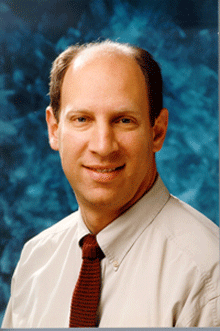
Dr. Soslowsky’s award-winning paper was, “Understanding the Etiology, Pathogenesis, and Repair Response of Rotator Cuff Injuries: A Series of Interconnected Studies Developing and Using an Animal Model.” He developed his own rat model which demonstrates the impact of extrinsic and overuse factors on rotator cuff injuries of the shoulder and the importance of post-surgical activity levels in healing. Because of Dr. Soslowsky and his team, researchers everywhere can now look into the true mechanisms of injury and healing at the molecular, cellular, and tissue level in this rat model and other animal models.
“Dr. Soslowsky’s career commitment to excellence in musculoskeletal research has been recognized at the highest level with this award, ” said L. Scott Levin, MD, FACS, Chair of Orthopaedic Surgery at Penn Medicine, in the news release. “This honor is well earned and well deserved.”
Dr. Soslowsky added, “The great apes may be man’s closes animal relative, but it’s the rat that may teach us the most about rotator cuff disease.”
Dr. Soslowsky told OTW,
This work is helping to define treatment modalities for tendinopathies and tendon tears, based on real data, rather than anecdotal experience. Further, our work is defining fundamental characteristics of these common injuries and healing processes.
The research editor of the Journal of Shoulder and Elbow Surgery, Dr. Soslowsky began his shoulder research journey at Columbia University where he received his undergraduate, graduate and doctorate degrees. He then went to the University of Michigan Orthopaedic Surgery and in their Bioengineering Program and rose to Assistant and Associate Professor of Orthopaedic Surgery and Mechanical Engineering and Applied Mechanics. He also served at the Associate Director of the University of Michigan Orthopaedic Research Laboratories in 1997, when he joined the faculty at the University of Pennsylvania School of Medicine as an Associate Professor of Orthopaedic Surgery and Bioengineering and was named Director of Orthopaedic Research.
In 2002, Dr. Soslowsky was named Vice Chair for Research in the Department of Orthopaedic Surgery at Penn and a full professor of Orthopaedic Surgery and Bioengineering in 2004. He is also the founding Director of the Penn Center for Musculoskeletal Disorders and then named the Fairhill Professor of Orthopaedic Surgery in 2008.
Regarding his future work in this area, Dr. Soslowsky told OTW,
We have several areas of research building on our recent work. One area is in evaluating the complete joint response to the tendon injuries, including functional changes and cartilage damage leading to osteoarthritis. Additionally, we are evaluating various tissue engineered graft materials, as mechanical reinforcements, as biologic enhancers, or combinations of both.
React:
Discussion
This is a fascinating development. In my practice we've seen similar outcomes with the revised protocol. The key differentiator seems to be patient selection criteria. Has anyone else noticed the correlation with BMI thresholds?
Great point. I'd push back slightly on the conclusion, the sample size in the cited study is too small to draw population-level inferences. That said, the directional signal is compelling and worth a larger RCT.
We implemented a similar approach last year. Early results are promising but we're still gathering 12-month follow-up data. Happy to share our protocol if anyone is interested.
Join the conversation
Orthopedic professionals are discussing this. Sign in and upgrade to read every comment and add your voice.