
This message was not delivered by a neuropeptide…more likely by a friendly phone call. Dr. Robert C. Bray of the University of Calgary has been selected as the winner of the American Orthopaedic Society for Sports Medicine’s (AOSSM) $250, 000 Ligament and Tendon Repair and Regeneration Grant for his project, “Biological Augmentation of Ligament and Tendon Healing: Role of Neuropeptides.”
Dr. Robert C. Bray Awarded AOSSM Grant
2 min read Premium comments
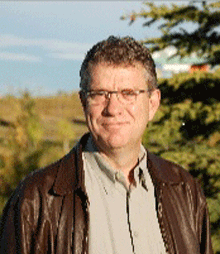
Along with colleagues Paul Salo (University of Calgary), Per Renstrom and Paul Ackermann (the Karolinska Institute), Dr. Bray will conduct a series of experiments to define the cellular, physiological, mechanical and structural changes in healing chronically injured tendons and ligaments. The team will then assess the impact of blocking the action of a specific inflammatory neuropeptide, or augmenting the action of an anti-inflammatory neuropeptide.
When asked where they are in the process of designing the experiments, Dr. Bray told OTW,
We’re just at the stage of preliminary testing to determine the correct doses of peptides that will safely promote healing (through reduction of endogenous inflammation and promotion of repair processes) in ligaments, tendons and in joints. This is a significant and crucial step that will be the foundation for the main portion of the project. We’re also working on finalizing assays to measure functional outcome in injured ligaments and tendons.
“We are grateful to AOSSM and RTI Biologics for selecting our project and allowing us to continue to study such an important piece of the ligament and tendon repair puzzle, ” said Dr. Bray in the news release.
This grant is part of a series of three-year AOSSM research initiatives intended to highlight important issues in orthopedic sports medicine and to foster high-level research. The first initiative focused on articular cartilage followed by the current initiative on ligament and tendon repair and regeneration. Following a think tank meeting in January 2009, and a grant workshop in July 2009, the Society solicited formal grant applications from workshop participants. This research initiative is sponsored by RTI Biologics Inc.
“We are proud to provide financial support to AOSSM’s research initiatives. The efforts of the AOSSM membership in the field of ligament and tendon repair and regeneration will lead to improved patient care. Continued research in this field is central to both the mission of RTI Biologics and the ongoing scientific leadership of the AOSSM, ” said Rod Allen, VP of Sports Medicine Distribution, RTI Biologics Inc., in the news release.
As for anything else Dr. Bray would like orthopedists to know about this work, he told OTW, “The overall aim of the work is to determine the role of early inflammation induced by peptides after a ligament injury to the ongoing development of osteoarthritis in ligament-injured knees. It’s a novel and exciting area of research that could easily lead to a new biological modulation of connective tissue healing.”
React:
Discussion
This is a fascinating development. In my practice we've seen similar outcomes with the revised protocol. The key differentiator seems to be patient selection criteria. Has anyone else noticed the correlation with BMI thresholds?
Great point. I'd push back slightly on the conclusion, the sample size in the cited study is too small to draw population-level inferences. That said, the directional signal is compelling and worth a larger RCT.
We implemented a similar approach last year. Early results are promising but we're still gathering 12-month follow-up data. Happy to share our protocol if anyone is interested.
Join the conversation
Orthopedic professionals are discussing this. Sign in and upgrade to read every comment and add your voice.