
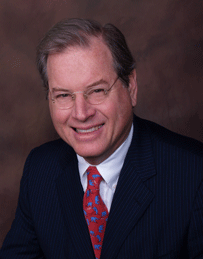
Born to missionary parents who roamed the globe, a young Richard Strain thought, “That’s nice. Now how about that car?” Dr. Richard Strain, M.D., President of Orthopaedic Associates of South Broward, explains, “As a youngster I didn’t understand the value of my parents’ work or how accomplished they were. My father was a brain surgeon and my mom was the third woman to graduate from the Yale School of Divinity. Now, of course, I am impressed with their work…when I see the photo of them with Ghandi, I get it.”
Dr. Richard Strain
7 min read Premium comments
Picture Of Success
More concerned with the water temperature of a lake than that of a beaker, Rick Strain was in no hurry to impress anyone academically. He admits, “I was a poor student until 10th grade and truthfully, almost anything could distract me from my studies. Especially fun was the time I spent water skiing—made more wonderful by the fact that I became the state champion one year. It began to dawn on me, however, that if I didn’t earn good grades then I would have no future. I did show some affinity for the sciences, and in my 10th grade biology class the teacher said that if we could remove a frog’s brain and spinal cord in one piece then we wouldn’t have to take the final exam…I was proud to be the only one to accomplish this feat. About the same time my parents were trying to figure out how to motivate me. As I was on my way from being a ‘C’ student to an ‘A’ student, my dad said that if I could maintain a ‘B’ average then he would give me his old car—a Pontiac GTO (which he did).”
Perhaps if Dad Strain had known his son could attain such heights, he would have thrown in a boat. But the need for parental bribery had gone by the wayside. Dr. Strain: “I attended Tulane University for my undergraduate studies where things went so well that I was given the moniker, ‘4.0 Strain.’ Although I majored in engineering, I designed my own curriculum and packed it with a lot of chemistry and physics. For my honors thesis on Xray crystolography I drew upon the distinguished Linus Pauling, who was on sabbatical in our lab after he won the Nobel Prize in chemistry. In fact, I still take Vitamin C because of him.”
His confidence (and immune system) boosted, Richard Strain began medical school at Vanderbilt University in 1971. “Unusually, Vanderbilt’s medical school was located in the hospital, so that meant we started out with the conviction that the basic sciences did not have to be divorced from the clinical realm. One particularly impressive mentor was Dr. Jack Davies, an anatomy professor. He said,
It doesn’t matter whether you are a psychiatrist or a surgeon, anatomy isn’t going to change. Theories…those are what change.
Dr. Rick Strain then headed for Boston. “At Vanderbilt I worked in the lab of Dr. Bill Olsen, who had done his residency at Harvard. In addition to encouraging me to follow in his institutional footsteps, he taught me to be tenacious about my research. So while waiting for the Harvard doors to swing open, I obtained a research grant, developed a basic science animal model and used electron microscopy to examine how nerves are injured by pressure.”
Once ensconced in the Harvard milieu, it was a ritual of bagels and Xrays that would launch his days. “In 1975 I began my residency and rotated through a number of different hospitals. While at Massachusetts General we would start our days with Dr. Henry Mankin, an exceptional teacher who met the residents for breakfast every morning. An unknown Xray would go up and we would discuss the differential as Dr. Mankin led us in a round of piercing questions. Also valuable was my rotation with Dr. Richard Scott, the famed total joint surgeon. He insisted on planning out each element of an operation beforehand so that there were no surprises.”
But of course there are unintended situations from time to time. And when there were, Dr. Strain was glad to be a witness.
I remained under the tutelage of Dr. Scott and did a tailored mini fellowship (this was a time when no one did fellowships). The words of my father still ring in my ears: ‘You learn more watching a good surgeon get out of trouble than at any other time.’
Heading back to the sunbelt, Dr. Strain then joined a local private practice. “We have a stellar mix of personalities and talents in the group; in fact, no one has ever left the group except in the case of death or retirement. At one point we went to work for a large local hospital, but it turned out to be a major mistake. Physicians tend to put quality of care first and for the most part, those running hospitals don’t understand how to deliver quality care. Anything that can be counted they can understand, but the nebulous idea of quality is foreign to them, so you end up with conflicts related to dollars and sense versus quality. I’m not saying they are evil. When you ask a color blind person to dress you they are not being mean when they make you look like a clown. The problem is that other than a few superb institutions, none of the hospital systems in this country are headed by doctors.”
But the diplomatic Dr. Strain, now on the AAOS Committee on Professionalism, does understand physicians…and how they should comport themselves. “We discuss doctors who may have violated the Academy’s standards of professionalism. For example, we deal with expert witness cases where the doctor has been sued and in his or her role as an expert witness may have violated one of the Academy’s standards of professionalism.”
On the research front, Dr. Strain looks into a common post-surgical threat—deep vein thrombosis (DVT). “I am the principle investigator in several drug studies and am concerned that so many (40%) joint replacement patients get DVT. There is a new group of oral Xa inhibitors coming out now that have been shown to be effective. These drugs may be what we have been looking for.”
And his most memorable moments as an orthopedist? “These are the times when patients show me the strength of the human soul. I recall one child who suffered with osteogenesis imperfecta for years. He had experienced about 35 fractures and had undergone many surgeries…despite this, he always had a positive outlook.”
Thrilled with the acumen of those in the field today, Dr. Strain does have a few things that keep him awake at night. “The explosion of subspecialization in orthopedics is dangerous in that surgeons lose the ability to deal with different problems. If someone is a joint guy he just flat out won’t see a patient with shoulder bursitis. This fragmentation will have serious clinical consequences in the coming years. It’s also lamentable because small towns are wonderful places and you may not be able to live in one because the town needs a generalist.”
One medium through which Dr. Strain may be able to effectuate change on the subspecialization—and other—issues, is through his work with residents. “I want my residents to know that although various techniques change, the fundamental principles of the field do not…those are what you must know. I remember one case I did alongside Dr. John Hall, the Chief of Pediatric Orthopedics at Children’s Hospital in Boston. He was cleaning one side of the spine and I was cleaning the other and he looked at me and said, ‘Your side isn’t clean. Do it right the first time and you don’t have to come back and do it again.’ I also impress upon my students the importance of thoroughly reading the literature. When our residents start this rotation I give them a CD with all of the papers I want them to read. And in the OR we are continuously quizzing them via the Socratic method. We start with the most junior resident in the room. If he or she doesn’t know, then that person asks the next in line, and so forth. Finally, if no one knows, then Helen, our knowledgeable scrub nurse, gives the answer. The residents quickly realize that if they don’t read the literature then they will be in my OR for a long time.”
Which, of course, would cut into his family time. “My wife Elizabeth and I have one child Britta, our nine year old daughter. One day it just dawned on me that love is spelled ‘t-i-m-e.’ Since she has an extraordinary interest in horses and rides in the local rodeos, we are always there to support her. Our little cowgirl is actually a champion barrel racer. This all began one day when she asked to go to our neighbor’s stable and learn how to ride. From that moment on we couldn’t get her to leave the stable…she would do whatever was needed…shampoo the horses, clean out the stables…she just loves the world of riding.”
Her athleticism hasn’t rubbed off on her father, however. “My wife runs a lot, but I don’t exercise. My hobby is sort of the opposite of exercise…wine. In 1968 I went into a wine specialty shop in New Orleans and told the owner that I wanted to learn about wine. He gave me two lasting pieces of advice: always consume one bottle next to another, and keep notes. I took my old physics lab book and started writing…I still have that notebook.”
Dr. Richard Strain…toasting patients and life.
React:
Discussion
This is a fascinating development. In my practice we've seen similar outcomes with the revised protocol. The key differentiator seems to be patient selection criteria. Has anyone else noticed the correlation with BMI thresholds?
Great point. I'd push back slightly on the conclusion, the sample size in the cited study is too small to draw population-level inferences. That said, the directional signal is compelling and worth a larger RCT.
We implemented a similar approach last year. Early results are promising but we're still gathering 12-month follow-up data. Happy to share our protocol if anyone is interested.
Join the conversation
Orthopedic professionals are discussing this. Sign in and upgrade to read every comment and add your voice.