
Dr. Richard Parker, Chair of Orthopaedic Surgery at Cleveland Clinic in Ohio, learned the art of diplomacy in a crowded Buick. Raised in Youngstown, Ohio, Dr. Parker says, “My father owned a dry cleaning business and both he and my mother drove home the point that my two siblings and I needed to work hard and be responsible. My father put his customers first, something that is not lost on me as I go about my workday trying to put patients first. As the middle child I was the peacekeeper in the family. There were many trips in the family car where I had to sit between my older brother and younger sister in order to keep them from hurting each other. This early lesson in peacemaking goes a long way toward helping me negotiate interactions with residents, fellows, and peers.”
Dr. Richard Parker
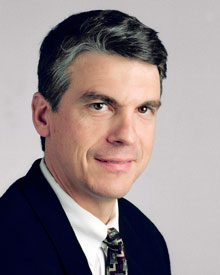
While somewhat motivated by the shock factor in science, Richard Parker came to see that there were real life possibilities for his interests. “The most fun part of my science education was a project my freshman year when I dissected an earthworm and examined the six aortic arches. (I enjoyed the fact that it freaked out the English teacher, who promptly fled the room.) Overall, however, I spent more time on athletics than on my studies. When I had an injury, and went to a well respected podiatrist in Youngstown, something clicked and I found myself interested in his work. As I moved into my college years I realized that if I studied I would do well—and that the medical field held infinite possibilities and frontiers.”
After graduating from Walsh College in Canton, Ohio, Dr. Parker took his emerging interest in medicine to Ohio State University’s College of Medicine in 1981.
I was a little concerned about measuring up because I had attended from a small school (85 people in my graduating class), but Walsh had prepared me very well. The combination of a good college foundation and the fact that I was raised in a family with an incredible work ethic meant that I could complete medical school in three years.
A young Dr. Parker’s philosophy was taking shape along the way. In part, he felt, “What is the point of your days if you are not able to live as you wish?” Dr. Parker: “I was leaning towards cardiology, but after an orthopedic rotation that went by the wayside. The visual side of things in orthopedics—the anatomy—along with the engineering that was required, was very alluring. I saw that orthopedists could vastly improve quality of life, something as important if not more important than saving lives.”
Since so much of his youth had been spent on the athletic field, Dr. Parker was naturally intrigued by how knee twists caused injuries and what happens when ankle ligaments are overstretched. “While in medical school I was given the opportunity to be student doctor for the school’s athletic department. I was assigned to hockey and it amazed me to see how accepting athletes were and that they called me ‘doc’ from the outset.”
An internship then narrowed his focus. “In 1982 I did six months of surgery and six months of internal medicine at The Mount Sinai Medical Center (now closed) in Cleveland. This experience solidified my desire to pursue orthopedics…I didn’t like that, with regards to chronic diseases, we are only able to temporize and not influence them in a more permanent and positive manner.”
Remaining at Mount Sinai for his residency, Dr. Parker learned the importance of avoiding the random approach to treatment. “The Chair was Dr. Avrum Froimson, a superb doctor who insisted upon an extraordinary attention to detail. ‘Do step A correctly, then move to step B, then C…no skipping B.’ Dr. Malcolm Brahms, the former Cleveland Browns team orthopedist, also influenced me in the caring way that he worked with patients, and on more specific situations such as how to behave in a training room.”
He already knew how to behave in an OR—talk. “In 1986 I began a sports medicine fellowship at Orthopaedic Specialty Hospital in Salt Lake City, where I was able to train with two of the most innovative, respected sports medicine surgeons in the country. Dr. Tom Rosenberg taught me how to be an arthroscopic surgeon, emphasizing attention to detail and the importance of doing things in a methodical fashion. At the same time he stressed innovation, something which allowed me to develop new ways of doing things. It was a really stimulating environment as there were always engineers and industry people who were picking his brain during surgery.”
Also showing me the arthroscopy ropes was Dr. Lonnie Paulos, who taught me the importance of engineering and biomechanical research. He showed me the pitfalls of not carefully reading the literature—he also made sure I understood how to synthesize it. I got to learn as he performed innovative arthroscopically guided procedures that were not yet being done in Cleveland.
Returning to Mt. Sinai in 1987, Dr. Parker was charged with building the department’s sports medicine program. “Although things came together pretty well, I wanted to care for athletes beyond high school and could see that this was probably not a possibility at Mt. Sinai. In 1992 I learned that Cleveland Clinic was adding another surgeon and after a long interview process I joined their staff the next year.”
The early lessons in statesmanship would serve Dr. Parker well in his next roles. “I soon became fellowship director for sports medicine and then was later named Education Director of Sports Health for Cleveland Clinic Sports Health. This meant that I had responsibility for the orthopedic sports medicine fellowship, the primary care sports fellowship and some of allied health programs. I came to see the importance of understanding that each of these disciplines historically have a different way of approaching their educational experiences, including, for example, how much case based learning is involved.”
More and more, the young man who once wondered if he would “measure up” had his answer. “In 1997 I had my first break as a head team doctor at a professional level. I had been working as the team physician for the local all boys’ high school when I was approached to be the team doctor for the new Women’s National Basketball Association franchise, the Cleveland Rockers. I held that position for the five years they were in existence and because of that experience, in 2000, I was asked by Dr. John Bergfeld of Cleveland Clinic and the Cleveland Cavaliers to be the head team doctor. The adrenaline rush for me being on the sidelines is as thrilling today as it was then.”
“The Cleveland Cavaliers basketball team has improved its record from 17 wins in 2004 to 66 wins in 2009…I had much to do with that of course…me and a certain gentleman named Lebron James. While the medical staff is there to maximize the athletes’ potential and help them have a long career, the reality is that when the team is losing the team doctor is faced with a situation where injuries that might otherwise have been considered to be trivial can be magnified. The bumps and bruises hurt more, and the depth of a team’s talent may not be as great and, as a result, players may not be able to take off as much time to heal.”
Dr. Parker’s mentors would be pleased to find that their former trainee has found his own creative spark. “I have been able to participate in the development of several arthroscopic, as well as open, techniques related to posterior cruciate ligament reconstruction, all of which involve an inlay technique. Another topic of interest for me is knee meniscal cartilage transplantation, an area in which I have developed techniques and guides which provide surgeons easier access of fixation points.”
In 2005 Dr. Parker became Professor of Surgery at the Cleveland Clinic Lerner College of Medicine. “Three years later Cleveland Clinic changed to the institute model and so the orthopedics and rheumatology departments joined to form the Orthopaedic and Rheumatology Institute. After a national and international search in December 2009 I was chosen to be the Chair of the department of orthopedic surgery.”
Dr. Parker would then focus his experience and dynamism and enact a higher level of personal efficiency. “Becoming Chair meant going from 90% clinical care to 40%; this demanded that I refocus my efforts in order to be as clinically efficient as possible. In preparation for this I stopped performing shoulder surgery two years ago and began focusing on the knee. Since then I have narrowed my focus to knee problems as they relate to sports and arthritis in patients who are under my ongoing care.”
Dr. Parker informs his clinical work with a devotion to systematically studying ACL injuries. “We are involved in the Multicenter Orthopaedic Outcomes Network, a group of eight medical centers including around the country that have come together to investigate the variables associated with ACL injury, as well as those affecting recovery after reconstruction. This is a longitudinal cohort that has resulted in numerous observations which are helping us give our patients appropriate prognoses.”
Some of that advice makes in onto the court. “My passion is being the Head Team Physician for the Cleveland Cavaliers. It’s really the merger of work and hobby. I reserve much of my energy for my family—my wife of 30 years, Jana, and our two children; Aric who is 21 years old and is enrolled at school in Boulder, Colorado, where he studies Eastern Religion and Jaclyn who is 19 years old and is in college here in Cleveland. I do indulge in the typical doctor sport of golf, and I also enjoy the adventure involved in traveling.”
Dr. Richard Parker…dedicated to ensuring that people can live as they wish.
Discussion
This is a fascinating development. In my practice we've seen similar outcomes with the revised protocol. The key differentiator seems to be patient selection criteria. Has anyone else noticed the correlation with BMI thresholds?
Great point. I'd push back slightly on the conclusion, the sample size in the cited study is too small to draw population-level inferences. That said, the directional signal is compelling and worth a larger RCT.
We implemented a similar approach last year. Early results are promising but we're still gathering 12-month follow-up data. Happy to share our protocol if anyone is interested.
Join the conversation
Orthopedic professionals are discussing this. Sign in and upgrade to read every comment and add your voice.