
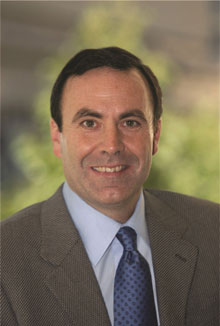
Dr. Ray Baker, the newly elected President of the North American Spine Society (NASS), knows how to put things together…he learned from taking things apart. Dr. Baker, who practices at Washington Interventional Spine Associates in Bellevue, Washington, is the first anesthesiologist to serve as head of the organization.
Dr. Ray Baker
7 min read Premium comments
Picture Of Success
Traversing several continents as a youngster, Ray Baker learned the value of humor and quick thinking. “My father was in the Air Force, and we moved from my birthplace, Cambridge, England, to Turkey, then Texas. Following that we settled in California when I was six years old. Moving around so much meant that I learned the importance of assessing my environment and having a sense of humor, things that helped me make friends quickly.”
The analytical Ray Baker has a natural bent for curiosity and has never shied away from examining things. “Within days of having my first computer, I ripped it apart and had to rebuild the operating system. This sense of wonder led me to enroll in engineering classes at my undergraduate institution—Berkeley. I found the classes boring, however, and realized that I would rather work with human beings. I was dating someone at the time whose father was a physician, and after several discussions with him, I enrolled in premed classes and signed up to volunteer at a hospital. I read EKGs in the ICU; from there my interest in medicine only grew.”
Specializing in Pain
Perhaps it was witnessing so much pain in the ICUs that sent Ray Baker in the direction of interventional medicine. “I began medical school at the University of California, Irvine in 1981, after which time I did a rotating internship at Valley Medical Center in Fresno and was exposed to all different specialties—with the exception of spine.”
Remaining at Irvine for residency, Dr. Baker would connect with spine via pain. “The program was not particularly strong in regional anesthesia so I became interested in interventional pain as a way of making up for the deficiency…which got me curious about spine. Soon realizing that I needed a fellowship that would allow me to emphasize regional anesthesia, I did six months in obstetric anesthesia and six months in interventional pain management. This was a period in which people were transitioning from performing ‘blind’ injections into using fluoroscopy.”
Seeking familiar territory, in 1989 Dr. Baker left Irvine and headed to Washington State. “The climate and ambience are similar to Northern California where I grew up. I secured a job at Overlake Hospital as an anesthesiologist, but, interestingly, they were acutely uninterested in pain.
We are fine just doing OR anesthesia’ was their response to me. After two or three years I struck out on my own. Because my partners had not been interested in pain, I got all the patients, meaning that I garnered a lot of experience. I ‘had the market’ so to speak, in that there were not a lot of people doing injections in the Seattle area at the time.
Learning From Spine Specialists
You might say his entrée to spine was via a needle. “Because of this work, I became acquainted with a lot of spine surgeons, and could tell that it was time to make up for some more deficiencies in my education. I spent many days watching spine surgeons operate, and spent about three years (part time) in Dr. John Oakley’s office. A neurosurgeon well known for his work on spinal cord stimulation, Dr. Oakley told me, ‘I will teach you how to do an exam and read films like a neurosurgeon.’
“I was pleased to find myself comfortable in the language of spine, which has given me the ability to speak with orthopedic surgeons in a different way. Orthopedists are accustomed to pain doctors not understanding the way they think. This makes sense, of course, because as an anesthesiologist you do heart and lung exams, not musculoskeletal exams. The joke that floats around me is that I’m an anesthesiologist trying to become a physiatrist.”
Dr. Baker spent five years at the University of Washington as director of their interventional pain program. His spine colleagues got used to the eager anesthesiologist popping up at their events. “I was able to attend Tuesday morning orthopedic conferences and did spine rounds with orthopedists and neurosurgeons—I was the only pain doctor who showed up. Some of my mentors were Drs. Paul Anderson and Jens Chapman, spine surgeons who taught me to take the entire patient under consideration. For instance, they took standing films that included the back, hips, pelvis, etc., and checked the patient’s alignment and their hips, not just the spine. Dr. Ted Wagner also leant me a great deal of practical advice. His tremendous experience provided insight about when not to operate on patients as well as when to operate, and he served as a superb role model of how to be kind with patients.”
“Dr. Stan Herring, a former President of NASS, along with Dr. Stuart Weinstein and Paul Dreyfuss, helped me develop a knowledge base of physiatry. I watched as they discussed their cases, and then they asked me questions to ensure that I understood what was going on. These regular meetings strengthened my ability to see from another perspective. I learned that while orthopedists strongly focus on imaging because they have to operate on something, physiatrists are more interested in the physical exam. Different parties…different sides of the elephant.”
The Need for Improved Diagnoses
This is one anesthesiologist who is fully alert to the human tendency to want to believe things are solved. Dr. Baker: “It has been enlightening—and a little discouraging—to learn how deficient spine care is with regard to diagnostics. Just when you think you know the pain generator, you find that you are wrong. We fool ourselves about how well we can actually do that, especially in the surgical disciplines. We think we know what the problem is and just need to find a better way to fix it. It is not that simple. There remains a lot of work to be done in this area.”
“Spine is sexy” goes the current aphorism. Where some see ambrosia, however, Dr. Baker sees haste. He notes, “To paraphrase Alf Nachemson, ‘Perhaps time, effort, and monies are better spent improving diagnosis and patient selection before developing the next generation of hardware.’
“A couple of years ago I was part of designing a study on lumbar discography in which we were trying to predict who would be a good candidate for fusion. While I was used to a private practice model, in this situation they were getting many university patients, a population that sometimes has a good deal of psychological issues. I got a number of floridly mentally ill patients and subsequently thought, ‘This is an injustice. I will not send these people to surgery.’ I met with the participating orthopedic surgeons and said, ‘We have to do psychological testing on your patients.’ They assented, ordered the tests, but the team never looked at the results. They were just going through the motions.”
“We need prescreening of patients in order to select out the folks who are doomed to fail. We have the data showing that patients who are anxious or depressed, or those in moderate psychological distress, fare poorly after surgery. It is not simply a matter of finding a structural abnormality and then doing the surgery, as is often the case with low back pain patients.”
“This gets back to the fact that we don’t understand the pain generators. Let’s say you have three patients: one who has hit his thumb with a hammer, another who is normal/healthy, and a third who has fibromyalgia. If I put a certain amount of pressure on their thumbs, the person who hit his hand with a hammer is going to withdraw, while the normal person won’t react. The issue is that the person with fibromyalgia is sensitized to pain and will withdraw as well. That’s where discograms and other tests get us into trouble…the ultimate solution is to have a special kind of imaging or blood test to define the pain marker that isn’t altered by psychopathology.”
Urging Improved Collaboration
In the mind of Dr. Baker, a “red state/blue state” mentality just means that patients wait…wait for someone to remember that they are the reason doctors exist. “Now more than ever spine care requires collaboration…requires that we earnestly try to see all sides of the picture. I hope to bring this mentality to NASS so that we can eliminate some of the turf wars. For example, some orthopedists are wondering why NASS is holding injection courses. Meanwhile, some physiatrists are wondering why we have so many surgical courses. The bottom line: we must be able take off our political hats and think of what’s best for the patients.”
Elaborating, Dr. Baker says,
There are a number of us who are strongly focused on stopping the infighting–both within our organization and between organizations. This kind of behavior is quite detrimental whether it’s either ego driven or driven by the size of the organization. Let’s get together and talk; we have multiple disciplines within our society that are a natural fit.
As for his experience in viewing all sides of the spinal elephant, Dr. Baker states, “Before I became part of the NASS presidential line, I did consulting for United Healthcare and saw how the major insurers view spine care. I also participated in a local spine advisory board that brought together representatives from the state and county, as well as people from Microsoft (as an employer of those who have spine problems), hospital CEOs and private practitioners. Each person had different perspectives, of course, which was very enlightening. These and other experiences have given me a broad view of where we need to go from here.”
When Dr. Baker is sorting out patient and NASS-related issues via text message at 10pm, he has a lot of support on the home front. “My wonderful wife Jennifer and I have been married 16 years and have three children. The eldest, Kris, is attending law school at William and Mary, while our daughter Jennifer, 25, has just married and is living in Ireland and teaching literature. Our youngest son Geoff is 23 and has decided on a premed track. My wife and I really enjoy skiing and boating, and we take every opportunity to go to our vacation home in Sun Peaks, British Columbia.”
Dr. Ray Baker…elevating spine and its practioners.
React:
Discussion
This is a fascinating development. In my practice we've seen similar outcomes with the revised protocol. The key differentiator seems to be patient selection criteria. Has anyone else noticed the correlation with BMI thresholds?
Great point. I'd push back slightly on the conclusion, the sample size in the cited study is too small to draw population-level inferences. That said, the directional signal is compelling and worth a larger RCT.
We implemented a similar approach last year. Early results are promising but we're still gathering 12-month follow-up data. Happy to share our protocol if anyone is interested.
Join the conversation
Orthopedic professionals are discussing this. Sign in and upgrade to read every comment and add your voice.