

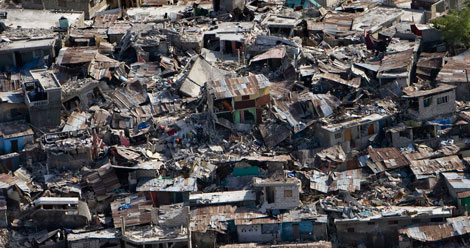
Photo Courtesy: PD-USGOV-MILITARY-NAVY“It looks like an atomic bomb went off in Port-au-Prince, ” is how philanthropist Hank Asher described what he saw a week after a 7.0 earthquake hit the island nation of Haiti on the western end of Hispaniola. The earthquake created one of the greatest needs for the assistance of the orthopedic community in our lifetimes.
Orthopedic Heroes of Haiti
8 min read Premium comments
The orthopedic community responded quickly, generously and efficiently. Within hours hundreds of orthopedic surgeons, caregivers and device company employees volunteered to help and rushed to Haiti.
The Catastrophe
The January 12 earthquake has been estimated by various organizations to have killed approximately 200, 000 people, with 80, 000 already buried in shallow graves and hastily dug trenches.
“We just dump them in, ” said one relief worker directing trucks with the dead bodies.
But it wasn’t the dead who needed help. The earthquake not only destroyed, injured and displaced over three million people, but according to the Pan American Health Organization/World Health Organization, at least eight healthcare facilities, including at least four hospitals, were destroyed or severely damaged in the earthquake.
On Saturday, January 16, CNN reported that Jennifer Furin of Harvard Medical School noted that almost a third of the patients at a makeshift hospital on a United Nations compound near Port-au-Prince’s airport would die without surgery. “They will die of infections, they’ll die of dead tissue, ” said Furin.
Hastily erected emergency medical centers almost everywhere were swamped with patients critically injured by the quake. There were dire shortages of surgeons, nurses, medicines, and medical tools.
Crush Syndrome
Doctors said patients were dying of sepsis from untreated wounds. “A large number of those coming here are having to have amputations, since their wounds are so infected, ” said Brynjulf Ystgaard, a Norwegian surgeon at a Red Cross field hospital.
Edward P. Fink, M.D., was quoted on the American Academy of Orthopaedic Surgeons’ (AAOS) Web site, “We are seeing the first wave of patients currently—those individuals who have significant open injuries, crush injuries, and lacerations. The next wave will be individuals with closed fractures who will require treatment; the third wave will be individuals with musculoskeletal complaints without obvious fractures.”
Help Arrives

USNS Comfort Arrives in Haiti/Army Knowledge Online (AKO)By Wednesday, January 20, the United Nations had brought in seven field hospitals to augment those few Haitian facilities left standing. On that day the USNS Comfort hospital ship also arrived.
The Comfort was carrying nearly 550 doctors, nurses, corpsmen, technicians and support staff, who were joined by 350 other medical staffers once the ship reached Haiti, according to the U.S. Southern Command. CNN reported that the ship has six operating rooms available and can house up to 1, 000 patients.

Dr. Scott Nelson, the first orthopaedic surgeon to start work in Haiti following the quake is joined by SIGN’s Dr. Lewis Zirkle at Adventist Hospital/SIGN
One hospital left standing was the Adventist University Hospital where an American volunteer, Eli Call told one reporter, “We have 300 to 400 patients waiting to be seen, and if we can’t get to them in the next 48 hours, half could die.”
As is often the case, the Surgical Implant Generation Network (SIGN) and its founder Lewis Zirkle, M.D., were on the scene within days and began working out of Kings Hospital in Port-au-Prince.

Dr. Scott Nelson and Dr. Duane Carlson work simultaneously on a fractured femur case/SIGN
Orthopedic Community Leaps into Action!
The rest of the worldwide orthopedic and surgical community also responded immediately.
Within hours of the quake, Synthes Chairman Hansjörg Wyss, M.D., contacted the Hospital for Special Surgery (HSS) in New York and offered the company’s airplane to bring a team of anesthesiologists, nurses and orthopedic trauma surgeons led by David Helfet, M.D., and Dean Lorich, M.D., to Haiti. They were joined by physicians from New York-Presbyterian Hospital. The team left for Haiti on Friday, January 15, and began working round the clock at Hopital de la Communaute Haitienne in Port-au-Prince suburb of Petion-Ville.
That team was relieved two days later when a new team from HSS took their place.
“We had to quickly adjust from the high-tech Hospital for Special Surgery environment with the most state-of-the-art radiologic and surgical equipment, to a makeshift hospital where we are trying to save lives and limbs, ” said Helfet.
That first HSS team to arrive in Haiti included surgeons Helfet, Lorich, Daniel Chan, Devon Jeffcoat, Neil MacIntyer, Anna Miller, Andrew Nevaiser; anesthesiologists Doug Green and Kethy Marie Jules-Elysee; nurse practitioner Patricia Donohue; and, RNs Ronald Perez and Louise Strickland.
Synthes spokesperson Gilgian Eisner told OTW that after a long wait for clearance to land on the island, the plane landed in the Dominican Republic and then transferred to Haiti on Saturday morning. Also on board was a large shipment of the company’s trauma products that had been requested through the Partners in Health Organization and coordinated with Dr. Helfet.
The plane returned to its home base and loaded up additional 4, 500 pounds of product, which it flew back to Haiti on Sunday morning.
One of the first reports coming from the ground came through posts on the huffingtonpost.com Web site by Mark Hyman, M.D.
Two orthopedic surgeons, my wife and father in-law, started the first amputation without water, electricity, or disinfectant. They used a rusty hacksaw we washed with vodka, lit by camping headlamps in an empty room with a few boxes of supplies we had packed into our plane.

Haiti earthquake camp/photo by: Agência Brasil
Here Come the Israelis
On the same day the HSS trauma team was on its way to Haiti, two Israeli jets carrying nearly 10 tons of medical equipment, 220 doctors, nurses, medics, police forces, and an elite search and rescue team landed in Haiti.
The Israelis established the field hospital noted earlier that included 40 doctors, 24 nurses, medics, paramedics, x-ray equipment and personnel, a pharmacy, an emergency room, two surgery rooms, an incubation ward, a children’s ward, a maternity ward, and more. Their field hospital was capable of treating nearly 500 victims per day and performing initial surgeries.
AAOS Coordination
On the 19th, AAOS was receiving reports that it seemed that finally, the log jam of trying to get medical supplies and personnel into the country was loosening.
“We have received numerous reports that orthopedic aid organizations are on their way to Haiti, and some—such as Operation Walk/Haiti, SIGN, CURE International, and many academic institutions—are already on the ground, ” wrote the AAOS leadership team of Drs. Joseph Zuckerman, John Callaghan and Daniel Berry.
The Academy coordinated member efforts to facilitate the movement of medical equipment and healthcare personnel to Haiti.
One member, Carlos Lavernia, M.D., reported he had access to a 40, 000 sq. ft. warehouse in Miami, where equipment can be sent and held until arrangements for shipping it into Haiti can be made. Groups that have or are in the process of making arrangements to go to Haiti can also use the warehouse as a holding space.
If your hospital is willing to support this effort, AAOS is asking you to please forward the following information to Haiti@aaos.org :
- Name of hospital
- Number of patients you can accept
- Pediatric or other specialty patients you will accept
- Availability of housing for family members
The Academy deserves special recognition for quickly sounding the alarm to its members to get involved and provided frequent updates and instructions for members to join relief efforts.
NASS and SAS
The North American Spine Society (NASS) issued a statement on January 19 encouraging its members to visit a list of links on its Web site where the members could offer their services or financial contributions.
The International Society for the Advancement of Spine Surgery (SAS) sent OTW a statement saying the group believes other organizations are better positioned to help at the moment, but that they were discussing a delayed mission in a couple of months when the emotions and journalists were gone and the need to treat is high
Industry Partners
While surgeons and some of their societies jumped into action, their industry partners responded quickly with calls for equipment, instruments and medical devices.

Sorting Contributions at SIGN/SIGN
This list is hardly exhaustive but the following are some of the contributions made by companies as reported to OTW:
Synthes, in addition to the support previously noted, helped restock the USNS Comfort. Due to other needs for the loading cranes, Synthes staff hand-carried everything on board the ship in an effort to save time.
DJO, Inc., donated orthopedic rehabilitation devices including immobilizers and splints for the neck, shoulder, arm, wrist, knee and foot and ankle valued at approximately $200, 000. The donation was made to Project HOPE (Health Opportunities for People Everywhere).
Stryker and its employees were contributing up to $250, 000 to the Red Cross. Product donations will be made as appropriate. The company’s Trauma business donated product with a value of about $200, 000, and other divisions will respond to requests as well.
Smith & Nephew is donating more than $2 million in orthopedic implants and surgical instruments. The products will be distributed to trained surgeons by Hope Force International.
Orthopedic surgeons who are trained to use these instruments and who are travelling to Haiti to assist in the relief effort are instructed to contact HFI (hopeforce.org) in the United States at (615) 371-1271 or info@hopeforce.org.
Zimmer was working through its ongoing product donation partner, AmeriCares.
Medtronic donated $1 million through its foundation.
Hanger Orthopedic Group contributed $250, 000 in cash and devices, including neck and back braces, limb immobilizers, fracture boots, wrist splints, and cervical collars, to Physicians for Peace and Project HOPE.
DePuy Orthopaedics and Spine contributed a supply of trauma-related orthopedic products and instruments. DePuy’s parent, Johnson & Johnson helped to airlift four disaster relief modules into Haiti. Sixty pallets of the company’s first aid and consumer hygiene kits were shipped. Antibiotics and pain medications were donated for use in acute care. Specialized medical devices to assist with traumatic limb and body injuries are being provided to qualified surgical teams.
Biomet reported it was contributing money and product to the recovery effort.
NuVasive contacted OTW with an offer to make supplies and devices available to efforts already reported in OTW.
The Bottleneck Opens
By Friday, January 22, the Miami Herald was reporting that after many examples of massive bottlenecks in getting supplies and medical equipment and personnel to victims, “deeply needed aid streamed into Haiti’s ravaged capital in quantities that relief agencies said is a clear sign of progress. Roads have been cleared, additional food and water distribution points are available and some new medical clinics were open.”

Crianças do Orfanato Fondation Blessing Hands/Wikimedia
The call for help from Haiti was unprecedented and immediate. For those in the orthopedic community that answered the call, we say you shined brightest in the moment of greatest need.
Author
React:
Discussion
This is a fascinating development. In my practice we've seen similar outcomes with the revised protocol. The key differentiator seems to be patient selection criteria. Has anyone else noticed the correlation with BMI thresholds?
Great point. I'd push back slightly on the conclusion, the sample size in the cited study is too small to draw population-level inferences. That said, the directional signal is compelling and worth a larger RCT.
We implemented a similar approach last year. Early results are promising but we're still gathering 12-month follow-up data. Happy to share our protocol if anyone is interested.
Join the conversation
Orthopedic professionals are discussing this. Sign in and upgrade to read every comment and add your voice.