
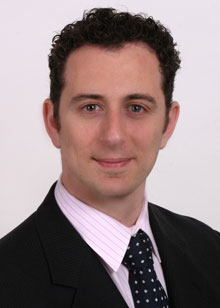
After essentially stumbling into medical school, Dr. Elad Levy, Associate Professor of Neurosurgery at the University of Buffalo, wasted no time distinguishing himself as an expert in the field of spine care. And he hasn’t yet reached his 38th birthday.
Dr. Elad Levy
7 min read Premium comments
Picture Of Success
Born in Israel, Elad Levy followed the peregrinations of his father as he pursued his studies to become an OB/GYN. “After my father’s studies, we settled in rural northern New York, a lovely area, but one that lacked a stellar primary educational system. After switching to boarding school for my last two years of high school, I entered Dartmouth College and proceeded to spend my time out on the water rowing, as well as playing a lot of guitar. As for a career strategy, most parents say, ‘Get a college education…you can always fall back on that.’ My parents said, ‘Go to medical school…you can always fall back on that.’ So, for lack of a better plan, in my junior year of college, I knuckled down, focused on my science courses and set my sights on medical school.”
While Elad Levy was still rather focused on crew, his family crew reigned him back into academia. “My parents were so concerned about my education that the year my team won the NCAA rowing competition they didn’t allow me to go to spring training so that I could study for the MCATs. I began medical school in 1993 at George Washington University in Washington, D.C., in part because I wanted to join their rowing team. Two years into medical school, however, I got tired of eating beans for breakfast, running into class dripping wet, and falling asleep while taking notes in lecture. I had to drop rowing. I still maintain that it was one of the best things I could have done for my career, though, because it gave me focus and discipline.”
Medical Training
Making his way through medical school, a pensive Dr. Levy perched on the fence between orthopedics and neurosurgery. “The chair of neurosurgery at George Washington, Dr. Laligam Sekhar, was a renowned physician who offered me the opportunity to do a summer research project after my freshman year of medical school. I was leaning toward orthopedics at the time because it was more congruent with my love of sports. I applied for an internship in orthopedics that would involve work on bone cancer; my backup choice was a project on neurosurgery for brain tumors. Destiny spoke…and I didn’t get the orthopedic internship. I came to discover a love of neurosurgery, in part because it allows you to move back and forth between spine and microsurgery. On the same day you can do macro 3D surgery involving fusion, and then go and perform a delicate operation on the nerves.”
Dr. Levy then entered a world of minimally invasive innovation. “I chose the University of Pittsburgh for my neurosurgical residency because it was one of the highest volume programs in the country. There was a strong culture of innovation at ‘Pitt’ where it was expected that you would help push the field forward. The Chair, Dr. Peter Janneta, was the father of microvascular decompression, a surgery that doesn’t damage the nerve and cures the clinical problem. His successor was Dr. Dade Lunsford, who brought the Gamma Knife to the University of Pittsburgh. I was intrigued by his work, and decided that I wanted to do minimally invasive endovascular surgery. At that point, however, the technology was insufficient to reach the brain.”
So Dr. Levy’s cerebrum began to churn…where could he learn the next level of vascular skills? “Pitt allowed me to take a two year leave of absence to go to Buffalo and work with the father of neurointerventional surgery, Dr. L. Nelson Hopkins. While the hours were horrific, on a monthly basis we were seeing many new technologies and ways of approaching things. Upon my return to Pittsburgh I shared those things with my mentors and colleagues.”
Research and Advice
In 2004 the University of Buffalo welcomed Dr. Levy back as partner in the neurosurgery group. Two years later he joined those advancing spine care by performing the first surgery in the U.S. to use axial lumbar interbody fusion (Axial LIF). “There are no silver bullets in medicine; having a large toolkit minimizes complications and maximizes good outcomes. The bottom line is: don’t force the patient to fit the technology.”
Spine care can be thrilling, yes. But know when to put the brakes on, advises Dr. Levy. “Sometimes doctors get so enamored of technology that they make a minor subtle compromise—multiple times—and these all add up to a significant compromise which not infrequently leads to device failure.”
I encourage residents and fellows to resist the temptation to be first, and ask them, ‘At the end of the day, would you do this surgery if patient X was a member of your family?’ If they are not 100% sure, then I have them draw up a new treatment plan. It is incumbent upon surgeons to stay current and thoroughly evaluate new technologies—not just take a sales rep’s word that XYZ product is the latest, greatest thing. In the end, we are the last line of defense for patients. I try to make sure residents understand that patients trust us and ask them to keep in mind that patients usually have no in depth understanding of the underlying pathology or treatment options.
Some of those patients only know about hospitals from TV; others have appeared on TV. “I have done a fair amount of work with patients who have scoliosis due to spinal tumors. In those cases I would call in an orthopedic surgeon who reconstructs the spine. One of our neurosurgeons, Dr. Kevin Gibbons, treated a player from the Buffalo Bills who had a traumatic cervical spine injury. The treatment began with an orthopedist who was at the game and who indicated that the player may have a spinal cord injury.”
One of the lingering post-surgical issues is infection control, an area where Dr. Levy and his colleagues are making headway. “We are finding that stroke patients with poor glucose control have worse outcomes. And, we think that the same is true in infection management. If so, better glucose control could lead to a lower incidence of infection and faster patient recovery with fewer complications. But, as is often the case, we need more data in order to make any definitive statements.”
Matching Patients With the Right Treatment
Of the five ‘W’s, Dr. Levy just may think that ‘Who’ is the most important. When asked what challenges he sees down the spine pike, Dr. Levy said, “A major issue continues to be patient selection…who should be operated on and who should be treated conservatively. Elderly patients with spine fractures are a complex demographic requiring thoughtful treatment plans. Also, once the decision is made to proceed with surgery, we need to know which approach is the most appropriate—maximum, minimally invasive, hybrid…side, front, back. Then once the surgery is complete, we need to have an appropriate way of assessing its success.”
What we’re talking about here is, of course, evidence based medicine (EBM). Not only is EBM best for patients, the fact is that going forward reimbursement will be tied to being able to prove what works. Unfortunately, the culture outside of academic centers tends to be resistant toward evidence based medicine. The reality is that the majority of physicians practice medicine the way they were trained—instead of evolving. We must, however, know if we should operate and how. And, fundamentally, are we indeed making a difference.
Detailing the importance of patient selection, Dr. Levy notes, “Let’s say you have a patient with L5S1 spondylolisthesis who has experienced loss of disc height and mechanical back pain. You might do an Axial LIF, use percutaneous pedicle screws, or do an ALIF or TLIF. In order to decide which approach to take you must understand the implications of the patient’s physiology, body type, and age, among other things. So, if the patient is morbidly obese you would not do an anterior approach and may do things minimally invasively and percutaneously so that you don’t have to retract the muscles and tissue. As for the age factor, in a younger person you want to get longevity out of the hardware so you would do everything possible to achieve a true fusion. In an older or frail person you might sacrifice longevity for a less traumatic surgery.”
What’s Next for Spine Care?
Although he fell in love with neurosurgery, Dr. Levy never forgot the appeal and the need for orthopedics in spine care. Dr. Levy: “I think we are going to continue to see a blurring of the lines between neurosurgery and orthopedics with regard to spine care. There are an increasing number of combined orthopedic/neurosurgery fellowships, and more and more of both ‘camps’ attending meetings in both specialties.”
Dr. Elad Levy can be found at many meetings around the country and globe. One day, he may just head out for one of these gatherings in his running shoes. “I have discovered the wonder of triathlons, ” says Dr. Levy. “They are an amazing way to relieve stress. I did two last summer, and am planning on doing another half ironman next May. These events are a real testament to preparation, just as with surgery. The family sports time involves going to Buffalo Sabers hockey games with my wife and three children. They are 11, 8, and 4 and have decided that they want to work with dad when they grow up so that we can have lunch together.”
Dr. Elad Levy…making residents think and patients thank.
React:
Discussion
This is a fascinating development. In my practice we've seen similar outcomes with the revised protocol. The key differentiator seems to be patient selection criteria. Has anyone else noticed the correlation with BMI thresholds?
Great point. I'd push back slightly on the conclusion, the sample size in the cited study is too small to draw population-level inferences. That said, the directional signal is compelling and worth a larger RCT.
We implemented a similar approach last year. Early results are promising but we're still gathering 12-month follow-up data. Happy to share our protocol if anyone is interested.
Join the conversation
Orthopedic professionals are discussing this. Sign in and upgrade to read every comment and add your voice.