
“Being a grandfather is awesome.”
Dr. Bernard Stulberg
9 min read Premium comments
Picture Of Success
While some might say he was fiddling around prior to his career in medicine, Dr. Bernard Stulberg, an orthopedic surgeon at the Cleveland Clinic in Ohio, knew that his interest in music was a natural part of his self discovery. Dr. Stulberg: “I was the third of four children born to a father who was a professor of violin at Western Michigan University and a mother who was a master’s level nutritionist. Growing up we all played stringed instruments, which led me to enroll at Oberlin College as a performance major. It was too isolated a world for me, however, and I elected to transfer to a different environment.”
Bernard Stulberg thought that he could find the right environment at the University of Michigan. “My older brother was in medical school there and as I watched him progress, I could see that I appreciated the patient interaction and the scientific aspects of patient care.”
But first, he continued on his undergraduate path of political science, which included a focus on Chinese and Russian studies. “This course of study served me well because next to politics itself, medicine is the most political environment there is.”
Medicine and Mentors
While in medical school at the University of Chicago, Bernard Stulberg worked with Dr. Phillip Spiegel, a luminary in the AO Foundation. “Dr. Spiegel was a unique person who was known for introducing AO techniques to the U.S. He saw that I might be able to make a difference in the field and was instrumental in helping me obtain a residency at Hospital for Special Surgery (HSS).”
When he arrived in New York in 1976, Dr. Stulberg encountered an elite world of joint replacement surgery. “I was fortunate to learn from the original greats, including Dr. John Insall, Dr. Philip Wilson, Jr., Dr. Chitranjan Ranawat, and Dr Eduardo Salvati, among others. Dr. Wilson in particular saw the value of putting resources toward research and education in helping to ensure the field would move forward. Drs. Ranawat and Insall pushed the envelope of the emerging biomedical research arena of device development. They were very open to residents, including myself, writing articles with them, and in fact were quite cognizant of how their trainees would contribute to the field.”
Staying on at HSS for his fellowship, Dr. Stulberg found a productive way to pay homage to one of his lead mentors. “Along with Dr. Fred Tria, I started the John Insall Club to honor this methodical, focused orthopedic leader. Dr. Insall would regularly ask his fellows and residents to review his results and would consistently ask us things like, ‘How are we doing?’ and ‘Is this making a difference?’ If his fellows found less successful results or if the results didn’t make a difference in the way he wanted them to, he would review everything in great detail. His integrity in how he approached knee surgery was unique. Our group meets yearly to discuss various aspects of knee disease, including the evaluation and evolution of medical devices. We feel that it is a special legacy for Dr. Insall.”
During his fellowship year, Dr. Stulberg was fortunate to work under the direction of a masterful researcher. “Dr. Joe Lane, head of the metabolic bone disease unit and the orthopedic service at Memorial Sloan Kettering Cancer Center at the time, was and is a brilliant thinker. Research was already a part of my life, but as time went on, I came to further understand that research isn’t something extraneous to our daily work as orthopedists…it’s something that makes you a better clinician.”
Research and Development
Part of improving one’s clinical—and engineering—skills, is learning to thoroughly evaluate failure: what went wrong and why. Dr. Stulberg explains, “After my fellowship I was recruited to the Cleveland Clinic by Dr. Alan Wilde, the Chair at the time, along with Dr. Lester Borden, the head of the joint replacement surgery section. In part because we had such a high volume of cases, I was fortunate to be able to start, along with Dr. Mike Manley, an implant retrieval lab.”
We had a keen interest in how devices behaved in vivo, and really wanted to learn from the patients. It was interesting to see how collaborative of an effort this becomes. We need to know about the implant from a clinical and radiographic standpoint, and how its performance is related to the engineering concepts behind the development of the device. This sort of work is invaluable in the development and evolution of new devices. It really helps close the loop of, ‘How did I design it?’ ‘How did it perform?’ and ‘What do I see in the retrieval that can help improve things going forward?’
For Dr. Stulberg, device development can turn on one key element: proper training. The creator of three knee systems, Dr. Stulberg says, “I have come to see that the success of a device has much to do with teaching people how to properly implant a device. While device integrity does relate to the design and manufacture, most procedural failures are related to how doctors implant devices.”
“Dr. Insall himself was specifically focused on how surgeons learned to use a device. If you study Sir John Charnley’s introduction of the Charnley Total hip, you will see that his devices were so successful because he focused on the manner in which the devices were used, and was able to control the training of how surgeons implanted them. Thus, those he trained were expert hip surgeons. Nowadays you see parallels in the FDA mandated training of selected devices. Companies are doing a better job these days. Biomet, for example, with its mandated training for their Oxford knee, does a wonderful job. I have participated in running Stryker’s resurfacing training program, a similarly well thought out and instituted training program. I think that surgeons in general are beginning to get better training on the devices. Keep in mind that as we develop increasingly sophisticated products we will need more and improved training.”
Fascinated with how bone changes in response to different implants and environments, in the early ‘80s Dr. Stulberg took his investigations to the laboratory. “I was fortunate that Cleveland Clinic had just begun a program for funding research which eventually helped me obtain a grant from the Orthopaedic Research and Educational Foundation to investigate bone remodeling around uncemented implants. This was the time when there was an explosion of uncemented arthroplasty and it was the thing for young investigators.”
“Along with Dr. Tom Bauer, we began tissue and implant retrievals to look at how the bone environment influences the success of the implants and the procedure to implant them. In addition to assessing techniques of undecalcified bone sectioning, we helped develop the application of bone densitometric evaluation (DEXA scanning) to the in-vivo measurement of bone remodeling around implants. This process, now widely used, helps to see whether the design goals you have evolved in the implant achieve the desired effect in vivo.”
Going Solo
During his 15 years spent in private practice, Dr. Stulberg learned how to blend brisk efficiency with a personal touch. “I left the Cleveland Clinic in 1990 to work at Case Western Reserve University, but left after two years to start a private practice. During the 15 years of solo practice I continued to work with Dr. Bauer in the form of a combined sponsorship of an international fellowship with several Japanese centers. As time progressed I also became intrigued by the business side of medicine and the delivery of healthcare. I was especially interested in high volume practices that can deliver a patient friendly product. Such environments are necessarily very collaborative, and the surgeon must be intimately involved in making it work. Running the back office ‘like a machine’ does not exclude the possibility of providing a highly personal patient-friendly environment. I was particularly influenced by the efforts of Dr Thomas Mallory, whose organizational genius has influenced many of the joint replacement centers around the US.”
“I returned to the Cleveland Clinic in May 2008, in part because my partner retired, but also because healthcare in Northeast Ohio has become less friendly to private practices. I also have had an opportunity to consult with Exactech, something that has been stimulating and great fun. This is particularly true because I get to work with Dr. Al Burstein, one of my mentors from HSS, as well as Drs David Covall, Jay Maybrey, and the entire design team at Exactech. We have developed a variation of their prior knee design to specifically address consistency in the placement of cruciate retaining TKA devices.”
A Born Leader
Having grown as a leader and grown leaders over the years, Dr. Stulberg is keen on the idea of professional level leadership. “I personally believe that leadership is developed in those who have the talent and vision to lead, and is not something everyone is comfortable with. I have had two particular experiences that have helped shaped my opinions/vision of leadership.”
“During my time in private practice, my program, the Cleveland Center for Joint Reconstruction, Inc., became the first joint replacement practice in the world and the first medical practice in the U.S. to embrace the tenets of customer-focused and transparent health care, and became certified to ISO9001 performance standards in 1995. We were a small group, and the behavior of all involved was appropriately focused. The effort, however, was led by my nurse manager at the time and by a business expert who co-managed the program and had successfully implemented ISO9001 in 6 different businesses. My role as leader was to step back, support the effort, and submit to the group-driven behavior.”
But sometimes leading involves stepping forward and taking charge. Dr. Stulberg had the opportunity (as Chairman of the AAOS’s Committee on Biomedical Engineering) to organize and oversee an expansive effort to ensure the safety and efficacy of orthopedic devices. “I am proud to have led the Orthopaedic Device Forum, a collaborative effort of the American Orthopaedic Association (AOA), the American Academy of Orthopaedic Surgeons (AAOS), Orthopaedic Manufacturers Association and the Orthopaedic Research Society.”
“This project brought together academicians, leaders of industry and research and clinical scientists to facilitate product development and to increase the availability of products to patients in the U.S. The primary focus was on collaborating and facilitating interactions with these groups and with the appropriate regulatory programs within the FDA. In that effort I had the opportunity to work with orthopedic industry leaders such as Dane Miller, Ph.D. (Biomet) and Jack Parr Ph.D. (Wright Medical), as well as many other very responsible individuals from industry.”
“Also part of this Forum, ” says Dr. Stulberg, “were major leaders of our research community, such as Drs. Barbara Boyan, Timothy Wright, Jack Lemons and Seth Greenwald, and leading clinicians of the AOA and AAOS. Each of these individuals, leaders in their own environments, recognized the importance of leaving their respective biases ‘at the door’ and working collaboratively for the common goal of making safe and effective new products available to the American public. What was accomplished during the 10 years I worked with this group was truly remarkable and inspiring. The efforts continue today under the excellent leadership of Dr. Michael Yaszemski, M.D., Ph.D.”
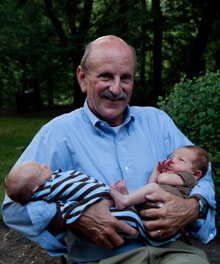
But despite his grand accomplishments in the world of doctors and researchers, Bernard Stulberg finds his most meaningful times with another group—the Stulberg clan. “The luckiest moment of my life was when I met my future wife, Carolyn. In our 33 years of marriage she has helped me achieve a balance of family and work that has allowed us to raise four terrific boys, all who have now moved toward careers and lives of their own. In fact, as of August, we have two grandsons. The family loves being together, whether supporting The Stulberg International String Competition, founded in memory of my parents by many of my father’s students, or pursuing outdoor activities such as boating, skiing, running, or soccer.”
We are known for large family gatherings…to the point where my close friend and colleague Dr. Bill Bargar and his wife Carol have noted, ‘the Stulbergs don’t travel, they herd.’ It has been and continues to be a wonderful journey together.
Dr. Bernard Stulberg…closing the research loop and opening doors for future generations.
React:
Discussion
This is a fascinating development. In my practice we've seen similar outcomes with the revised protocol. The key differentiator seems to be patient selection criteria. Has anyone else noticed the correlation with BMI thresholds?
Great point. I'd push back slightly on the conclusion, the sample size in the cited study is too small to draw population-level inferences. That said, the directional signal is compelling and worth a larger RCT.
We implemented a similar approach last year. Early results are promising but we're still gathering 12-month follow-up data. Happy to share our protocol if anyone is interested.
Join the conversation
Orthopedic professionals are discussing this. Sign in and upgrade to read every comment and add your voice.