
Professor Mark Haber, an orthopedic surgeon from Wollongong, Australia, won big in Japan at the International Society of Arthroscopy, Knee Surgery & Orthopaedic Sports Medicine’s (ISAKOS) seventh biennial congress in Osaka (April 5–9, 2009). A panel composed of members of the ISAKOS Upper Extremity Committee selected Dr. Haber’s work out of 1, 200 other abstracts to award him the Richard B. Caspari Award for his research on repairing torn rotator cuffs in the shoulder.
Dr. Haber Wins Caspari in Japan
2 min read Premium comments
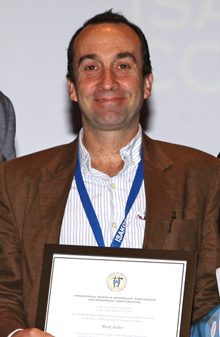
Dr. Haber conducted his research, titled “Biomechanical Contact Properties of Rotator Cuff Repairs During Passive Arm Movement: Perilously Low Levels Occur with Single versus Double-row Repairs, ” at the Royal North Shore Hospital’s Murray Maxwell Biomechanics Laboratory in Sydney in conjunction with Drs. Richard Appleyard and Eran Dolev, and the series was co-authored by Dr. Daniel Biggs.
The research clearly shows that too many rotator cuff repairs end in failure. According to Global Orthopaedic Technology, which partly funded Dr. Haber’s work, surgeons perform 12, 000 rotator cuff repairs in Australia every year, but almost half of those repairs fail structurally, often in the first 18 months. Fortunately, Dr. Haber found a way to improve on the traditional approach.
Using the Opus TwinLock Knotless Fixation System from ArthroCare Corp., which also partly funded the research, Dr. Haber developed a new technique now called “transosseous equivalent” or the “Perfect Print.” This new technique more securely attaches tendon to bone and could result in longer-lasting, more stable rotator cuff repairs. Dr. Haber’s team analyzed the strength of traditional rotator cuff repairs during and after surgery, as well as into the rehabilitation phase. They found that rotator cuff repairs have a period of “relaxation” which can result in poor fixation of tendon to bone. The “Perfect Print” technique, however, involves retightening the knotless repair before completing surgery. This method may allow patients to safely begin the rehabilitation process earlier which could improve healing and decrease recovery time.
ArthroCare’s Opus technology for rotator cuff repairs originally launched in 2007, and quickly earned the Frost & Sullivan Award for Product Innovation in 2008. Dr. Haber’s research shows that this line of technology still has the potential to aid further surgical innovations.
As for Dr. Haber, the award was a great moment of both personal and national pride. “This award is a great recognition of the outstanding work done by our whole research team, ” he said in a press release. “It also shows that although Australia has a small population, we are well represented among the world’s medical and surgical achievements by relying on originality. This prize is the greatest achievement in my professional life.”
React:
Discussion
This is a fascinating development. In my practice we've seen similar outcomes with the revised protocol. The key differentiator seems to be patient selection criteria. Has anyone else noticed the correlation with BMI thresholds?
Great point. I'd push back slightly on the conclusion, the sample size in the cited study is too small to draw population-level inferences. That said, the directional signal is compelling and worth a larger RCT.
We implemented a similar approach last year. Early results are promising but we're still gathering 12-month follow-up data. Happy to share our protocol if anyone is interested.
Join the conversation
Orthopedic professionals are discussing this. Sign in and upgrade to read every comment and add your voice.